
BAAM AI Blog
Automotive Copywriter: The Practical Guide To Copy That Sells Cars Without Sounding Like A Sales Script
An automotive copywriter does more than write polished words for dealership websites, vehicle detail pages, ads, emails, landing pages, and service campaigns. The real job is to translate inventory, offers...
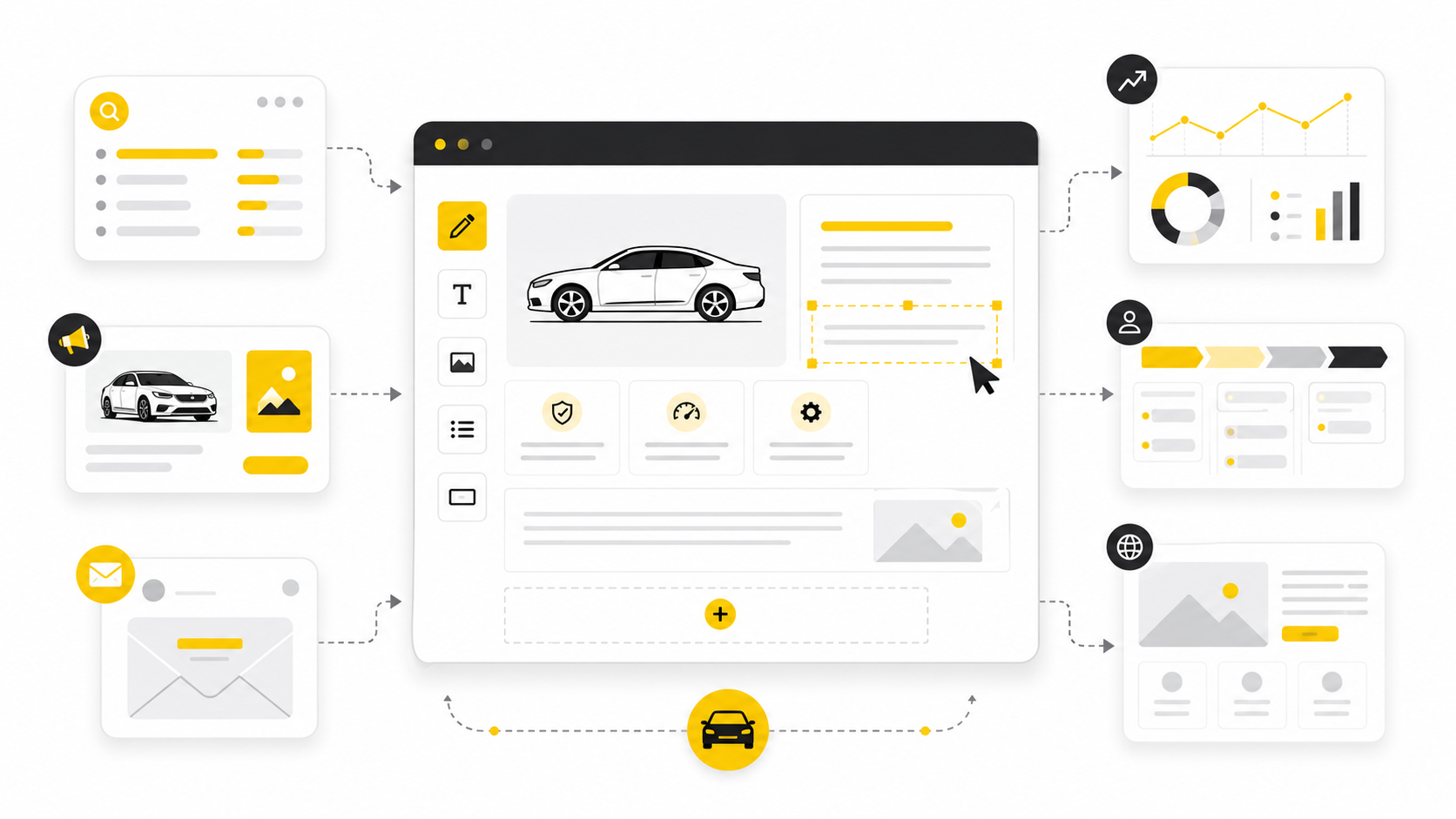
An automotive copywriter does more than write polished words for dealership websites, vehicle detail pages, ads, emails, landing pages, and service campaigns. The real job is to translate inventory, offers, financing, trade-ins, service needs, and buyer hesitation into clear messages that help people take the next step. In automotive, that next step is rarely casual because the purchase is expensive, emotional, researched heavily, and easy to delay.
That is why generic marketing copy usually falls flat in this market. A vehicle shopper may compare models, read reviews, check pricing, value a trade, look at financing, watch videos, and still hesitate before submitting a lead or walking into a showroom. The latest Cox Automotive Car Buyer Journey research shows how much the buying process now depends on efficiency, digital tools, transparency, and trust.
The best automotive copywriter understands that the customer is not just buying horsepower, cargo space, leather seats, or a monthly payment. They are trying to reduce risk. They want to know whether the price is fair, whether the dealer is trustworthy, whether the vehicle fits their life, whether the offer is real, and whether the process will waste their time.
That makes automotive copy a strategic function, not just a creative task. Strong copy helps a dealership, marketplace, OEM, detailer, repair shop, rental company, or automotive SaaS brand connect the right message to the right stage of the buyer journey. Weak copy adds friction exactly where the customer already feels uncertain.
Why Automotive Copywriting Matters Now
Automotive buyers are more informed than ever, but that does not mean they are easier to convert. More information often creates more comparison, more doubt, and more abandoned intent. Good copy helps organize that messy decision process into a clear path.
The modern car buyer moves between online and offline touchpoints, which means every message has to work harder. A shopper may first meet a brand through a search result, marketplace listing, social ad, YouTube review, email offer, or service reminder. If the message is vague, overhyped, or missing the details buyers care about, the next click goes somewhere else.
This matters even more because loyalty is not guaranteed. S&P Global Mobility reported that U.S. automotive brand loyalty was 51.1% for January through December 2025, which means a large share of buyers are open to switching when the value story is stronger elsewhere. Copy cannot fix a weak offer, but it can make a strong offer easier to understand, believe, and act on.
The Automotive Copywriting Framework
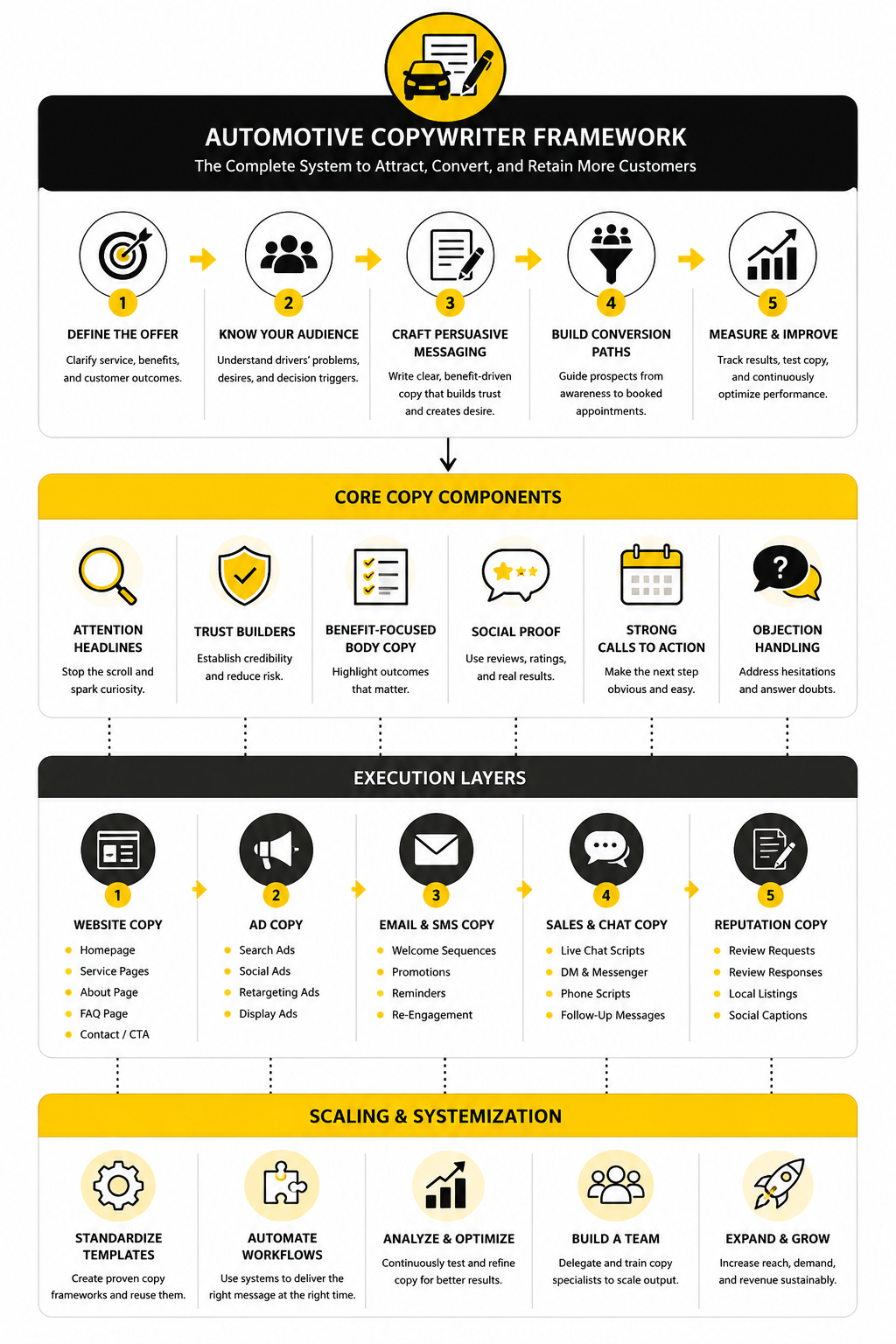
Automotive copy works best when it follows the buyer’s actual decision path instead of forcing a generic sales formula onto every page. A shopper looking for a family SUV is not thinking the same way as someone comparing electric sedans, booking a brake inspection, or evaluating fleet financing. The framework has to match intent before it tries to persuade.
The practical framework starts with the customer’s situation, then connects it to the vehicle, offer, proof, process, and next step. That sounds simple, but it is where many automotive brands lose money. They lead with inventory facts when the buyer needs confidence, or they lead with emotion when the buyer needs specifics.
A professional automotive copywriter builds messaging around four questions. What does the customer want to solve? What makes this option credible? What friction could stop the action? What should the customer do next? When those questions are answered clearly, copy starts feeling useful instead of pushy.
Core Components Of High-Converting Automotive Copy
The first core component is clarity. Automotive buyers need fast answers about price, availability, mileage, trims, features, financing, incentives, warranties, trade-ins, location, and timing. Clever writing is useless if the customer still has to hunt for the information that determines whether they continue.
The second component is trust. Deloitte’s 2025 Global Automotive Consumer Study highlights how consumer preferences, data concerns, electrification questions, and buying expectations continue to reshape the market. Copy has to make the buyer feel that the business is transparent, competent, and easy to deal with.
The third component is momentum. A strong headline earns attention, but the body copy must reduce hesitation line by line. That means showing relevant benefits, explaining the process, using proof where it matters, and making the call to action feel like a helpful next step rather than a trap.
From Shopper Intent To Sales Action
The strongest automotive copy starts before the sentence is written. It starts with the searcher’s intent, the shopper’s situation, and the commercial action the business needs. A person searching for “used Toyota RAV4 under $25,000” does not need the same message as someone comparing lease specials, booking service, or researching whether an EV fits their commute.
That is where an automotive copywriter earns the fee. The work is not just making a page sound better. The work is deciding what the buyer needs to believe before they feel safe enough to click, call, schedule, apply, reserve, or visit.
A practical intent map usually separates automotive audiences into a few groups. Some are researching broadly. Some are comparing specific models. Some are checking local inventory. Some are looking for payment clarity. Some already own a vehicle and need service. Each group needs a different level of detail, confidence, and urgency.
Match The Message To The Buying Stage
Early-stage shoppers need copy that helps them narrow the field without feeling pushed. They may care about fuel economy, range, safety, cargo space, towing, ownership costs, technology, or resale value. At this stage, copy should educate and frame the decision, not rush the buyer into a lead form.
Mid-stage shoppers need comparison language. They want to know why this trim, this offer, this dealership, this service center, or this brand deserves attention over the alternatives. This is where strong automotive copy explains trade-offs clearly instead of pretending every option is perfect.
Late-stage shoppers need friction removed. They are looking for availability, price transparency, trade-in steps, financing details, appointment options, delivery choices, and what happens after they submit their information. The 2025 Cox Automotive Car Buyer Journey Study found that mostly digital buyers who used AI assistants showed especially high satisfaction, which reinforces a simple point: buyers reward experiences that make decisions faster and less confusing.
Build Copy Around Friction, Not Just Features
Most automotive pages are overloaded with features and underbuilt around objections. That is a problem because buyers rarely stop because a vehicle has too few bullet points. They stop because something feels unclear, risky, inconvenient, or too hard to verify.
A good automotive copywriter identifies the friction before writing the pitch. Is the buyer worried about hidden fees? Is the monthly payment unclear? Are they unsure whether the advertised vehicle is still available? Do they distrust the trade-in process? Are they comparing a certified pre-owned vehicle against a cheaper used model?
Once the friction is clear, the copy can do its job. It can explain the warranty, show the inspection process, clarify how financing works, describe what the appointment includes, or make the next step feel low pressure. That is not fluff. That is conversion work.
Use Proof Where Buyers Actually Need It
Proof should appear where doubt appears. A dealership homepage may need proof of local reputation, selection, and service convenience. A vehicle detail page may need proof around condition, history, pricing, warranty, and availability. A service page may need proof around technician expertise, genuine parts, turnaround time, and booking simplicity.
The mistake is dumping every award, testimonial, and claim into every page. That creates noise. Automotive buyers want confidence, but they also want speed, so the proof has to support the decision instead of interrupting it.
Proof can come from many places when it is real and relevant. It can include verified reviews, OEM certifications, inspection standards, warranty details, transparent pricing policies, service guarantees, or clear process explanations. The 2025 Deloitte Global Automotive Consumer Study surveyed more than 28,500 consumers across 27 countries, and its focus on brand perception, connected technology, EV interest, and software-driven vehicles shows how complex buyer confidence has become.
Write For Humans First, Then Optimize For Search
Search visibility matters in automotive because local intent is valuable. People search for specific makes, models, trims, service needs, financing options, and dealership locations every day. But search optimization should never turn the copy into a stiff pile of keywords.
The keyword should fit naturally inside useful sentences. A page written by an automotive copywriter should still sound like a knowledgeable person is guiding the buyer through a decision. That means the page can include model names, location terms, inventory details, and service keywords without sounding like it was assembled by software.
The best SEO copy in automotive is specific. It answers the questions people actually bring to Google, explains what makes the offer relevant, and gives the reader a clear next step. Search engines may bring the visitor in, but human clarity earns the lead.
Connect Copy To The Sales Process
Automotive copy cannot live in a vacuum. If a page promises a fast trade-in estimate, the follow-up process has to support that promise. If an ad promotes a simple financing path, the landing page and sales team need to make that path obvious.
This is why copywriters working in automotive should understand CRM workflows, lead routing, appointment setting, email follow-up, and SMS sequences. A tool like GoHighLevel can fit naturally for agencies or operators building lead capture, nurture, and follow-up systems around dealership or automotive service campaigns. The copy gets stronger when the writer knows exactly what happens after the click.
The same principle applies to landing pages. If a campaign needs a focused page for a trade-in offer, seasonal service promo, fleet inquiry, or model-specific launch, builders like Replo or ClickFunnels can support the implementation. The point is not to add tools for the sake of tools. The point is to make the message, page, and follow-up work as one system.
How Professional Automotive Copywriters Build Campaigns
Professional implementation starts with diagnosis, not drafting. Before an automotive copywriter touches a headline, they need to understand the business model, inventory position, lead quality, local competition, offer structure, and sales process. Otherwise, the copy may sound good while solving the wrong problem.
For a dealership, that problem might be low form submissions on vehicle detail pages. For a service department, it might be weak retention after the warranty period. For an automotive SaaS company, it might be unclear positioning in a crowded market where every tool claims to improve efficiency.
The process also depends on whether the copy is built for acquisition, conversion, retention, or reactivation. A conquest campaign needs sharper differentiation. A service reminder needs relevance and timing. A finance pre-approval page needs reassurance, clarity, and compliance awareness.
Start With The Offer And The Buyer
The offer is the center of the campaign. Not the slogan. Not the design. Not the clever angle. The offer is what the buyer can actually do, get, save, compare, schedule, reserve, or understand better after reading the copy.
In automotive, vague offers are expensive. “Huge savings available” is weaker than a specific payment path, service package, trade-in process, model comparison, or appointment promise. Buyers are already comparing options, so the copy has to make the offer concrete enough to evaluate.
The buyer profile then shapes the language. A parent looking for a three-row SUV wants a different kind of confidence than a contractor shopping for a work truck. A customer booking maintenance wants speed and convenience, while a first-time buyer may need more explanation around financing and paperwork.
Audit The Existing Customer Journey
A serious automotive copywriter audits the journey before writing the campaign. That means reviewing search results, ad copy, landing pages, vehicle pages, lead forms, emails, SMS follow-ups, CRM notes, sales scripts, and service reminders. The goal is to find where the message becomes unclear, inconsistent, or too generic.
This is especially important because digital retailing is no longer a side channel. Cox Automotive’s digitization research found that 43% of dealers offered customers the ability to complete every step of the car-buying process online in 2025, up from 34% in 2022. When more of the journey happens online, the copy has to carry more of the explanation that once happened face to face.
The audit should also expose handoff problems. If the ad says “get your trade value fast,” but the form asks too much too soon, the copy and process are fighting each other. If the landing page promises transparent financing, but the follow-up email feels robotic, trust leaks out of the funnel.
Turn Research Into A Practical Messaging Brief
The messaging brief is where scattered research becomes usable. It should define the audience, offer, primary objection, supporting proof, conversion goal, required compliance notes, tone, and channel requirements. Without this step, campaigns tend to become a collection of disconnected assets.
A strong brief also clarifies what should not be said. That matters in automotive because exaggerated savings claims, vague financing language, and overpromised availability can create real trust problems. The copy needs to be persuasive, but it also needs to be accurate.
This is where the best writers become operationally useful. They do not just ask, “What sounds good?” They ask, “What can the sales team actually fulfill?” That question protects the customer experience and the business at the same time.
Build The Campaign In A Clear Sequence
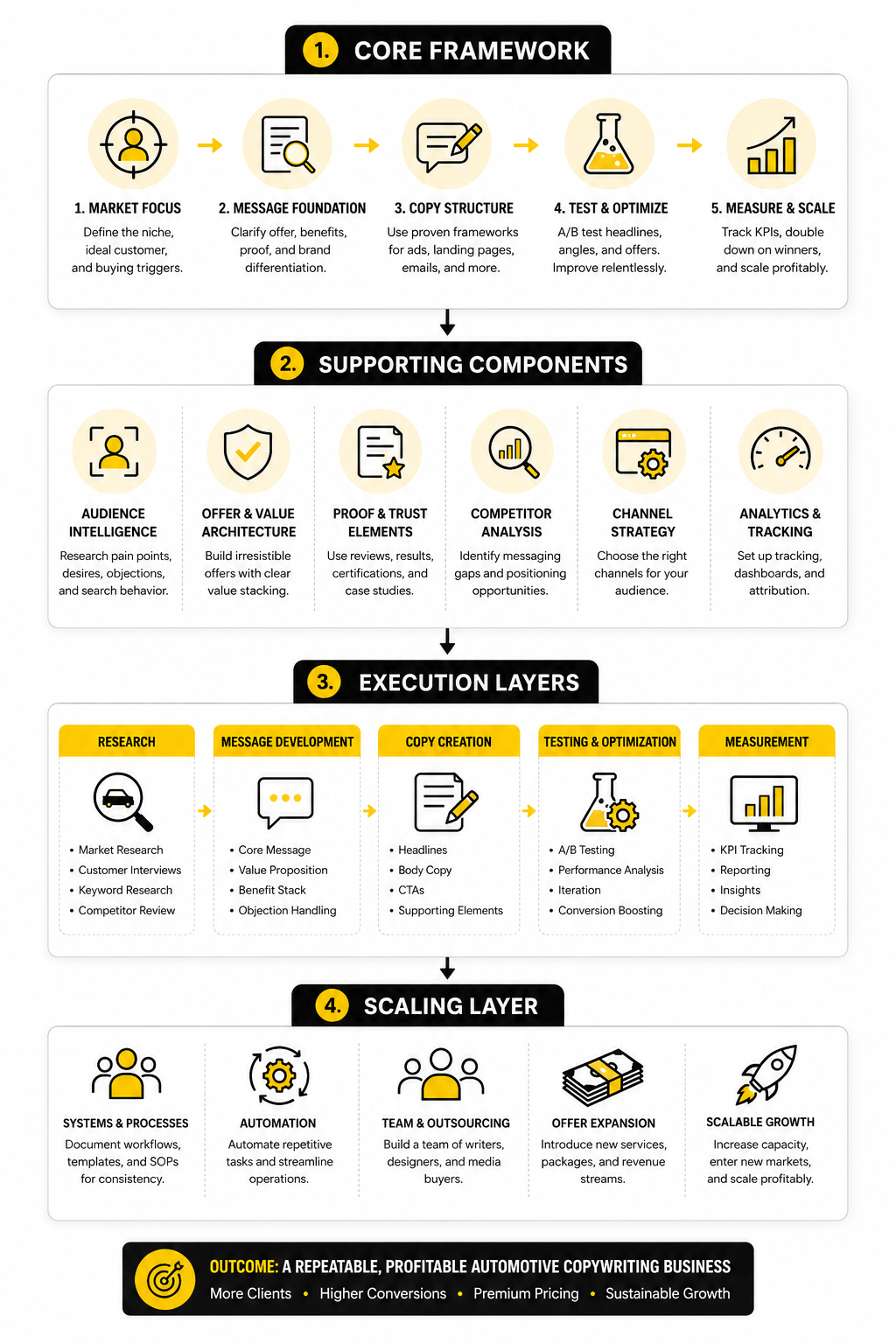
Once the brief is solid, execution becomes much easier. The campaign should be built in the order the customer experiences it, not in the order the team happens to request assets. That usually means starting with the core landing page or offer page, then adapting the message into ads, emails, SMS, chat scripts, and follow-up sequences.
A practical build sequence looks like this:
This sequence keeps the copy connected. The customer should feel like every step belongs to the same conversation. When the ad, page, form, email, and sales follow-up all say different things, conversion drops because confidence drops.
Write The Landing Page Before The Ads
The landing page should usually come before the ads because it forces the team to define the real promise. If the page cannot explain the offer clearly, the ad should not run yet. Sending traffic to a weak page only makes the campaign fail faster.
For dealership and service campaigns, the page needs to answer practical questions quickly. What is the offer? Who is it for? What vehicles or services does it apply to? What happens after the form is submitted? What proof makes the business credible?
Tools can help when the team needs fast, focused campaign pages. A page builder like Replo can make sense for ecommerce-style automotive offers or accessory campaigns, while ClickFunnels can fit simple lead-generation funnels. The tool is secondary, though. The copy and offer logic have to be right first.
Create Follow-Up That Feels Human
Lead follow-up is where a lot of automotive campaigns lose momentum. The shopper raises a hand, then receives a generic email that sounds like it could have been sent to anyone. That is a bad handoff because the buyer has already shown intent.
Good follow-up copy references the action the person just took. If they requested trade-in information, the message should continue that conversation. If they booked service, the message should confirm expectations and reduce no-show risk. If they asked about a specific model, the reply should make the next step easier, not bury them in generic dealership language.
Automation can help, but only if the messages are written with context. Platforms like GoHighLevel can support CRM workflows, SMS, email, booking, and pipeline management for agencies or automotive businesses that need structured follow-up. The win is not automation by itself. The win is relevant communication delivered while the buyer still cares.
Measure What The Copy Is Supposed To Change
Automotive copy should be measured against the behavior it is meant to influence. A model comparison page may be judged by qualified clicks to inventory. A service campaign may be judged by booked appointments. A finance page may be judged by completed applications or calls from high-intent shoppers.
The wrong metric creates the wrong copy. If a team only rewards clicks, the copy may become loud and shallow. If the team rewards qualified actions, the copy becomes clearer, more specific, and more useful to serious buyers.
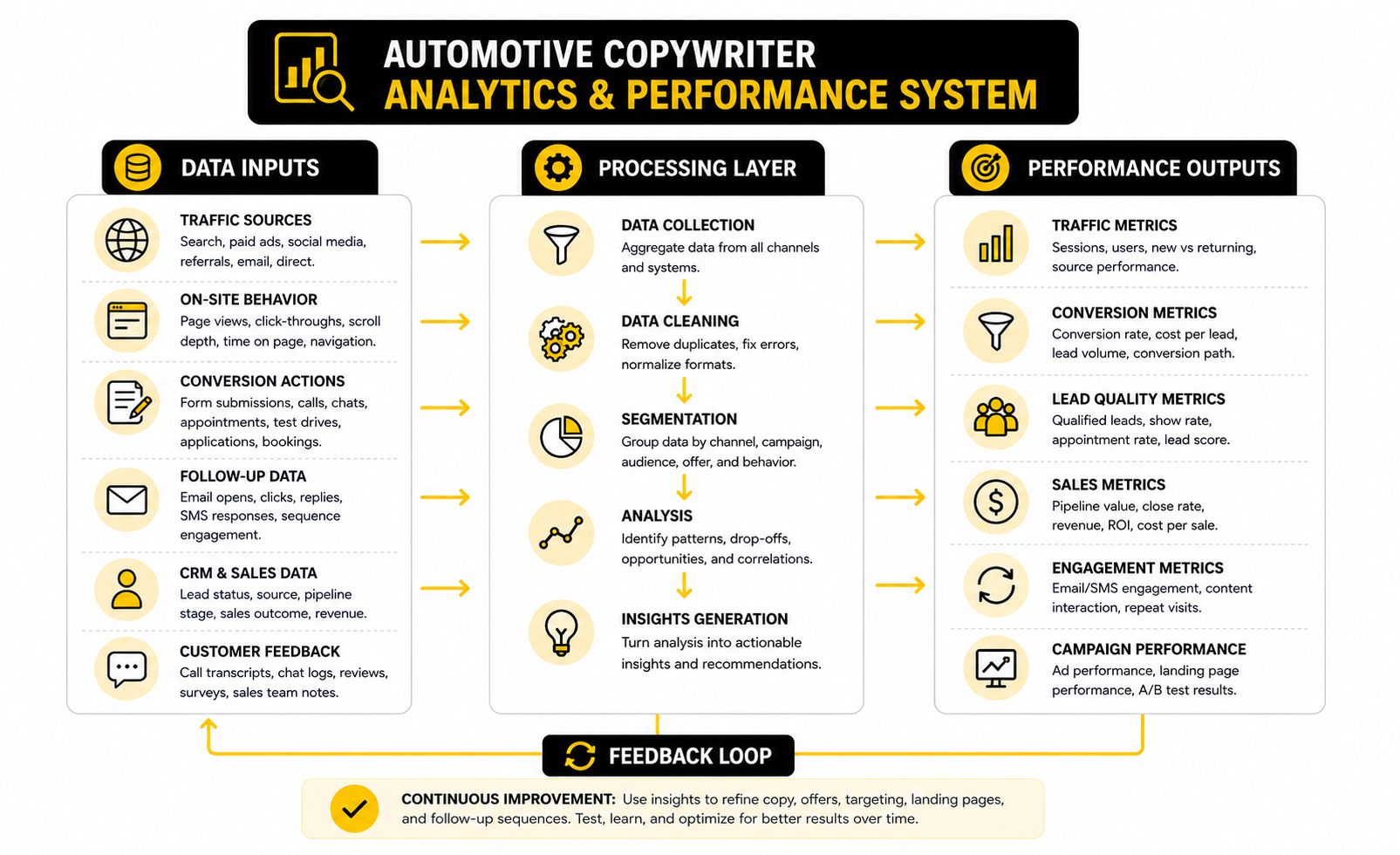
Measurement also gives the copywriter better inputs for the next round. Search terms, call transcripts, form abandonment, chat questions, CRM outcomes, and sales feedback all reveal what buyers still do not understand. That is how automotive copy improves over time instead of becoming another one-off campaign that disappears after a few weeks.
Advanced Considerations For Automotive Copy That Scales
Once the basics are working, the job gets harder in a different way. The question is no longer, “Can we write a better page?” The question becomes, “Can we keep the message accurate, useful, compliant, and profitable across hundreds or thousands of buyer interactions?”
That is where automotive copywriting turns into a systems problem. A single campaign can be managed manually, but a dealership group, marketplace, service brand, or automotive software company needs messaging that can scale without becoming generic. The copy has to stay sharp while the operation gets more complex.
This is also where a more experienced automotive copywriter becomes valuable. They understand that growth creates tradeoffs. More automation can improve speed, but it can also make the brand sound robotic. More personalization can improve relevance, but it also raises data and privacy questions. More offers can create urgency, but they can also create compliance risk if the details are sloppy.
Personalization Needs Guardrails
Personalization can be powerful in automotive because buyer intent is often specific. Someone browsing hybrid SUVs, checking service coupons, or returning to a finance page is giving useful signals. The copy can respond to those signals with more relevant messages, better follow-up, and clearer next steps.
But personalization should not feel invasive. The line is crossed when the buyer feels watched instead of helped. Deloitte’s 2025 Global Automotive Consumer Study highlights connectivity, consumer data concerns, and software-driven vehicle expectations as major issues shaping the market, which makes privacy-aware messaging more than a legal checkbox.
The practical rule is simple. Use personalization to reduce effort, not to show off how much data you have. A reminder that helps someone continue a trade-in estimate is useful. A message that feels too revealing or oddly specific can damage trust before the sales team ever gets involved.
AI Can Speed Up Production, But It Cannot Own The Promise
AI can help with drafts, variations, research organization, headline options, and repurposing. That is useful, especially when a business needs many versions of copy across search ads, landing pages, emails, SMS, and inventory-related content. Cox Automotive’s 2025 tech trend coverage points to data-driven, connected solutions helping dealerships create more relevant shopper experiences, which is exactly where AI-assisted workflows can support speed.
The risk is letting AI invent certainty. Automotive copy often touches price, availability, incentives, delivery timing, financing, warranties, and vehicle condition. Those details must be verified because a confident but wrong sentence can create customer frustration and legal exposure.
A professional workflow keeps AI inside a controlled process. The writer can use it for speed, but the final message still needs human judgment, source checks, offer validation, and approval from the people responsible for fulfillment. In automotive, the promise is the product. Do not outsource the promise.
Compliance Should Shape The Copy Early
Compliance is not something to fix after the campaign is already written. It should shape the offer, claims, disclaimers, and calls to action from the beginning. That does not mean the copy has to become lifeless, but it does mean the writer needs to understand where precision matters.
Pricing, rebates, financing terms, add-ons, availability, lease claims, trade-in ranges, and limited-time offers all need careful handling. The FTC warned 97 auto dealership groups in March 2026 about deceptive pricing and unavailable vehicle advertising, making clear that regulators are still watching how dealerships present offers to consumers. The FTC also maintains an active cars and auto marketplace enforcement hub, which is a useful reminder that automotive marketing is not a free-for-all.
This is not legal advice, and an automotive copywriter should not pretend to replace a compliance professional. But a good writer should know when a claim needs review, when a disclaimer is not enough, and when the cleanest solution is to rewrite the offer so the customer can understand it without squinting at fine print.
Scaling Copy Across Locations Without Losing Local Relevance
Multi-location automotive businesses face a specific problem. They need brand consistency, but every market has different inventory, competitors, customer expectations, seasonal patterns, and service demand. If every location uses the same copy, the message becomes bland. If every location writes from scratch, the brand becomes messy.
The answer is usually a controlled messaging system. Core brand language stays consistent, while local proof, inventory references, service offers, financing details, and calls to action are adapted by market. This gives the business scale without flattening the customer experience.
For example, a dealership group can standardize how it explains trade-ins, financing, certified pre-owned benefits, and appointment booking. Then each location can adjust copy around local inventory strength, nearby neighborhoods, service capacity, or model demand. That balance is where scale starts to feel personal instead of mass-produced.
First-Party Data Makes Copy more carefully
As paid media gets more expensive and privacy expectations rise, first-party data becomes more important. Email engagement, form behavior, service history, CRM notes, appointment outcomes, and repeat visits can all reveal what customers actually care about. The copy gets better when it is informed by real behavior instead of assumptions.
This does not mean blasting every customer with more messages. It means using data to make communication more relevant. A past service customer may need a maintenance reminder, while a shopper who viewed finance content may need a clearer explanation of pre-approval steps.
Platforms like Brevo or Moosend can support email segmentation and nurture campaigns when the business has permission-based lists and a clear communication strategy. The tool is not the strategy. The strategy is sending the right message because the customer’s behavior justifies it.
Brand Voice Matters More As Automation Increases
The more a business automates, the more important brand voice becomes. Without a defined voice, automated messages start sounding like generic templates stitched together by a machine. That is especially dangerous in automotive, where customers already expect pressure, vague claims, and canned follow-up.
A strong voice guide gives the team boundaries. It defines how the brand explains offers, handles urgency, talks about financing, responds to hesitation, and asks for action. It also protects the customer experience when multiple people or tools produce content.
The best voice in automotive is usually plain, confident, and specific. It does not need hype. It needs to sound like a competent person who knows the product, respects the buyer’s time, and can clearly explain what happens next.
The Biggest Risk Is Misalignment
Most automotive copy problems are not really writing problems. They are alignment problems. The ad says one thing, the landing page says another, the CRM follow-up says something else, and the sales team has a different version again.
That misalignment creates doubt. The buyer may not be able to name the issue, but they feel it. When the offer changes from touchpoint to touchpoint, the customer starts wondering what else is unclear.
The fix is a single source of truth for each campaign. Everyone should know the offer, audience, qualifying details, proof points, restrictions, next step, and follow-up path. Once that is documented, copy becomes easier to create, easier to review, and easier to scale.
When To Hire A Specialist Instead Of A Generalist
A general copywriter can help with basic content, but automotive has enough complexity that specialization often pays off. The writer needs to understand inventory language, buyer hesitation, local search behavior, finance sensitivity, service retention, lead quality, and dealership operations. Without that context, the copy may look polished but miss the commercial reality.
Hiring a specialist makes the most sense when the business depends on lead quality, paid traffic, seasonal offers, multi-location consistency, or high-value conversion paths. It also matters when the copy touches regulated claims, financing language, or complex product positioning.
A strong automotive copywriter should ask better questions than “What tone do you want?” They should ask about margins, lead handling, inventory pressure, buyer objections, CRM follow-up, compliance review, and what the sales or service team can actually deliver. That is the difference between writing words and building revenue assets.
The Final System: Copy, Process, Data, And People
At this point, the pattern should be clear. Automotive copy is not just a layer of words placed on top of a campaign. It is the connective tissue between the buyer’s intent, the offer, the page, the follow-up, the sales process, and the trust required to move forward.
A strong automotive copywriter thinks in systems because the buyer experiences the business as one system. They do not care which team wrote the ad, which vendor built the page, which CRM sends the email, or which sales rep answers the phone. They care whether the business feels clear, credible, and easy to deal with.
That is the real standard. Copy should reduce confusion, sharpen the offer, protect trust, and make the next step obvious. When those pieces work together, the customer feels guided instead of chased.
What does an automotive copywriter do?
An automotive copywriter writes marketing and sales copy for businesses in the automotive industry. That can include dealership websites, vehicle detail pages, landing pages, ads, emails, SMS follow-ups, service campaigns, model comparison pages, finance pages, and brand messaging. The goal is to help customers understand the offer, trust the business, and take the next logical step.
The role is more strategic than many people assume. A good automotive copywriter needs to understand buyer intent, vehicle research behavior, local competition, compliance-sensitive claims, lead quality, and the sales process after the click. Clean writing matters, but commercial understanding matters more.
Why should a dealership hire an automotive copywriter?
A dealership should hire an automotive copywriter when generic copy is costing leads, appointments, calls, or trust. Dealership buyers usually arrive with questions about price, availability, trade-ins, financing, incentives, service, and timing. If the copy does not answer those questions clearly, the shopper has little reason to stay.
The value is not just better wording. The value is a clearer path from search to inquiry to appointment. A specialist can help align ads, landing pages, vehicle pages, CRM messages, and sales follow-up so the customer does not feel like they are starting over at every step.
Is automotive copywriting only for car dealerships?
No. Automotive copywriting applies to any business that sells, services, finances, rents, supports, or builds products for vehicle owners and buyers. That includes dealerships, OEMs, auto repair shops, detailers, parts brands, tire shops, EV charging companies, rental businesses, insurance-adjacent services, marketplaces, and automotive SaaS platforms.
The same core principle applies across the category. The copy must make a complex or high-consideration decision easier to understand. Whether the customer is buying a truck, booking maintenance, comparing software, or choosing a service provider, clear copy reduces friction.
What skills does an automotive copywriter need?
An automotive copywriter needs strong writing skills, but that is only the starting point. They also need research ability, offer strategy, customer journey thinking, basic SEO knowledge, conversion copywriting, and enough industry fluency to avoid shallow claims. They should understand how buyers compare vehicles, evaluate dealers, book service, and respond to follow-up.
The best writers also know how to ask operational questions. They want to know what happens after the form is submitted, how quickly leads are handled, what claims are legally safe, and what the business can actually deliver. That practical mindset separates useful copy from decorative copy.
How is automotive copywriting different from general copywriting?
Automotive copywriting is different because the customer decision is often expensive, research-heavy, and trust-sensitive. A car buyer may spend days or weeks comparing options before contacting a business. A service customer may care about convenience, price, technician quality, and whether the shop will recommend unnecessary work.
That means the copy has to balance persuasion with precision. Overhyped language can backfire because customers are already alert for pressure and hidden details. The best automotive copy sounds confident, specific, and helpful rather than aggressive.
Does automotive copywriting help SEO?
Yes, but only when it is written around real buyer questions rather than keyword stuffing. Automotive SEO can include make and model pages, local landing pages, service pages, comparison content, finance pages, and dealership information pages. The copy needs to help search engines understand relevance while still helping humans make decisions.
A page written for search should still feel natural. The primary keyword can appear in useful sentences, but it should never make the page sound mechanical. Search gets the visitor to the page. Clear copy gives them a reason to act.
What pages should an automotive copywriter improve first?
The best starting point is usually the page closest to revenue. For dealerships, that often means vehicle detail pages, trade-in pages, finance pages, offer landing pages, and service booking pages. For automotive SaaS companies, it may be the homepage, product pages, comparison pages, demo pages, and onboarding emails.
The right priority depends on where the business is losing momentum. If traffic is strong but leads are weak, focus on conversion pages. If leads are coming in but quality is low, focus on offer clarity and qualification. If follow-up is poor, improve email and SMS sequences before spending more on traffic.
Can AI replace an automotive copywriter?
AI can support an automotive copywriter, but it should not fully replace one. It can help draft variations, summarize research, generate headline options, and speed up repetitive production. That is useful when teams need more content across many channels.
The risk is accuracy. Automotive copy often involves pricing, incentives, inventory, finance language, warranties, service claims, and compliance-sensitive details. A human still needs to verify the facts, protect the offer, and make sure the copy matches what the business can actually deliver.
What should be included in an automotive copywriting brief?
A strong brief should include the audience, offer, vehicle or service details, market context, main objections, proof points, compliance requirements, conversion goal, channel, tone, and follow-up process. It should also explain what the customer already knows and what they need to believe before taking action.
The brief should be practical, not academic. The writer needs enough context to make good decisions quickly. If the brief does not clarify the offer, the buyer, and the next step, the copy will probably need multiple rounds of avoidable revision.
How do you measure automotive copywriting performance?
Performance should be measured by the action the copy is designed to influence. That might be form submissions, calls, booked appointments, test drive requests, trade-in leads, finance applications, service bookings, demo requests, or qualified conversations. The metric should match the business goal.
You should also look at quality, not just volume. More leads are not automatically better if they waste the sales team’s time. Good automotive copy improves both clarity and intent, which means the people who respond are more likely to understand what they are asking for.
What mistakes should automotive brands avoid in copy?
The biggest mistake is being vague. Phrases like “great deals,” “huge savings,” and “best service” do not mean much unless the copy explains what the customer actually gets. Buyers need specifics, proof, and a clear next step.
Another common mistake is creating a disconnect between the ad, page, and follow-up. If the ad promises one thing, the landing page explains another, and the CRM email says something generic, trust drops. Automotive copy works best when every touchpoint continues the same conversation.
How can a new writer become an automotive copywriter?
A new writer can start by studying real automotive buyer journeys. Look at dealership websites, vehicle detail pages, service pages, model comparison content, trade-in flows, financing pages, and follow-up emails. Pay attention to where the copy answers questions well and where it creates confusion.
Then build sample projects around real business scenarios without inventing fake case studies. Create a service booking page, a trade-in landing page, a used inventory email sequence, or a model comparison page. The portfolio should prove you understand the customer’s decision, not just that you can write polished sentences.
Build a stronger local presence with BAAM AI
Turn your website, Google profile, social channels, and AI visibility into one growth engine
Most businesses do not need more random marketing activity. They need a consistent presence system that helps the right people find them, trust them, and take action. BAAM AI brings strategy, local SEO, website updates, Google Maps visibility, social content, AI-search readiness, media production, and reporting into one practical monthly engine.
If you want your marketing to keep working after the campaign ends, start with a free BAAM AI presence audit. See how your business shows up today and where the fastest visibility wins are at BAAM AI.