
BAAM AI Blog
Automation, Sales Funnels, And Professional Implementation
Once traffic, conversion, and measurement are working, the next challenge is scale. This is where internet marketing websites start to become operational systems instead of static assets. The question changes from...
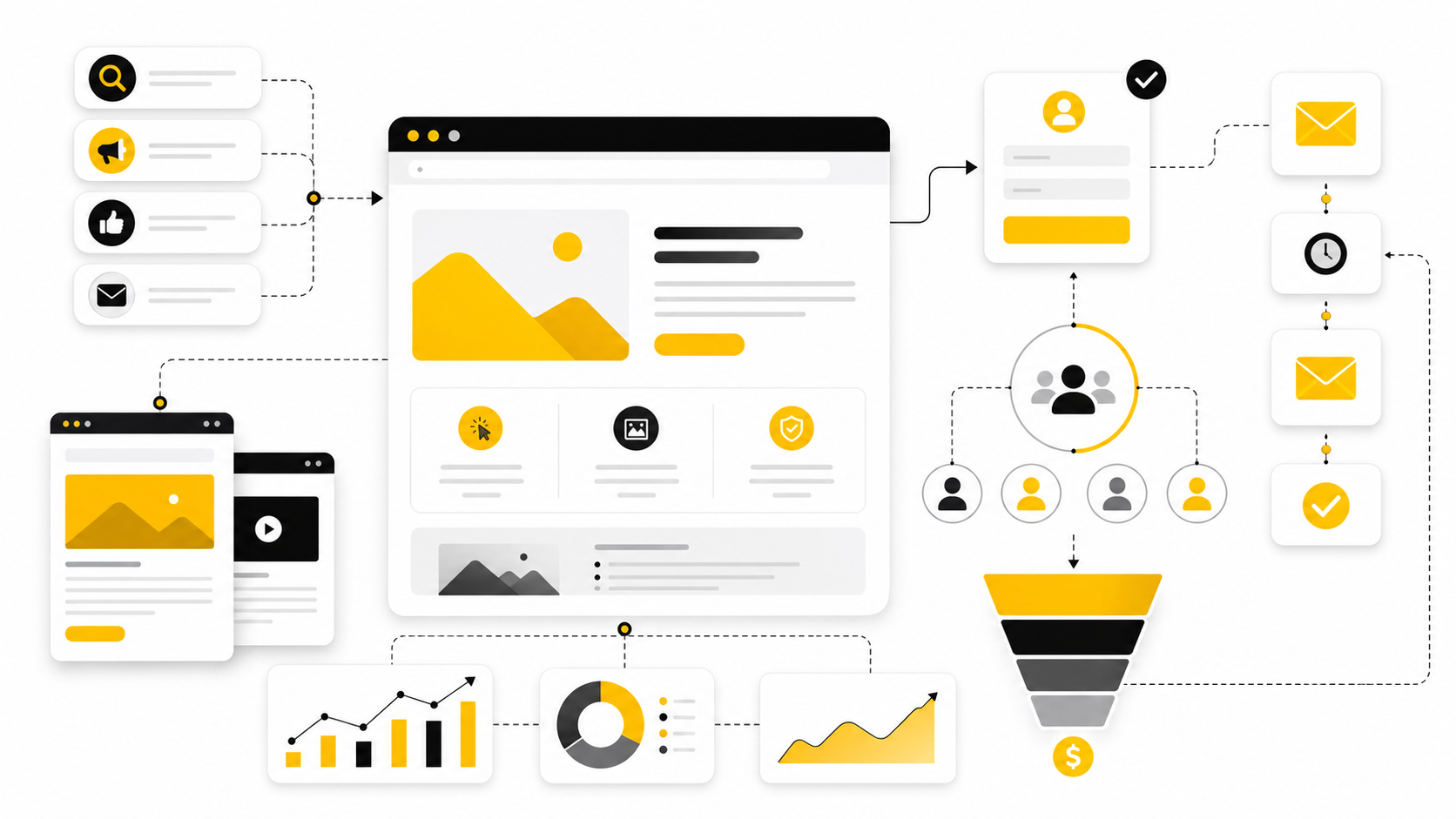
Once traffic, conversion, and measurement are working, the next challenge is scale. This is where internet marketing websites start to become operational systems instead of static assets. The question changes from “Does the website convert?” to “Can the website convert consistently without creating chaos behind the scenes?”
That shift matters because growth creates pressure. More leads can overwhelm sales. More content can create messy navigation. More campaigns can split data across too many tools. More automation can create strange customer experiences if nobody controls the logic.
Professional implementation is not about making the stack complicated. It is about making the website reliable as the business grows. The best systems feel simple to the visitor, even when there is a lot happening behind the scenes.
Use Automation To Protect Speed And Consistency
Automation is most valuable when it protects speed, consistency, and follow-through. If someone fills out a form, books a call, starts a trial, downloads a guide, or clicks through from a campaign, the next step should not depend on someone remembering to act manually. That is how leads get lost.
This matters because response time still has a direct impact on revenue opportunities. Harvard Business Review’s classic lead response research found that companies were far more likely to qualify leads when they responded quickly, and modern lead generation still punishes slow follow-up because buyers can compare alternatives instantly. The exact timing standard may vary by industry, but the principle has not changed: intent decays fast.
Good automation keeps the promise made on the website. A form submission should trigger the right confirmation, the right internal notification, the right CRM update, and the right follow-up sequence. A booked call should trigger reminders and context. A content download should trigger a nurture path that matches the topic the person cared about.
A platform like GoHighLevel fits this type of implementation when the website needs CRM pipelines, calendars, email, SMS, automations, and sales follow-up in one place. A lighter email-first setup with Brevo or Moosend can work well when the website’s main job is list growth, nurture, and campaign communication. The tool choice should follow the workflow, not the other way around.
Build Funnels Around Buyer Readiness
A sales funnel is not just a sequence of pages. It is a sequence of commitments. Each step should match how ready the visitor is to act, how much trust they have, and how much risk they feel.
For low-ticket offers, the funnel can usually move faster. A focused landing page, a clear checkout, a strong guarantee, and a simple follow-up sequence may be enough. For high-ticket services, the funnel usually needs more trust-building, qualification, proof, and human conversation before the sale can happen.
This is where internet marketing websites need discipline. It is tempting to copy funnel structures from other businesses, but the wrong funnel can damage conversion quality. A funnel that is too aggressive can push poor-fit leads into sales. A funnel that is too slow can lose high-intent buyers who were ready to act.
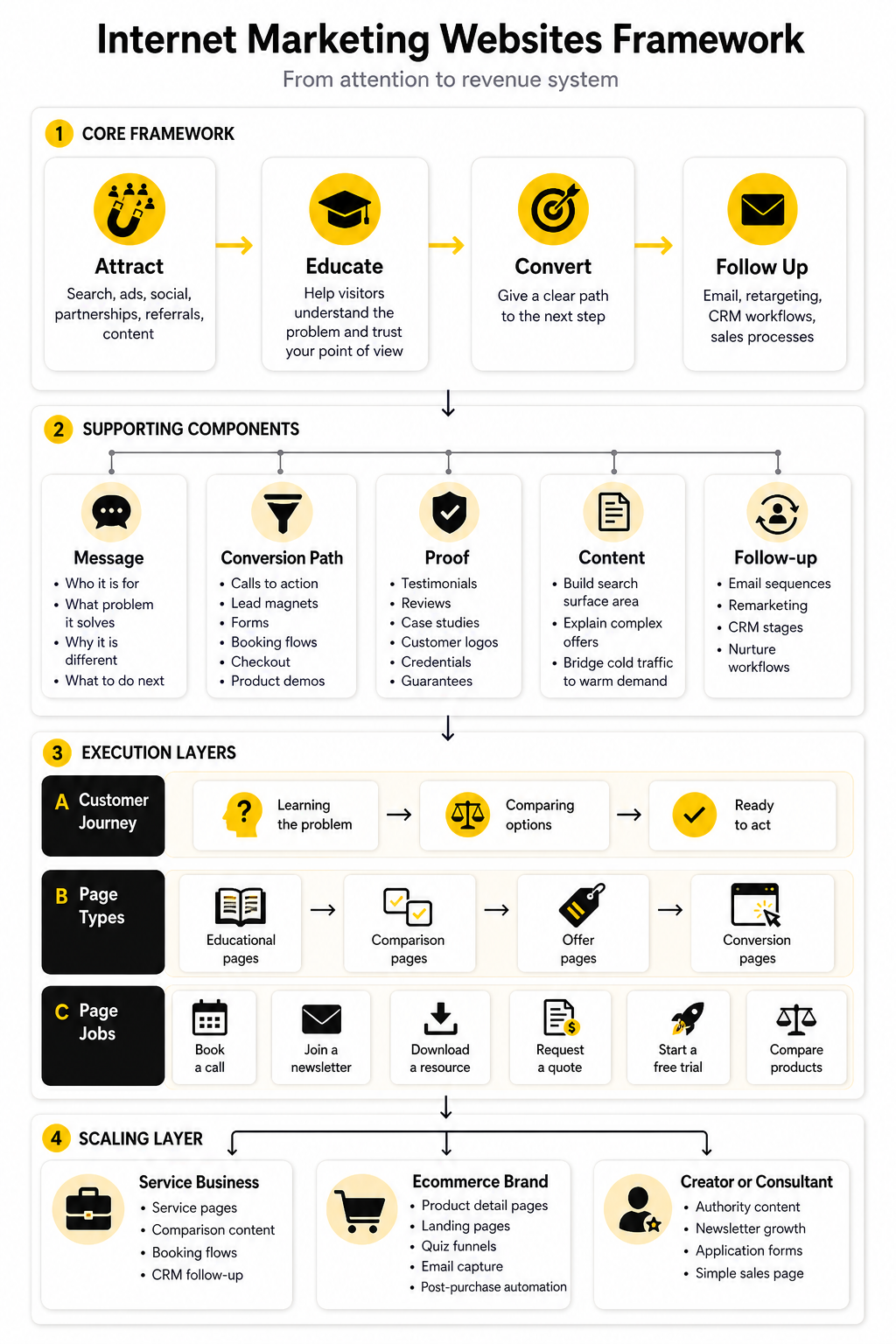
A practical funnel should answer one question at each step. What does the visitor need to believe before they move forward? If they need education, give them useful content. If they need comparison, give them positioning and proof. If they need reassurance, give them process clarity, testimonials, or transparent pricing context. If they are ready, remove distractions and make the action easy.
For businesses that want focused sales pages, order forms, upsells, and offer sequences, ClickFunnels can be a practical choice. For creators or lean businesses that want pages, email, and simple automation without a heavy stack, Systeme.io can fit. The right funnel platform is the one that helps the business execute the sales process cleanly.
Segment Before You Personalize
Personalization sounds advanced, but basic segmentation usually matters more. Before a website tries to personalize every message, it should know the main visitor groups it needs to serve. Those groups might be based on industry, company size, buyer role, problem type, funnel stage, traffic source, or previous behavior.
Segmentation helps the website avoid generic follow-up. Someone who downloaded a beginner guide should not receive the same next message as someone who visited pricing three times. Someone who came from a comparison page is probably thinking differently from someone who arrived through a broad educational article.
This is where CRM, email, and analytics need to work together. Tags, lists, page visits, form answers, lead scores, and campaign source data should help the business understand what the visitor likely needs next. Salesforce’s current marketing research highlights how marketers are pushing further into AI, data, and personalization based on insights from thousands of marketing leaders, but the foundation is still clean data and clear customer groups.
Bad personalization feels creepy or random. Good segmentation feels relevant. The visitor does not need to know that a workflow is running; they just need the next message, offer, or page to make sense based on what they already showed interest in.
Keep The Tech Stack From Becoming The Strategy
A growing website often attracts too many tools. One tool for funnels, one for email, one for chat, one for forms, one for scheduling, one for CRM, one for analytics, one for heatmaps, one for reporting, and suddenly nobody knows which system is the source of truth. That is not growth. That is operational drag.
The stack should be built around clear responsibilities. The website should present the offer and capture intent. The CRM should manage relationships and pipeline. The email platform should handle communication and nurture. Analytics should measure behavior and outcomes. Automation should connect the steps without creating confusion.
Too many businesses add tools because they are trying to avoid strategic work. A new chatbot will not fix unclear positioning. A new funnel builder will not fix a weak offer. A new CRM will not fix a team that does not define lead stages.
That does not mean tools are unimportant. They are very important when they support a clear process. For example, Fillout can improve lead capture and qualification when forms need logic and structure. Cal.com can simplify scheduling when booked meetings are the conversion. Chatbase can support visitor questions when the site has enough content and clear guardrails for what the assistant should answer.
Watch The Risks That Appear At Scale
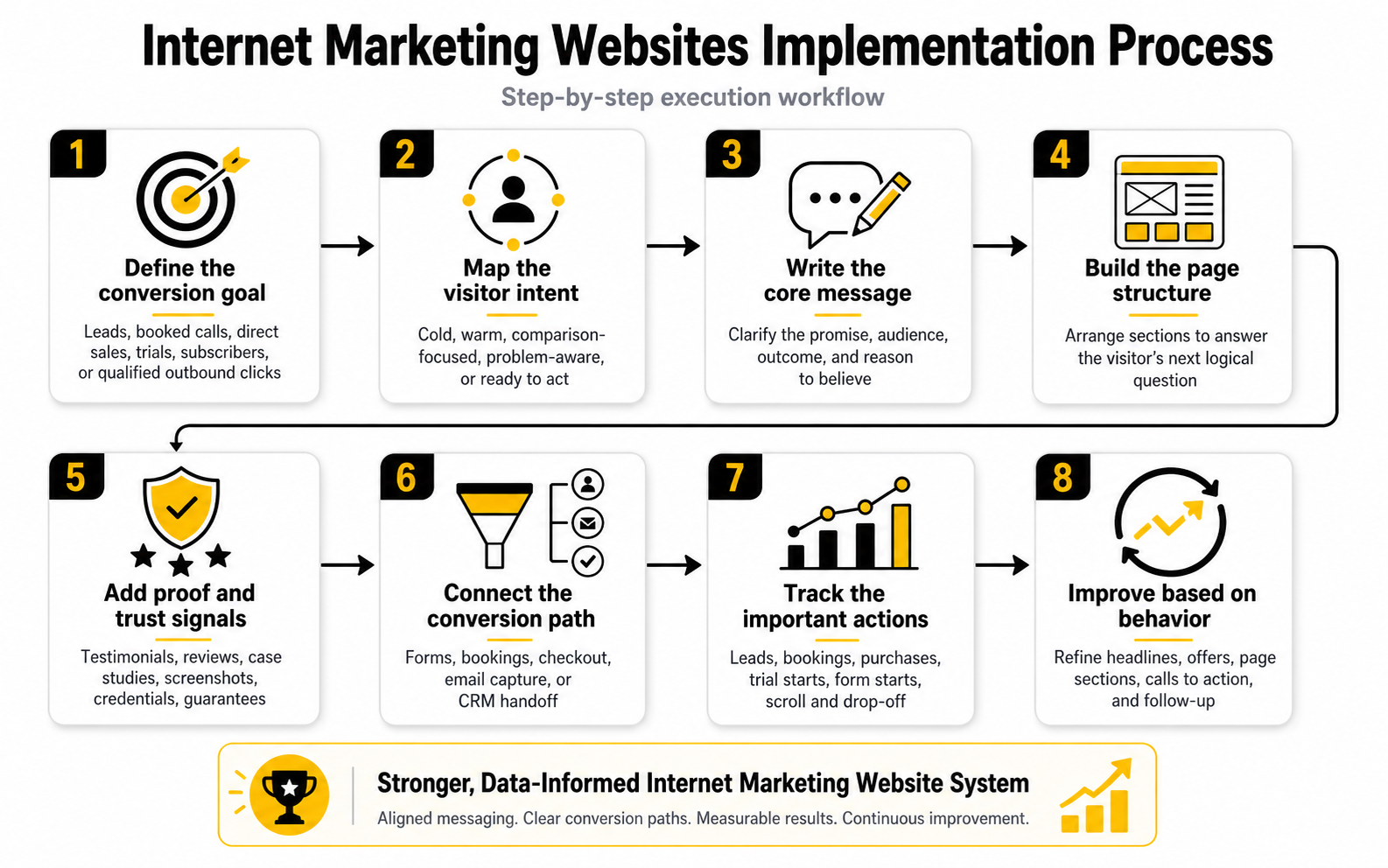
Scaling an internet marketing website creates new risks. The first risk is message drift. As more pages, campaigns, and content pieces get added, the brand can start saying slightly different things in different places. Over time, that weakens trust and makes the offer harder to understand.
The second risk is data fragmentation. If lead source, campaign data, form answers, CRM stages, and revenue outcomes are split across disconnected systems, the team cannot see what is actually working. Demandbase’s 2025 B2B marketing report points to disconnected data, tracking quality, and fragmented platforms as persistent barriers to marketing progress in its State of B2B Marketing research. That problem gets worse as the website and campaigns become more complex.
The third risk is automation without accountability. Automated messages can go out at the wrong time, sales alerts can be ignored, tags can be applied incorrectly, and old workflows can keep running after the offer changes. Automation saves time only when someone owns the system.
The fourth risk is trust erosion. More tracking, more personalization, more AI, and more data collection can create a better experience, but only if consent and privacy are handled clearly. Usercentrics’ 2025 digital trust research shows how consumer expectations around transparency, control, and consent are shaping digital experiences in the State of Digital Trust report. A marketing website should not treat trust as legal housekeeping. It is part of conversion.
Protect Performance As Pages Grow
A website can become slower as it becomes more ambitious. More scripts, more tracking pixels, more embedded forms, more chat widgets, more videos, more animations, and more third-party tools can all add weight. The problem is that visitors do not care why the page feels slow. They just leave.
Performance should be treated as a conversion factor, not only a technical score. Google’s Core Web Vitals focus on loading, interaction, and visual stability, and the current guidance around Core Web Vitals keeps user experience at the center of measurement. Fast, stable pages make every traffic source work harder.
This creates a real tradeoff. Tracking and personalization can improve marketing decisions, but too many scripts can damage the experience. Rich visuals can improve persuasion, but heavy media can slow the page. Chat widgets can help visitors, but they can also distract from the main call to action.
The answer is not to remove everything. The answer is to be intentional. Every script, widget, and visual asset should earn its place by improving the visitor experience, measurement quality, or conversion path.
Create Governance Before The Website Gets Messy
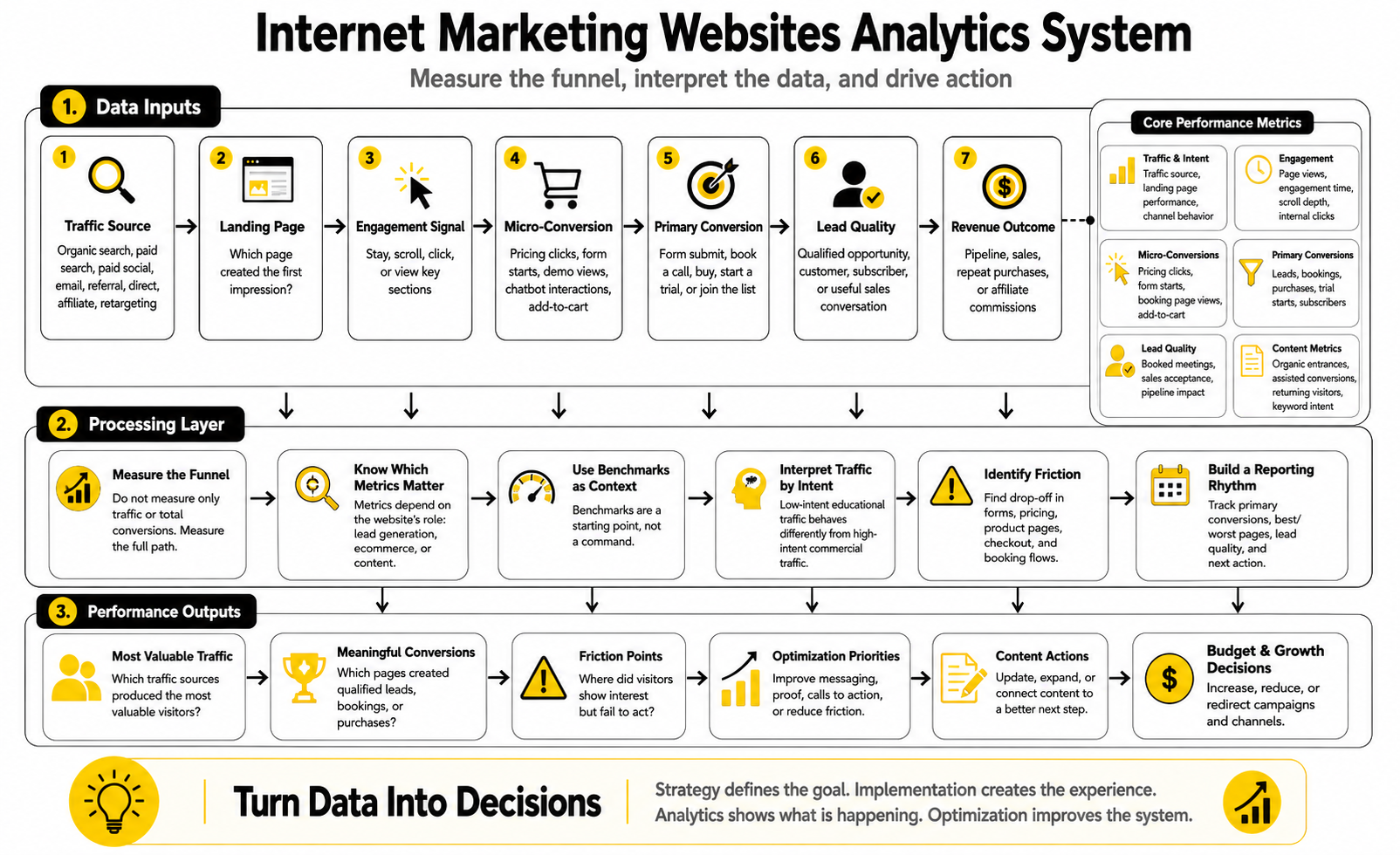
Governance sounds boring, but it prevents expensive cleanup later. A growing website needs clear rules for who can publish pages, update offers, add tracking scripts, change forms, edit navigation, and modify automation. Without rules, the site becomes a patchwork.
A simple governance system should define ownership. Marketing may own messaging and content. Sales may own lead qualification feedback. Operations may own CRM hygiene. Development or web operations may own performance, tracking implementation, and technical quality. Leadership should own the business priorities the website supports.
Governance also protects consistency. Page templates, call-to-action standards, naming conventions, UTM rules, form fields, CRM stages, and reporting definitions should not change randomly. If every campaign uses different naming and every form asks different questions, analysis becomes painful.
This is especially important for teams using AI in content and marketing operations. AI can speed up ideation, drafting, analysis, and personalization, but it can also create inconsistent claims, duplicated pages, weak fact-checking, and brand voice drift. Human review still matters, especially for pages that affect revenue, compliance, pricing, or customer trust.
Choose Between Centralized And Specialized Systems
There is no perfect stack. Centralized systems and specialized systems both have tradeoffs. A centralized platform can reduce tool sprawl, make automation easier, and help smaller teams move faster. Specialized tools can offer deeper features, better flexibility, and stronger performance in specific areas.
A business should choose based on complexity and team capacity. If the team is small and the funnel is straightforward, an all-in-one system can be the more carefully move. If the business has complex ecommerce, multiple regions, advanced analytics, heavy integrations, or a large marketing team, specialized tools may be worth the extra coordination.
The danger is choosing a complex stack because it feels more professional. Complexity is not a strategy. Every additional tool adds cost, training, maintenance, and integration risk.
A good decision process is practical. List the must-have workflows, identify the source of truth for each data type, estimate who will maintain the system, and decide which setup creates the least operational drag. The best stack is the one the team can actually use consistently.
Scale Content Without Losing Quality
Content scaling is one of the biggest opportunities for internet marketing websites, but it is also one of the fastest ways to create a weak site. Publishing more pages does not automatically create more demand. More content only helps when it targets the right intent, supports the offer, and stays useful over time.
The first scaling risk is duplication. If ten articles say nearly the same thing with slightly different keywords, the site becomes bloated and less helpful. The second risk is shallow coverage. If content is created only to fill a keyword gap, it may attract visitors without earning trust. The third risk is poor maintenance. Old pages can keep ranking while giving outdated advice, broken links, or irrelevant calls to action.
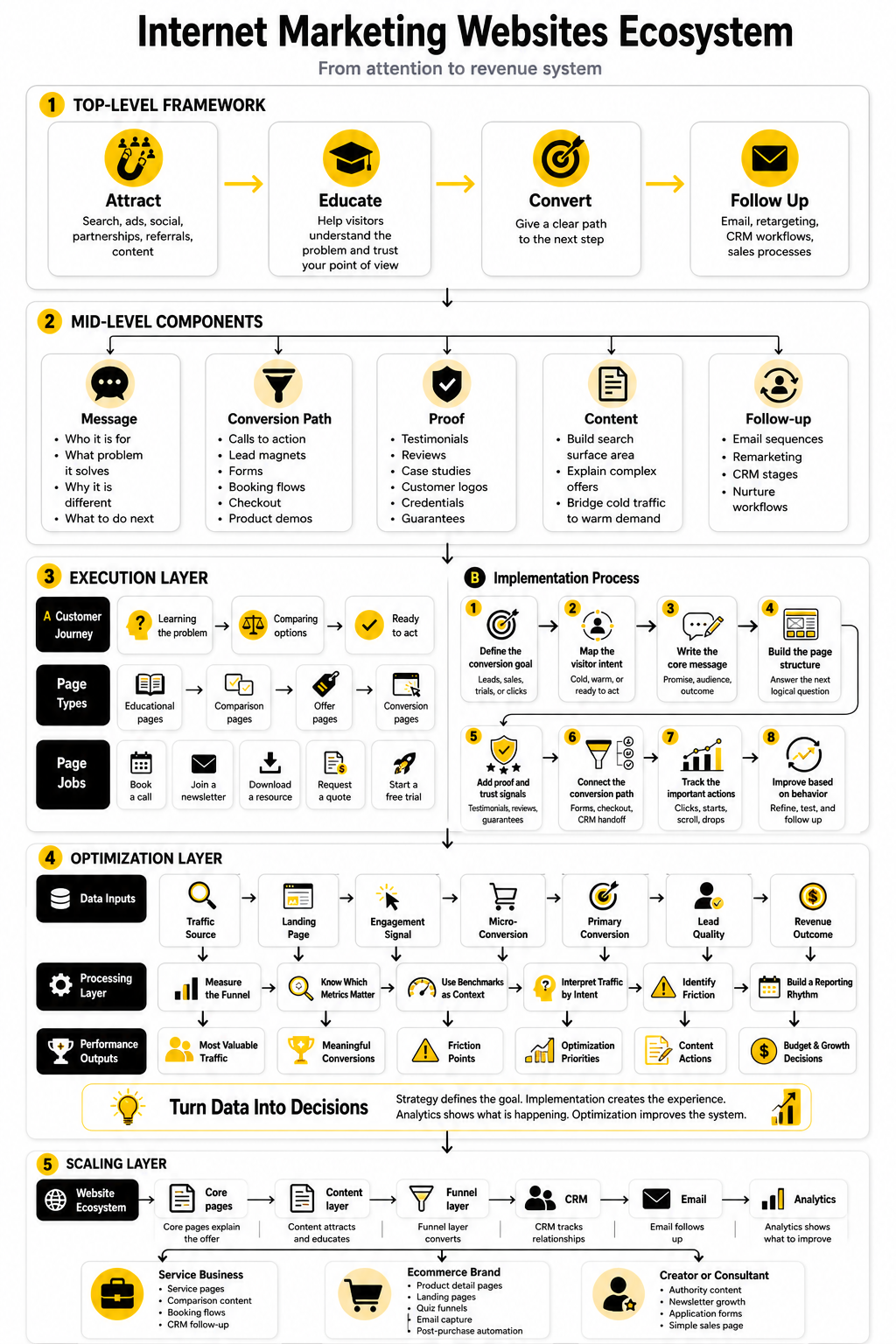
A scalable content system needs editorial rules. Each page should have a clear intent, a distinct angle, a defined next step, and a reason to exist. Existing content should be updated before the team creates endless new pages around overlapping topics.
Distribution also matters. A tool like Buffer can help keep social publishing consistent, while Flick Social can support social planning and hashtag research when social discovery is part of the strategy. But the content itself still has to carry the weight. Scheduling weak posts more efficiently does not make them stronger.
Know When To Simplify
Advanced strategy often means removing things. Removing weak pages. Removing extra form fields. Removing unnecessary popups. Removing confusing menu items. Removing campaigns that attract the wrong visitors. Removing automations nobody owns.
Simplification is not the same as doing less marketing. It means reducing friction so the parts that matter can work harder. Many websites improve when the team stops adding and starts clarifying.
This is especially true before scaling paid traffic. If the offer is unclear, the landing page is slow, the follow-up is messy, and the sales team does not trust the leads, more ad spend only exposes the weakness faster. Fix the system before amplifying it.
The most mature internet marketing websites are not always the flashiest. They are the ones where the offer, pages, traffic, data, automation, and sales process are aligned. That alignment is what makes scale feel controlled instead of chaotic.
Prepare For Optimization And Tool Selection
By this stage, the website has a strategy, a structure, a measurement system, and a growth process. The final step is knowing how to optimize it without getting distracted by every new tactic. Optimization should be steady, prioritized, and tied to business outcomes.
The right question is not “What can we test?” The right question is “Which improvement is most likely to increase qualified conversions or revenue?” Sometimes that means testing a headline. Sometimes it means rewriting a service page. Sometimes it means improving lead routing. Sometimes it means replacing a tool that has become a bottleneck.
This is also where tool selection becomes easier. Once the business understands its website system, it can choose platforms based on actual needs instead of hype. A funnel-heavy business may need one stack. A content-led brand may need another. A service business with sales follow-up may need something else entirely.
The final part will bring the whole guide together with practical optimization guidance, tool selection criteria, and frequently asked questions. That is where the strategy turns into a clear decision framework for building, improving, or rebuilding internet marketing websites with confidence.
Build a stronger local presence with BAAM AI
Turn your website, Google profile, social channels, and AI visibility into one growth engine
Most businesses do not need more random marketing activity. They need a consistent presence system that helps the right people find them, trust them, and take action. BAAM AI brings strategy, local SEO, website updates, Google Maps visibility, social content, AI-search readiness, media production, and reporting into one practical monthly engine.
If you want your marketing to keep working after the campaign ends, start with a free BAAM AI presence audit. See how your business shows up today and where the fastest visibility wins are at BAAM AI.