
BAAM AI Blog
Amazon Copywriter: The Practical Framework For Listings That Rank, Click, And Sell
An amazon copy writer does more than make a product sound nice. The real job is to turn search behavior, buyer intent, product proof, and Amazon’s listing rules into a product detail page that shoppers can understand...

An amazon copy writer does more than make a product sound nice. The real job is to turn search behavior, buyer intent, product proof, and Amazon’s listing rules into a product detail page that shoppers can understand quickly. That matters because Amazon is not a normal website where people casually browse for inspiration; it is a high-intent marketplace where the title, image stack, bullets, A+ Content, and backend structure all work together.
The mistake most sellers make is treating Amazon copy like regular ecommerce copy. They write pretty paragraphs, add a few keywords, and hope the algorithm figures it out. But Amazon itself says listing quality depends on the product title, images, brand, description, and bullet points, and that this information can help a detail page show higher in search results and earn more customer clicks through Amazon’s listing quality guidance.
Good Amazon copy has to serve two audiences at the same time. It has to give Amazon enough relevance signals to understand the product, and it has to give shoppers enough confidence to stop comparing and buy. That is why this guide treats Amazon copywriting as a system, not a writing task.
Why Amazon Copywriting Matters
Amazon copywriting matters because the product detail page is often the final sales conversation before the buyer makes a decision. The shopper has already searched, clicked, compared, skimmed reviews, checked images, and looked for reasons not to buy. If the listing copy is vague, overloaded, or generic, the product can lose the sale even when the product itself is strong.
This is also why keyword stuffing is such a weak strategy. Amazon’s 2025 title requirements tightened expectations around clarity, repetition, and special characters, including a general 200-character title limit for most categories and restrictions on repeating the same word more than twice through Amazon’s product title update. In plain English, Amazon wants listings that are useful, not messy.
The commercial pressure is real. Amazon’s 2024 annual report showed total revenue rising from $575 billion to $638 billion year over year, which tells you the marketplace is still massive, competitive, and worth taking seriously through Amazon’s investor report. In a marketplace that big, a skilled amazon copy writer is not just polishing words; they are helping a product compete for attention, trust, and conversion.
The Amazon Copywriting Framework
The simplest way to understand Amazon copywriting is to separate it into four layers: search, click, trust, and conversion. Search is about relevance, so Amazon can match the product to the right query. Click is about making the product look like the best option in the search results.
Trust is where the shopper starts asking harder questions. Does this fit my use case? Is it the right size? Will it solve the problem better than the cheaper option? Conversion is where the copy removes friction by making the strongest benefits, differentiators, proof points, and product details easy to absorb.
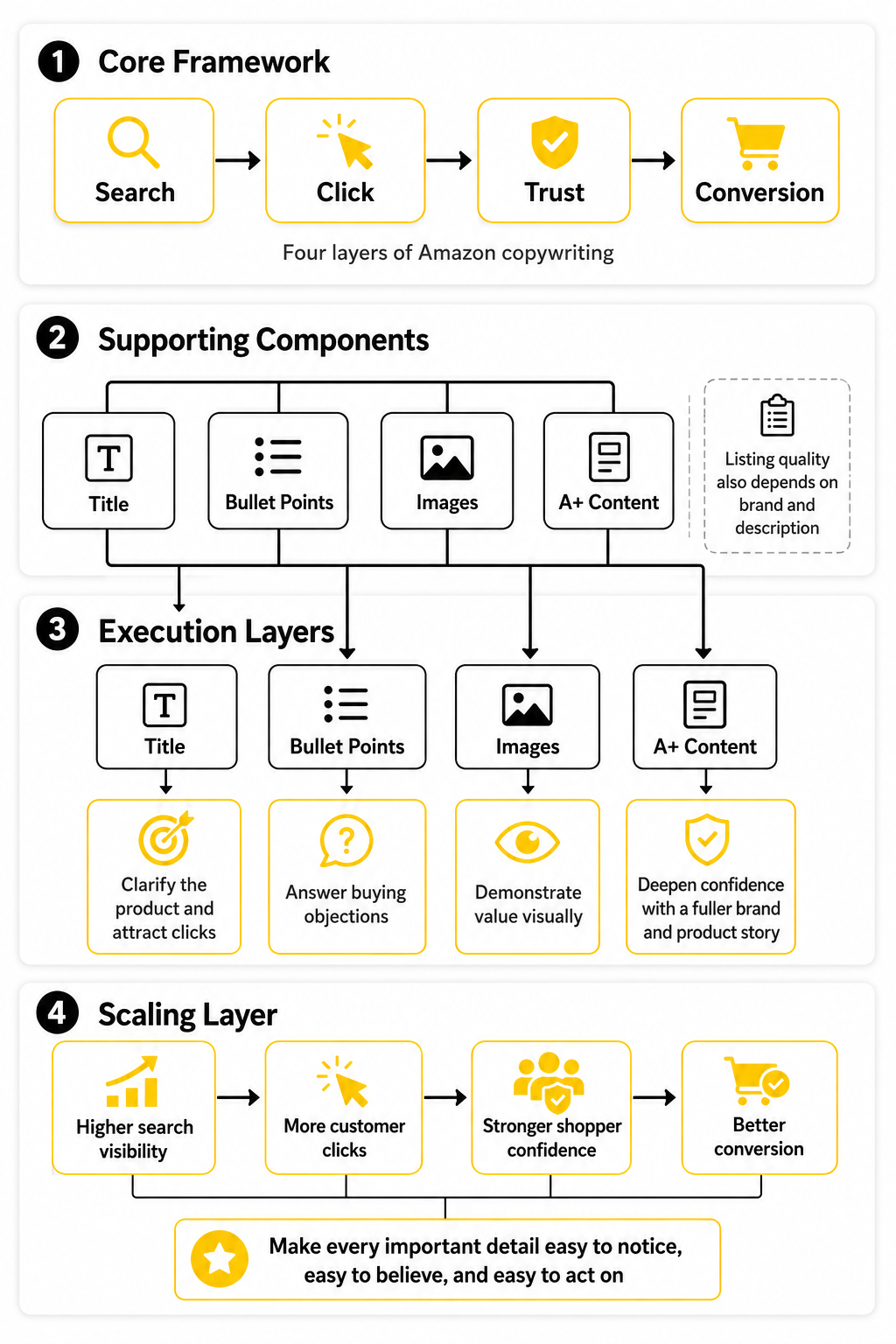
This framework keeps the writing practical. Instead of asking, “Does this sound good?”, the better question is, “What job does this line do?” A title should clarify and attract clicks, bullets should answer buying objections, images should demonstrate value, and A+ Content should deepen confidence with a more complete brand and product story.
Core Components Of A High-Converting Listing
A strong Amazon listing usually starts with the title because the title affects both search visibility and shopper expectations. It should identify the product clearly, include the most important searchable terms naturally, and avoid looking like a pile of disconnected keywords. A good title helps the right buyer immediately understand what the product is, who it is for, and why it deserves a click.
The bullet points carry much of the persuasive weight. They need to translate features into buyer-relevant outcomes without exaggeration. This is where many listings fall apart because they either repeat specs already visible elsewhere or make broad claims that do not help the shopper decide.
Images and A+ Content then support the copy visually. Amazon Ads recommends using four or more images that show the product from different angles, highlight important details, and demonstrate how it can be used through Amazon’s product detail page guidance. Amazon also positions A+ Content as a way to use enhanced images, videos, and richer product information to improve listings through Amazon’s A+ Content tool page.
Professional Implementation Starts With Strategy
A professional amazon copy writer should not begin by writing. They should begin by understanding the product, the category, the buyer, the competing listings, the search terms, and the reasons shoppers hesitate. Without that groundwork, the copy may sound polished while missing the actual buying triggers.
Amazon Brand Analytics gives enrolled brands access to search behavior signals such as query volume, impressions, clicks, cart adds, and purchases through Amazon’s Brand Analytics overview. That kind of data changes the writing process because the copy no longer depends only on guesswork or competitor imitation. It can be built around the language shoppers already use and the terms that matter commercially.
The goal is not to make every listing loud. The goal is to make every important detail easy to notice, easy to believe, and easy to act on. That is the difference between basic product writing and Amazon copywriting that actually supports ranking, clicks, and sales.
How To Research Before Writing
Before an amazon copy writer touches the title, bullets, or description, they need to understand what the buyer is actually trying to do. That means looking beyond the obvious product keyword and asking what problem brought the shopper to Amazon in the first place. A person searching for a “portable blender” may care about travel, gym bags, cleaning time, battery life, or whether it can crush frozen fruit without becoming a regret purchase.
The research stage should separate three things that sellers often mix together: keywords, buying triggers, and objections. Keywords help the listing become discoverable. Buying triggers explain why someone would choose this product instead of another one. Objections reveal what the copy, images, and product details must clarify before the shopper feels safe enough to buy.
This is where weak Amazon copy starts to show. A generic listing says the product is “high quality,” “easy to use,” and “perfect for everyday life.” A researched listing explains the specific use case, the product constraint, the buyer’s worry, and the reason the product is still the right choice.
Start With Search Intent, Not Word Count
Search intent is the difference between writing for traffic and writing for sales. A keyword can look valuable because it has volume, but if the listing does not match the buyer’s expectation, that traffic can turn into wasted impressions. The better move is to group keywords by intent: broad category searches, feature-led searches, problem-led searches, and comparison-style searches.
Amazon Brand Analytics is useful here because the Search Query Performance dashboard shows query volume, impressions, clicks, cart adds, and purchases, which helps brands understand how shoppers move from search to purchase through Amazon’s Brand Analytics tools. That matters because a keyword that gets clicks but few cart adds may signal curiosity without confidence. A keyword that gets fewer searches but stronger purchase behavior may deserve more attention in the copy.
A practical amazon copy writer does not chase every keyword equally. They decide which terms belong in the title, which belong in bullets, which can fit naturally in the product description, and which should be handled through backend search terms if they are relevant but awkward. This keeps the visible listing clean while still supporting discoverability.
Study The Competitive Set Carefully
Competitor research is not about copying top listings. It is about finding patterns, gaps, and weak spots in the category. If every competing product leads with the same feature, the writer has to decide whether that feature is table stakes or a real differentiator.
The useful questions are simple. What do top listings mention first? What details do they repeat across titles and bullets? What do negative reviews complain about? What do positive reviews praise in the buyer’s own language? Those answers help the copy become more grounded and less dependent on generic benefit claims.
Review mining has to be handled carefully. You are not looking for dramatic quotes to paste into the listing, and you should not invent customer language that is not there. You are looking for recurring patterns that reveal what buyers notice before and after purchase, then turning those patterns into clearer product communication.
Separate Features From Buyer Outcomes
A feature is what the product has. A buyer outcome is what that feature helps the shopper do, avoid, save, or feel more confident about. Amazon copy becomes stronger when the writer can connect those two without exaggerating.
For example, “double-wall insulation” is a feature. “Keeps drinks colder during a long commute without sweating on your desk” is closer to a buyer outcome, assuming the product can honestly support that claim. The second version is stronger because it gives the shopper a use case they can picture.
This does not mean every sentence should become emotional or long. Amazon shoppers scan. The job is to make each benefit concrete enough to matter and concise enough to read fast.
Build A Product Claim Inventory
Every listing should have a product claim inventory before writing begins. This is a simple working document that separates verified facts from assumptions. It prevents the copy from drifting into claims the product cannot support.
A good claim inventory includes materials, dimensions, compatibility, included items, care instructions, certifications, warranty details, and any measurable performance information. It should also flag claims that need proof, such as “waterproof,” “non-toxic,” “BPA-free,” “medical-grade,” “commercial-grade,” or “dishwasher safe.” These phrases can be powerful, but only when they are true and allowed for the category.
This step is boring, and that is exactly why it matters. The best Amazon listings often feel clear because someone did the unglamorous work first. They checked the details, removed risky language, and made sure the final copy would survive both customer scrutiny and platform review.
Match Copy To Amazon’s Listing Rules
Amazon copywriting is not free-form creative writing. It has to fit the marketplace’s standards for titles, bullets, images, descriptions, claims, and category expectations. Amazon’s 2025 title update requires most product titles to stay within 200 characters, avoid certain special characters unless they are part of the brand name, and avoid repeating the same word more than twice through Amazon’s product title requirements.
That rule changes the way titles should be written. A title cannot simply repeat the primary keyword in five different forms and hope that volume wins. The title has to make prioritization decisions: product type, brand, core feature, size, quantity, compatibility, or use case.
The same discipline applies to bullets. Amazon Ads recommends strong product titles, useful product information, clear images, and complete detail pages as part of improving products for advertising through Amazon’s product detail page guidance. In practice, paid traffic exposes weak copy faster because more shoppers arrive, compare, and leave if the listing does not answer the obvious questions.
Turn Research Into A Writing Brief
The research is only useful if it becomes a clear writing brief. Without that bridge, the writer ends up with a pile of notes and no real direction. The brief should define the target shopper, primary use case, strongest differentiator, top objections, required keywords, compliance limits, and the order of persuasion.
The order of persuasion matters more than most sellers think. A shopper does not need every detail at once. They need the right detail at the right moment, starting with recognition, then relevance, then confidence, then action.
For an amazon copy writer, the brief becomes the guardrail. It keeps the title focused, the bullets useful, the description consistent, and the A+ Content aligned with the product’s real selling points. More importantly, it stops the listing from becoming a random collection of benefits that all compete for attention.
Professional Implementation And Optimization
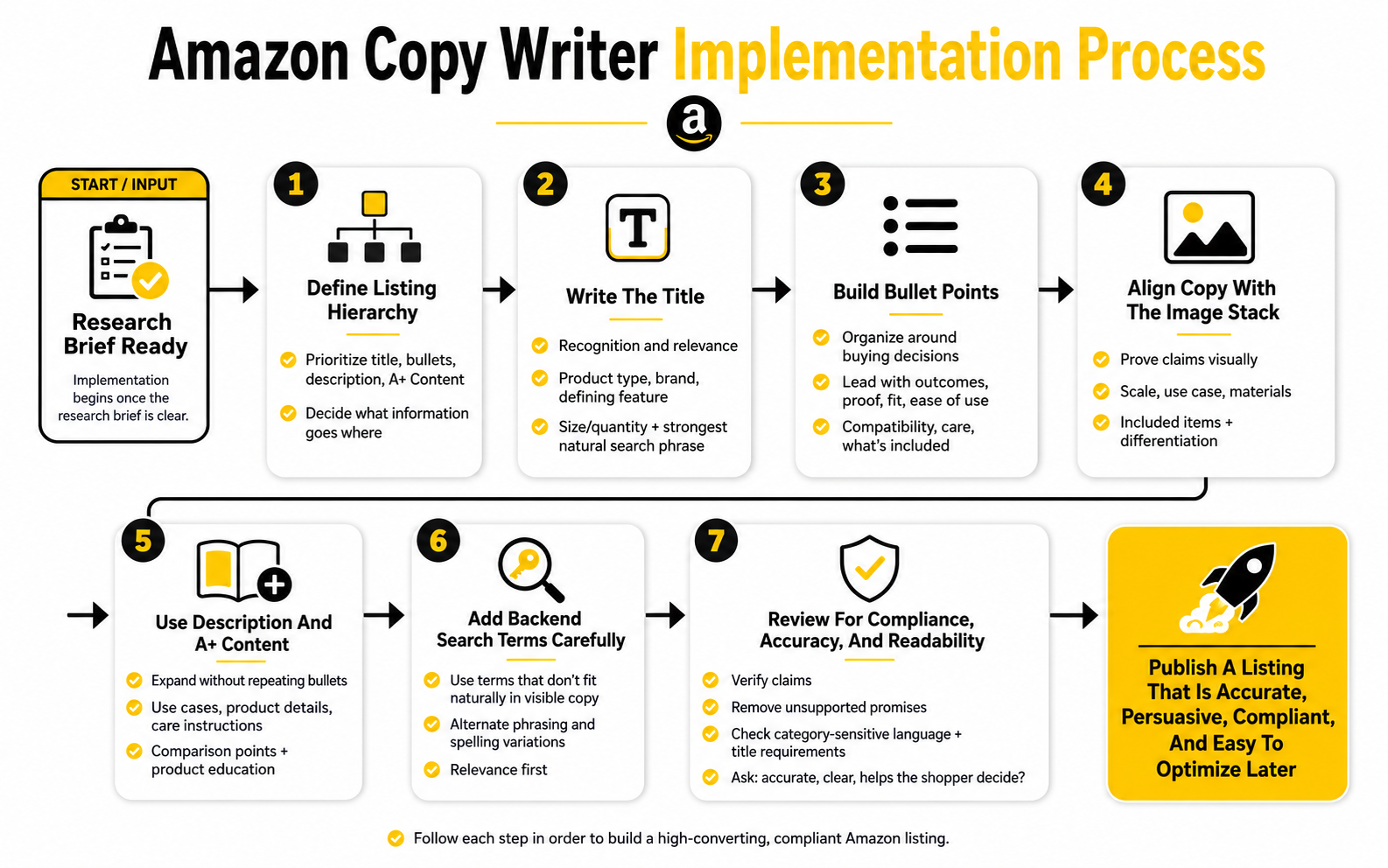
Once the research brief is clear, implementation becomes a controlled process. This is where an amazon copy writer turns raw inputs into a listing that can be published, reviewed, tested, and improved. The goal is not to create one clever version and walk away; the goal is to build a product detail page that is accurate, persuasive, compliant, and easy to optimize later.
A practical implementation process keeps each listing element in its lane. The title should not try to do the job of five bullet points. The bullets should not bury the strongest buying reasons under filler. The description and A+ Content should not repeat the same claims with slightly different wording.
Step 1: Define The Listing Hierarchy
The first implementation decision is hierarchy. This means deciding which information gets priority in the title, which points deserve bullet placement, which details belong in the description, and which ideas need visual support. Without hierarchy, every feature feels equally important, and the listing becomes noisy.
A clean hierarchy starts with the shopper’s first decision. They need to recognize the product quickly, understand its primary use case, and see one or two reasons it deserves attention. Amazon’s product title requirements push sellers toward clearer, more concise titles, including the 200-character limit for most categories and limits on repeated words through Amazon’s 2025 title requirements.
The title should usually carry the product type, brand, defining feature, size or quantity when relevant, and the strongest search phrase that still reads naturally. If the title becomes a dumping ground for every keyword, the listing may technically include more terms, but it becomes harder for humans to trust. That is a bad trade.
Step 2: Write The Title For Recognition And Relevance
A strong Amazon title works because it helps the right shopper say, “Yes, this is what I was looking for.” That is more important than sounding clever. Amazon shoppers are usually comparing several options fast, so clarity beats personality at this stage.
The title should include the core product phrase as naturally as possible. For an amazon copy writer, the real skill is deciding what to leave out. You may have ten relevant features, but only the strongest few belong in the title because the title has to stay readable on desktop, mobile, and search results.
The best titles also avoid overpromising. Words like “best,” “ultimate,” or “perfect” rarely add useful information unless they are part of a legitimate product name or brand positioning. Specifics work harder because they help the shopper understand the product without forcing them to decode marketing language.
Step 3: Build Bullets Around Buying Decisions
Bullet points should not read like a spec sheet with random benefits attached. They should walk the shopper through the most important buying decisions in a logical order. A useful sequence often starts with the main outcome, then moves into proof, fit, ease of use, compatibility, care, or what is included.
Each bullet should earn its place. If a bullet only says the product is “premium quality,” it is too vague. If it explains what material is used, why it matters, and what situation it helps with, the shopper gets something useful.
Amazon Ads highlights product titles, detailed product information, and high-quality images as practical improvements that can help advertised products earn more engagement through Amazon’s product detail page guidance. That matters because bullets sit right where the shopper is deciding whether to keep reading, check reviews, or leave. They are not decoration.
Step 4: Align Copy With The Image Stack
The image stack is not separate from the copy. It is part of the same sales argument. If the bullets say the product is compact, durable, or easy to clean, the images should help prove it visually instead of leaving the claim unsupported.
Amazon recommends adding four or more high-quality images as one of the small upgrades that can help generate more engagement for advertised products through Amazon’s advertising guidance. That is a useful baseline, but the deeper point is strategy. Every image should answer a question the shopper is likely to have.
A practical image-copy plan might assign one visual to scale, one to use case, one to materials, one to included items, and one to comparison or differentiation. This prevents the listing from wasting image slots on pretty but unhelpful shots. Pretty can help, but useful usually sells better.
Step 5: Use The Description And A+ Content To Deepen Confidence
The description and A+ Content should expand the argument without repeating the bullets word for word. This is where the brand can explain use cases, product details, care instructions, comparison points, and the broader reason the product exists. It should feel like a helpful continuation, not a pasted brochure.
Amazon describes A+ Content as a way to add videos, enhanced images, customized text placements, shoppable comparison charts, and richer product information to detail pages through Amazon’s A+ Content program. Used well, this gives the amazon copy writer more room to organize information visually and reduce buyer hesitation.
A+ Content is especially useful when the product needs education. If the shopper needs to understand sizing, compatibility, ingredients, routines, bundles, or product differences, plain bullets may not be enough. The job is to make the decision easier, not to make the page longer.
Step 6: Add Backend Search Terms Carefully
Backend search terms are useful when relevant terms do not fit naturally into the visible copy. They can help cover alternate phrasing, spelling variations, and related search language without making the listing look awkward. But they are not a magic drawer where every possible keyword belongs.
The same rule still applies: relevance first. If a term does not describe the product, match the buyer’s intent, or belong in the category, it should not be forced into the listing. Bad keyword discipline can create poor traffic, weak conversion, and a less coherent product page.
A professional amazon copy writer treats backend terms as support, not the strategy. The visible listing still has to do the heavy lifting. Search visibility gets the shopper to the page, but the copy, images, price, reviews, and offer decide what happens next.
Step 7: Review For Compliance, Accuracy, And Readability
Before publishing, the listing needs a final review that is more disciplined than a quick spell check. The writer should verify every claim against the product facts, remove unsupported promises, check category-sensitive language, and make sure the title follows Amazon’s requirements. This is where small mistakes can become expensive.
Readability matters too. The copy should be easy to scan, especially on mobile. Long, overloaded bullets may contain useful information, but if the shopper cannot process them quickly, they fail in practice.
The final pass should ask three questions. Is this accurate? Is this clear? Does this help the shopper make a decision? If the answer is no, the line should be rewritten or removed.
Statistics And Data
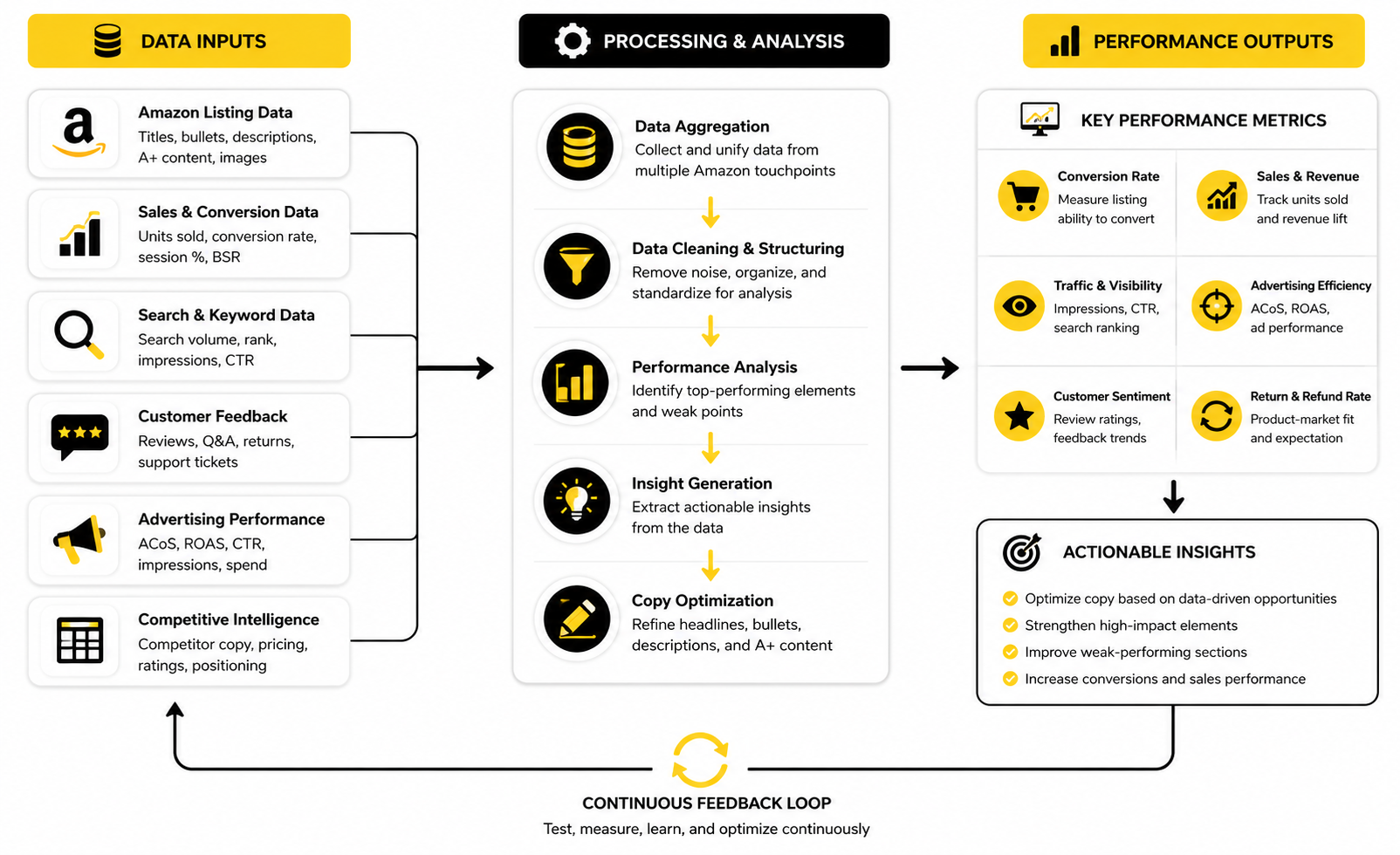
Data should not be used to decorate an Amazon listing strategy. It should tell you where the listing is leaking attention, trust, or sales. A professional amazon copy writer needs to understand the numbers well enough to know whether the problem is visibility, click-through, conversion, or product-market fit.
The cleanest way to think about Amazon listing performance is as a funnel. Shoppers search, Amazon shows results, a percentage of shoppers click, some add to cart, and some purchase. If you only look at sales, you see the outcome but not the reason behind it.
Amazon’s Search Query Performance dashboard is useful because it breaks that funnel into query volume, impressions, clicks, cart adds, and purchases through Amazon Brand Analytics. That gives sellers a better view of where a listing is strong and where it is losing shoppers. The point is not to stare at dashboards every day; the point is to connect each metric to a practical copywriting decision.
Impressions Show Whether The Listing Is Being Seen
Impressions tell you whether the product is appearing for relevant searches. If impressions are low for an important query, the issue may be keyword relevance, indexing, offer strength, category fit, or advertising coverage. Copy can help, but it is not always the only lever.
For an amazon copy writer, low impressions can mean the listing is not communicating the product clearly enough to Amazon. The title, bullets, and backend search terms may need better alignment with the most relevant search language. This does not mean stuffing the same phrase everywhere; it means making the listing easier for Amazon and shoppers to understand.
The action is simple but disciplined. Compare the product’s most important search terms against the visible listing structure. If the core term is missing, buried, or replaced by clever wording shoppers do not use, the copy needs to be tightened.
Clicks Reveal Whether The Offer Looks Worth Opening
Clicks are the first real shopper response. If impressions are healthy but clicks are weak, the listing may not look attractive enough in the search results. That can point to the title, main image, price, rating, reviews, coupon, delivery promise, or brand recognition.
Copy still matters here because the title is part of the search result. A confusing title can make the product look less relevant even when the product is a good fit. A clear title can help the shopper understand the product faster and reduce the mental effort needed to click.
This is where benchmarks can become dangerous. A “good” click-through rate depends heavily on category, price point, competition, search intent, and ad placement. The better comparison is usually against the product’s own historical performance and the strongest competing search terms inside the same category.
Cart Adds Show Whether The Page Builds Enough Confidence
Cart adds sit in the middle of the funnel, and they are underrated. A shopper who adds to cart has moved beyond curiosity. They have seen enough to consider the product seriously.
If clicks are strong but cart adds are weak, the listing may be attracting attention but failing to build confidence. The copy may not answer sizing, compatibility, material, use case, warranty, what is included, or why the product costs what it costs. This is usually where bullets, images, product details, and A+ Content need closer inspection.
Amazon’s A/B testing tool, Manage Your Experiments, allows eligible sellers to test titles, images, bullet points, descriptions, and A+ Content to see what resonates with customers through Amazon’s Manage Your Experiments tool. That matters because cart behavior often changes when a listing explains the product more clearly. The action is not to rewrite everything at once; the action is to isolate the weakest confidence point and test a focused improvement.
Purchases Measure The Whole Listing, Not Just The Words
Purchases are the final visible signal, but they are not purely a copywriting metric. Price, reviews, stock status, shipping speed, competition, seasonality, ads, and product quality all influence conversion. Good copy can remove friction, but it cannot save a weak offer forever.
That is why an amazon copy writer should avoid taking full credit or full blame for purchase movement. The right question is more useful: did the copy improve the shopper’s ability to understand, trust, and choose the product? If the answer is yes but purchases still lag, the issue may sit outside the listing copy.
Amazon has said that Manage Your Experiments can help sellers discover content that resonates with customers and may help increase sales by up to 25% through Amazon’s A/B testing guidance. That number should be treated as potential upside, not a promise. The practical lesson is that listing content is measurable, and serious sellers should test meaningful changes instead of arguing from opinion.
Conversion Rate Needs Context Before Action
Conversion rate is powerful because it shows how efficiently traffic turns into buyers. But it can be misleading when viewed alone. A listing can have a high conversion rate on a small amount of branded traffic and still miss huge growth opportunities on broader category searches.
A low conversion rate is not automatically a copy problem either. It may mean the listing is attracting the wrong traffic, the price is too high, the review profile is weak, or the product is being compared against stronger alternatives. The copywriter’s job is to diagnose before rewriting.
A useful conversion review should look at traffic source, keyword intent, product price, rating, review count, image quality, availability, and competitor positioning. Only then does the copy decision become clear. Sometimes the answer is a stronger first bullet; sometimes it is a better comparison chart; sometimes it is removing a claim that creates confusion.
Benchmarks Should Guide Questions, Not Decisions
Benchmarks can help you spot unusual performance, but they should not dictate your entire Amazon copy strategy. A category with expensive, considered purchases will behave differently from a category with cheap impulse products. A new product with few reviews will behave differently from a mature listing with years of trust signals.
The better approach is to build internal benchmarks. Track each listing before and after major changes. Watch query-level performance over time. Compare similar products within the same catalog instead of chasing generic marketplace averages.
This is especially important for brands managing multiple ASINs. One product may need stronger keyword coverage because it is underexposed. Another may need better bullets because shoppers click but do not buy. Another may need a cleaner image-copy system because the product is visually misunderstood.
What The Data Should Change In The Copy
The data should drive specific copy decisions, not vague “optimization.” If impressions are weak, review keyword placement and relevance. If clicks are weak, review the title, main image alignment, and visible offer clarity. If cart adds are weak, improve the bullets, image stack, and product detail clarity.
If purchases are weak after cart adds, look deeper at objections. The listing may need clearer size guidance, comparison details, stronger proof, more transparent limitations, or better explanation of what makes the product worth choosing. This is where the best Amazon copy becomes brutally practical.
The strongest measurement system connects each metric to one action:
Testing Beats Guessing
Amazon copywriting improves fastest when sellers stop treating every rewrite as a final answer. A good listing version is a hypothesis. It says, “We believe this clearer title, stronger bullet order, or better A+ Content module will help shoppers make a decision.”
Manage Your Experiments exists for exactly this kind of disciplined testing. Amazon’s tool supports experiments on product images, titles, bullet points, descriptions, A+ Content, and Brand Story through Amazon’s testing tool overview. That gives the seller a way to compare versions with real shopper behavior instead of relying only on internal preference.
The key is to test meaningful differences. Changing one adjective rarely teaches much. Changing the value proposition, bullet hierarchy, title structure, or visual explanation can reveal what shoppers actually care about. That is how an amazon copy writer moves from “this sounds better” to “this performs better.”
Advanced Tradeoffs An Amazon Copy Writer Has To Manage
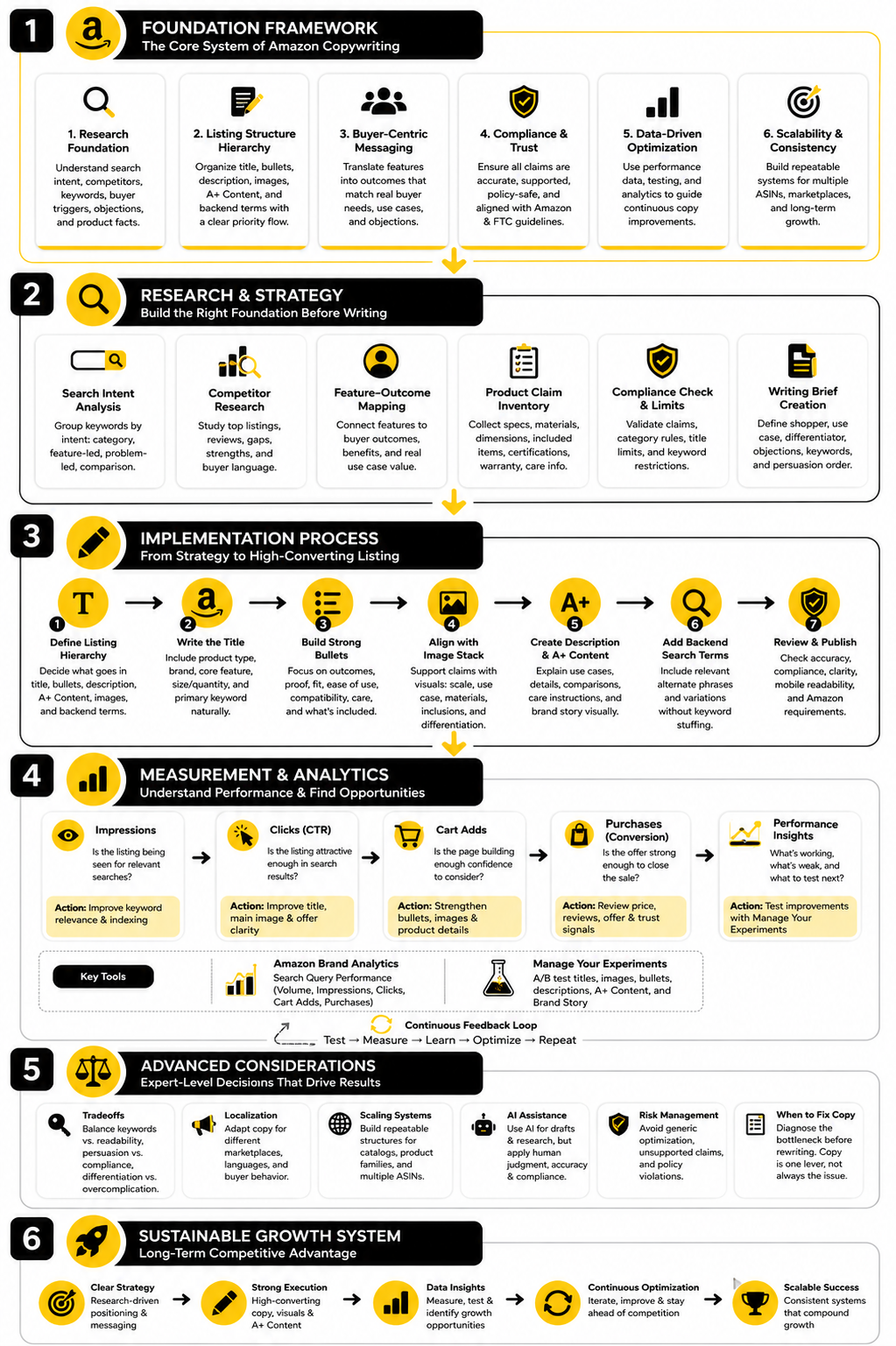
At a basic level, Amazon copywriting is about clarity, keywords, and conversion. At a higher level, it becomes a series of tradeoffs. Every listing has limited space, limited shopper attention, and limited tolerance for claims that feel inflated or unclear.
This is where an experienced amazon copy writer becomes valuable. They are not just asking, “Can we fit this keyword?” They are asking, “Will this phrase improve relevance without hurting trust?” That distinction matters because the highest-converting listing is rarely the one with the most words.
The best Amazon copy is strategic restraint. It says enough to help the buyer decide, but not so much that the page becomes exhausting. That takes judgment, not just writing ability.
Keyword Coverage Versus Human Readability
The first advanced tradeoff is keyword coverage versus readability. Sellers often want every relevant phrase included in the visible listing because they are worried about missing search demand. That instinct is understandable, but it can create titles and bullets that feel mechanical.
Amazon’s title requirements now push listings toward clearer, less repetitive wording, including the 200-character limit for most categories and restrictions on repeating the same word more than twice through Amazon’s 2025 product title update. This forces better prioritization. You cannot treat the title as a keyword warehouse anymore.
A practical rule is simple: the most commercially important and natural terms belong in visible copy, while secondary variations can be handled more carefully elsewhere. The title should help the shopper recognize the product. The bullets should help the shopper believe in the product. If keyword insertion damages either job, it is probably not worth it.
Persuasion Versus Compliance
The second tradeoff is persuasion versus compliance. Strong copy needs to be specific, but specific claims must be supportable. Phrases like “clinically proven,” “non-toxic,” “medical grade,” “eco-friendly,” “kills bacteria,” or “safe for children” can carry regulatory and platform risk if the seller cannot prove them.
Amazon’s policy on misleading and prohibited claims says product claims must be truthful, verifiable, and substantiated, and that the policy applies across detail pages, images, descriptions, packaging, and marketing materials through Amazon’s claims guidance. The FTC also emphasizes that advertising claims need solid proof through truth-in-advertising guidance. That means the copywriter has to know when a persuasive line crosses into a claim that needs evidence.
The safer and usually stronger move is to write from verified product facts. Instead of saying a product is “the safest choice,” explain the exact safety feature if it is real. Instead of saying “professional quality,” name the material, construction, certification, or use case that supports the point.
Brand Voice Versus Marketplace Expectations
Amazon is not the place to let brand voice run wild without structure. A distinctive tone can help, especially in A+ Content and Brand Story modules, but the shopper still needs fast answers. If the brand voice slows down understanding, it becomes a liability.
This is especially true in crowded categories. Buyers are often comparing similar products with similar promises, so overly clever copy can make the listing harder to evaluate. Clear copy feels more premium than forced personality because it respects the shopper’s time.
A skilled amazon copy writer keeps the brand voice in service of the decision. The product title and bullets should stay direct. The description and A+ Content can carry more brand personality, but only after the practical buying questions are handled.
Differentiation Versus Overcomplication
Every product needs a reason to be chosen. The problem is that sellers often try to create differentiation by listing too many advantages at once. When everything is emphasized, nothing feels important.
Differentiation should be built around the strongest meaningful difference. That might be a material, a bundle, a sizing advantage, a compatibility feature, a design improvement, a warranty, or a specific use case. The job is to make that difference easy to notice and easy to believe.
The trap is adding complexity because the category feels competitive. More claims, more bullets, and more modules do not automatically make the product stronger. Often, the better move is to sharpen one core reason to buy and support it consistently across the title, images, bullets, and A+ Content.
Scaling Copy Across A Product Catalog
Writing one good listing is hard. Scaling strong Amazon copy across a full catalog is harder because consistency starts to matter. If each ASIN uses a different structure, different claims, and different positioning logic, the catalog becomes difficult to manage and optimize.
A scalable system needs repeatable standards. Each product family should have rules for title structure, bullet order, claim language, use case wording, image messaging, and A+ Content modules. This does not mean every listing should sound identical. It means every listing should be built from the same strategic logic.
Catalog-level consistency also makes testing more useful. If one product uses a clear benefit-led bullet structure and another uses random feature lists, the performance data becomes harder to interpret. A strong amazon copy writer helps create a system where improvements can be rolled out across related products without reinventing the process every time.
Localization And Market Differences
Amazon copy does not always transfer cleanly between marketplaces. A listing written for the United States may not work well in the United Kingdom, Germany, France, Spain, Italy, or Japan. Search behavior, category norms, measurement units, compliance expectations, and buyer objections can change by market.
Direct translation is the weak version of localization. The stronger version adapts the listing to how shoppers in that marketplace search, compare, and make decisions. That can affect title structure, bullet emphasis, sizing language, claims, and even the order of benefits.
This matters more as brands expand. A listing that performs well in one market can underperform elsewhere if the copy ignores local buying behavior. The strategic move is to treat each marketplace as its own conversion environment, not just another language version.
AI Assistance Versus Expert Judgment
AI can help with Amazon copywriting, but it should not replace judgment. It can organize research, generate draft angles, summarize review themes, and create alternate wording. That can save time, especially when managing large catalogs.
The risk is that AI often writes copy that sounds confident but lacks product specificity. It may overstate benefits, create unsupported claims, or smooth over details that actually matter to buyers. That is dangerous on Amazon because vague confidence does not answer practical shopping questions.
A professional workflow uses AI as a drafting assistant, not the final decision-maker. The amazon copy writer still needs to verify claims, check Amazon rules, apply category knowledge, prioritize keywords, and decide what the shopper needs to see first. The human part is not optional.
When A Listing Should Not Be Rewritten Yet
Not every performance problem should trigger a copy rewrite. Sometimes the listing has too little traffic to measure. Sometimes the product has weak reviews, poor pricing, bad inventory coverage, or an image problem that copy cannot fix. Rewriting too early can create noise instead of insight.
A better approach is to diagnose the bottleneck first. If impressions are low, search relevance may need attention. If clicks are low, the title and main image may need work. If cart adds are low, the page may not be building enough confidence. If purchases are low, the issue may involve price, reviews, offer quality, or final decision friction.
This is where discipline pays off. An amazon copy writer should not sell rewriting as the answer to everything. The real value is knowing when copy is the lever, when it is only part of the lever, and when another part of the offer needs to be fixed first.
The Biggest Risk Is Generic Optimization
The most common expert-level mistake is generic optimization. This happens when a seller follows “best practices” without understanding the product, category, or buyer. The listing becomes technically acceptable but strategically forgettable.
Generic optimization usually sounds polished. It has clean grammar, decent keywords, and a few benefits. But it does not make the product easier to choose because it fails to explain why this product is the right one for this shopper.
That is the standard that matters. The copy is not finished when it sounds good. It is finished when it makes the buying decision clearer, faster, and more confident.
What does an amazon copy writer do?
An amazon copy writer researches the product, buyer intent, category language, competitors, keywords, and customer objections before writing the listing. Their job is to create titles, bullets, descriptions, A+ Content, and backend search term guidance that help the product become easier to find and easier to buy. The best ones do not just write attractive sentences; they build a listing system that supports search relevance, shopper confidence, and measurable performance.
Is Amazon copywriting the same as normal ecommerce copywriting?
No, and this is where many brands get it wrong. Normal ecommerce copy can lean more heavily on brand storytelling because the shopper is already inside the brand’s world. Amazon copy has to work inside a crowded marketplace where shoppers compare products quickly, so clarity, relevance, compliance, and conversion structure matter more.
Why is keyword research important for Amazon listings?
Keyword research helps the listing match how shoppers actually search. Amazon Brand Analytics gives enrolled brands search behavior signals such as query volume, impressions, clicks, cart adds, and purchases through Amazon’s Brand Analytics tools. That kind of data helps an amazon copy writer prioritize the terms that belong in visible copy and separate them from secondary terms that may be better handled elsewhere.
How many keywords should be included in an Amazon title?
There is no universal number because the title should be built around relevance and readability, not a fixed keyword count. Amazon’s 2025 title requirements limit most product titles to 200 characters, restrict certain special characters, and prevent the same word from appearing more than twice through Amazon’s title requirement update. The practical answer is to include the most important product phrase and strongest clarifying details while keeping the title easy to understand.
What makes Amazon bullet points effective?
Effective bullet points help shoppers make buying decisions. They should explain the product’s most important outcomes, clarify practical details, and answer objections before those objections become reasons to leave. Weak bullets list generic claims, while strong bullets connect verified product facts to real buyer concerns.
Should Amazon copy focus more on ranking or conversion?
It needs both, but not in a careless way. Ranking without conversion can bring traffic that does not buy, while conversion-focused copy with poor search relevance may never get enough visibility. A strong amazon copy writer balances search terms with human clarity so the listing can attract the right shoppers and help them decide faster.
How does A+ Content help an Amazon listing?
A+ Content gives brands more room to explain the product visually and strategically. Amazon describes it as a way to add videos, enhanced images, customized text placements, shoppable comparison charts, and more through Amazon’s A+ Content tool. It is especially useful when the product needs education, comparison, sizing guidance, usage context, or stronger brand trust.
Can Amazon copywriting improve conversion rate?
Yes, but it depends on the real bottleneck. If shoppers are clicking but not buying because the listing is unclear, incomplete, or poorly structured, better copy can help. If the issue is price, weak reviews, poor images, stock problems, or a bad product-market fit, copy may support the fix but cannot solve the whole problem alone.
How should sellers measure Amazon copywriting performance?
Sellers should look at the full funnel, not just total sales. Impressions help diagnose visibility, clicks show whether the search result earns attention, cart adds show whether the page builds enough confidence, and purchases show the final outcome. Amazon’s Search Query Performance data includes query volume, impressions, clicks, cart adds, and purchases, which makes it easier to connect copy decisions to shopper behavior through Amazon Brand Analytics.
Should Amazon listings be A/B tested?
Yes, when the ASIN has enough traffic and the seller has access to the right tools. Amazon’s Manage Your Experiments lets eligible brands test product images, titles, bullet points, descriptions, A+ Content, and Brand Story through Amazon’s testing tool. Testing is valuable because it turns copy opinions into customer behavior data.
What is the biggest mistake sellers make with Amazon copy?
The biggest mistake is writing generic copy that could apply to any product in the category. Phrases like “premium quality,” “easy to use,” and “perfect for everyday life” do not help shoppers choose unless they are supported by specific, useful details. Strong Amazon copy explains what the product is, why it fits the shopper’s use case, and what makes it worth choosing over the alternatives.
Can AI write Amazon listings?
AI can help draft, organize, and speed up the process, but it should not be trusted blindly. Amazon copy needs verified product facts, compliance awareness, category judgment, and clear prioritization. AI can produce fluent copy that sounds confident while still being vague, unsupported, or risky, so a human amazon copy writer still needs to review and shape the final listing.
When should a seller hire an amazon copy writer?
A seller should hire an amazon copy writer when the product has real commercial potential but the listing is not communicating clearly enough. This is especially true when clicks are weak, cart adds are low, the category is competitive, or the product has features that need better explanation. Hiring a specialist also makes sense when a brand is scaling across multiple ASINs and needs a repeatable listing structure.
What should a good Amazon copywriting brief include?
A good brief should include the target shopper, product facts, strongest differentiators, required keywords, competitor notes, customer objections, compliance limits, and the intended listing hierarchy. It should also define what the title, bullets, images, description, and A+ Content each need to accomplish. Without a brief, the writer is guessing, and guessing is expensive.
How often should Amazon listings be updated?
Listings should be reviewed when performance changes, Amazon rules shift, customer objections become clearer, competitors reposition, or new product information becomes available. That does not mean rewriting constantly. It means watching the data, identifying the bottleneck, and making controlled improvements when there is a clear reason.
Build a stronger local presence with BAAM AI
Turn your website, Google profile, social channels, and AI visibility into one growth engine
Most businesses do not need more random marketing activity. They need a consistent presence system that helps the right people find them, trust them, and take action. BAAM AI brings strategy, local SEO, website updates, Google Maps visibility, social content, AI-search readiness, media production, and reporting into one practical monthly engine.
If you want your marketing to keep working after the campaign ends, start with a free BAAM AI presence audit. See how your business shows up today and where the fastest visibility wins are at BAAM AI.