
BAAM AI Blog
Amazon Copy Writing: A Practical Framework For Product Pages That Sell
Amazon copy writing is not about stuffing a title with every search term you can find and hoping the algorithm rewards you. It is the discipline of turning shopper intent into clear product page messaging, so the...

Amazon copy writing is not about stuffing a title with every search term you can find and hoping the algorithm rewards you. It is the discipline of turning shopper intent into clear product page messaging, so the right customer understands what the product is, why it fits their need, and why buying it now feels like the lowest-risk decision.
That matters because Amazon is not a normal ecommerce website. Shoppers arrive with comparison behavior already switched on, ads compete directly with organic results, and the product detail page has to do several jobs at once. It has to rank, win the click, explain the product, answer objections, support ads, reduce returns, and stay compliant with Amazon’s rules.
The best Amazon copy does not sound clever for the sake of being clever. It sounds useful. It makes the product easier to understand, easier to compare, and easier to trust, while following Amazon’s requirement that titles, descriptions, and bullet points be clearly written, accurate, trustworthy, and not misleading.
this guide breaks Amazon copy writing into a practical six-part system you can use for product listings, A+ Content, ads, and post-click conversion work. We will keep the focus on decisions that actually affect discoverability, click-through rate, conversion rate, and customer confidence.
Amazon Copy Writing Fundamentals
Amazon copy writing is the process of writing product page and marketplace messaging that helps a product get discovered, understood, and purchased on Amazon. It covers the visible listing copy, including the title, bullet points, product description, A+ Content, comparison modules, brand story, and ad-adjacent messaging. It also includes the thinking behind backend keyword decisions, benefit hierarchy, objection handling, and the way product information is structured for both shoppers and Amazon’s systems.
The mistake many sellers make is treating Amazon copy as either SEO writing or sales writing. In reality, it is both, but it is also more constrained than either one. You are writing inside Amazon’s marketplace rules, category expectations, mobile layouts, search result pages, ad placements, and product detail page modules.
A strong Amazon listing has to satisfy multiple readers at once. The algorithm needs relevance signals, the shopper needs clarity, the brand needs differentiation, and Amazon needs policy compliance. Good copy balances all of that without becoming robotic.
Why Amazon Copy Writing Matters
Amazon copy writing matters because the product page is where traffic either becomes revenue or gets wasted. Sponsored Products are cost-per-click ads that promote individual listings, which means weak listing copy can turn paid visibility into expensive hesitation. Before a brand scales ads, the listing needs to be strong enough to convert the shoppers those ads bring in.
It also matters because Amazon itself treats listing quality as a discoverability issue. Amazon’s listing quality guidance says a high-quality detail page needs a product title, images, brand, description, and bulleted lists, and that this information can help a detail page appear higher in search results and increase the likelihood of discoverability or clicks. That makes copy a visibility asset, not just a conversion asset.
The pressure is even higher because Amazon keeps tightening listing standards. Amazon’s 2025 product title update was designed to standardize listings and improve the shopping experience, especially where titles had become too long, repetitive, or confidence-reducing. In plain English, messy copy is not just unattractive anymore; it can become a compliance and performance problem.
The Real Job Of Amazon Copy
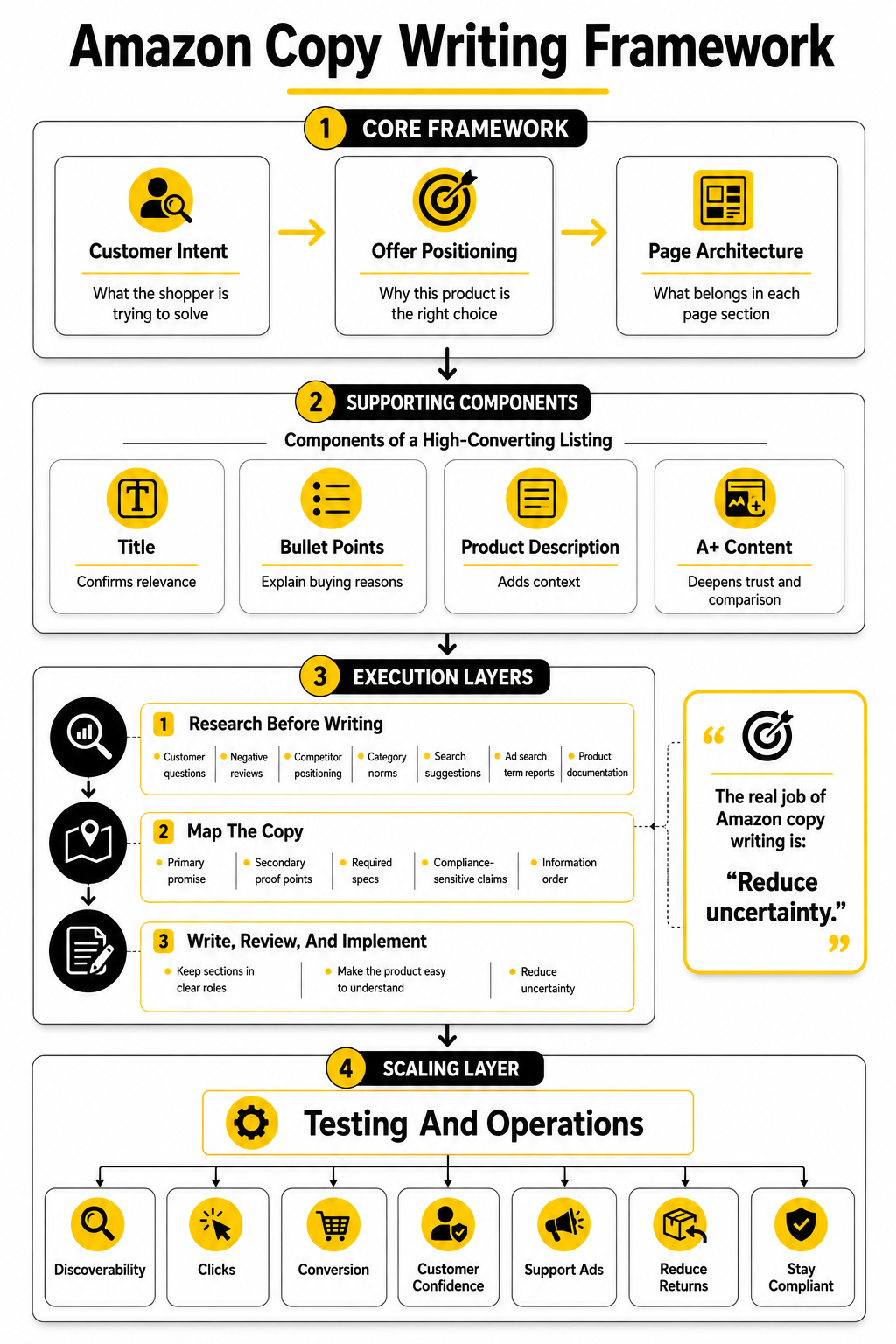
The real job of Amazon copy is to reduce uncertainty. Shoppers want to know whether the product fits their use case, whether it is compatible with what they already own, whether the size or material is right, whether the claim is believable, and whether there is a better option one click away. Copy has to answer those questions before doubt wins.
That does not mean every bullet point should be overloaded with detail. It means every section should have a clear role. The title should confirm relevance, the images should prove the promise visually, the bullets should explain the buying reasons, the description should add context, and A+ Content should deepen trust and comparison.
The strongest listings feel easy to scan because the seller has already done the thinking for the shopper. Important information appears where the shopper expects it. Benefits are connected to real product attributes, and the language stays specific enough to be useful without drifting into hype.
The Amazon Copy Writing Framework
A practical Amazon copy writing framework starts with customer intent, not with keywords. Keywords tell you what shoppers type, but intent tells you what they are trying to solve. Two customers can search for the same phrase and need different reassurance, depending on whether they care most about price, quality, compatibility, durability, ingredients, dimensions, design, or speed of delivery.
The second layer is offer positioning. This is where you define what makes the product the right choice in its category, without making claims you cannot support. On Amazon, vague superiority claims are weak because shoppers can immediately compare reviews, images, prices, specs, and competing listings.
The third layer is page architecture. That means deciding what the title must carry, what each bullet must prove, what the images should show, what belongs in A+ Content, and what should be left out because it creates clutter. This is where Amazon copy writing becomes more like conversion strategy than simple writing.
Core Components Of A High-Converting Listing
The title is the first copy asset most shoppers see, and it has to work in search results, ads, and the product page itself. A good title usually clarifies the brand, product type, defining feature, key use case, and important variant information. It should not read like a keyword dump, because unreadable titles can reduce trust before the shopper even opens the page.
Bullet points carry the main sales argument. Each bullet should focus on a distinct buying reason, such as performance, fit, materials, ease of use, compatibility, care, or what is included. When bullets repeat the same idea in slightly different words, the listing feels thin, even if it looks full.
The product description and A+ Content carry the deeper explanation. Amazon’s A+ Content tools allow brand-registered sellers to use enhanced images, comparison charts, and richer product storytelling, and Amazon describes A+ Content as a way to boost conversion and increase sales. This is where brands can move beyond basic features and help shoppers understand the product in context.
Professional Implementation
Professional Amazon copy writing starts with research before writing. That includes reviewing customer questions, negative reviews, competitor positioning, category norms, Amazon search suggestions, ad search term reports, and product documentation. The goal is not to copy competitors; it is to understand what shoppers already care about and where existing listings fail to explain the product clearly.
From there, the copy should be mapped before it is written. Decide the primary promise, secondary proof points, required specs, compliance-sensitive claims, and the order in which a shopper needs to see information. This prevents the common problem where every bullet tries to say everything and the page loses its argument.
Finally, implementation should be connected to testing and operations. If a brand is driving Amazon traffic from external funnels, email, SMS, or social, tools like ManyChat can support conversational follow-up, while landing page builders like Replo can help shape off-Amazon education before the shopper reaches the marketplace. Those tools do not replace Amazon copy, but they can support the broader conversion path when the offer needs more context than a product detail page alone can provide.
Amazon Search Intent And Keyword Strategy
Amazon search intent is the reason behind the words a shopper types into the search bar. A phrase like “stainless steel lunch box” is not just a keyword. It carries expectations about material, size, leak resistance, compartments, portability, cleaning, and probably whether the product is for adults, kids, meal prep, or work.
This is where Amazon copy writing becomes more strategic than simply placing keywords in a listing. The keyword gives you the entry point, but intent tells you what the shopper needs to believe before they buy. If the listing only repeats the phrase and never answers the buying question behind it, the copy is technically optimized but commercially weak.
The goal is to build a listing that feels relevant from the first scan. That means the main keyword should appear naturally where it helps clarity, while secondary phrases support specific shopper needs. You are not writing for a spreadsheet of keywords; you are writing for a person comparing options quickly.
Start With The Shopper’s Buying Situation
Before writing, identify the buying situation behind the keyword. Is the shopper replacing something broken, solving a recurring frustration, buying a gift, upgrading to a better version, stocking up, or comparing a new category for the first time? Each situation changes what the copy needs to emphasize.
A replacement buyer often cares about compatibility, measurements, materials, and whether the new product will avoid the same problem as the old one. A first-time buyer needs more education and reassurance because they may not know what details matter yet. A gift buyer needs confidence that the product feels presentable, easy to understand, and suitable for the recipient.
This is why two listings can target the same keyword but need different messaging. One product may win by being the premium choice, another by being simple and affordable, and another by solving one very specific use case better than everyone else. Strong Amazon copy writing makes that buying situation visible without overexplaining it.
Build A Keyword Map Before You Write
A keyword map is a simple planning document that tells you where each phrase belongs in the listing. It prevents the title, bullets, description, and A+ Content from fighting each other. More importantly, it helps you avoid repeating the same keyword awkwardly because every term has a job.
Start by separating keywords into four groups: primary terms, feature terms, use-case terms, and audience terms. The primary term usually belongs in the title because it defines the product. Feature terms often fit naturally in bullets, while use-case and audience terms can work in bullets, image copy, description, or A+ Content.
This mapping step matters because Amazon listings have limited attention, even when the page technically has room for more text. If every field tries to rank for everything, the listing becomes harder to read. A clean keyword map keeps the copy focused while still covering the language shoppers use.
Match Keywords To Page Sections
The title should carry the clearest product identity. It is usually the right place for the brand, product type, key differentiator, important variant details, and one or two major search terms when they fit naturally. It should not carry every keyword variation, because that makes the listing look lower quality and harder to trust.
Bullet points should translate keyword research into buying reasons. For example, if shoppers search around durability, cleaning, sizing, or compatibility, those themes should become useful bullet content instead of being dropped into the copy as isolated phrases. A bullet should make the shopper more carefully about the product, not just signal relevance to Amazon.
The description and A+ Content can support broader context. This is useful for explaining how the product is used, who it is best for, what makes it different from similar products, and what details shoppers should check before ordering. When done well, these sections reduce returns because the customer understands the product before buying.
Separate Search Terms From Sales Arguments
Not every keyword deserves visible space in the listing. Some phrases are useful as backend search terms, some are better implied through clear product language, and some should be ignored because they attract the wrong shopper. Chasing every variation can bring traffic that does not convert, which is not a win.
A sales argument is different from a search term. “Leakproof lunch container” may be a search term, but the sales argument is why the seal works, what it prevents, and when that matters. “Travel makeup bag” may be a search term, but the sales argument is organization, portability, material quality, and whether it fits the buyer’s routine.
This distinction keeps the copy human. The shopper does not need to see the same phrase five times to understand relevance. They need enough specific detail to feel confident that the product fits what they came to find.
Use Competitor Research Without Copying Competitors
Competitor research is useful, but only when you look beyond surface-level phrasing. Do not just collect the words competitors use in their titles and bullets. Look at what their reviews complain about, what their questions reveal, what their images fail to explain, and what their positioning leaves open.
Negative reviews are especially valuable because they show where expectations were not met. If customers complain about size, setup, smell, durability, compatibility, or confusing instructions, your copy should address those concerns clearly if your product genuinely solves them. This is not about attacking competitors; it is about closing information gaps.
Customer questions are just as useful. They often reveal the doubts shoppers have right before purchase. If several people ask whether a product fits a certain model, works in a certain setting, or includes a specific accessory, that information should be easy to find in the listing.
Prioritize Relevance Over Keyword Volume
High-volume keywords are tempting, but relevance matters more. A broad term may bring more impressions, but if the product does not match the shopper’s expectation, those impressions can turn into weak click-through, poor conversion, and wasted ad spend. Amazon copy writing should help the product attract the right traffic, not just more traffic.
This is especially important when running Sponsored Products campaigns. Paid clicks can expose weak copy quickly because the listing has to convert shoppers who may be comparing several options in the same session. If the keyword promises one thing and the listing explains another, the campaign will usually expose that mismatch.
A tighter keyword strategy often performs better because it lines up search, click, and purchase intent. The copy feels more relevant, the shopper feels less friction, and the product page has a clearer reason to exist. That is the point of keyword work: not just ranking, but matching the right buyer with the right offer.
Write For Mobile Scanning
Amazon shoppers often scan fast, especially on mobile. That means the first few words of a title and each bullet carry extra weight. If the copy buries the strongest information at the end of long sentences, many shoppers will never see it.
Mobile-friendly Amazon copy uses clear sequencing. Put the most useful benefit or product detail early, then support it with proof or context. Avoid filler openings like “High quality product designed to” because they waste the strongest real estate on words that do not help the shopper decide.
This does not mean every sentence should be short or blunt. It means each sentence should earn its place. Good mobile copy feels easy to skim, but it still gives enough substance for a serious buyer to make a decision.
Avoid Keyword Stuffing
Keyword stuffing makes a listing sound desperate. It creates sentences that technically contain search terms but do not help anyone understand the product. Worse, it can make the brand look less credible in a marketplace where trust is already fragile.
A better approach is semantic coverage. Use natural variations, related phrases, and concrete product details that support the same intent. For example, a listing does not need to repeat “Amazon copy writing” mechanically to be relevant to that topic; it can discuss product titles, bullets, search intent, listing optimization, A+ Content, and conversion messaging in a way that naturally covers the subject.
The same principle applies to product listings. If the product is genuinely relevant, the language should make that relevance obvious without forcing it. Clear, specific copy usually beats repetition because shoppers reward understanding, not keyword density.
Turn Keyword Research Into A Message Hierarchy
Once the keyword map is finished, turn it into a message hierarchy. This is the ordered list of what the shopper needs to understand first, second, third, and fourth. It helps you decide which ideas belong in the title, which belong in the first two bullets, and which can wait for the lower page sections.
The hierarchy should start with the product’s clearest identity. Then it should move into the strongest buying reason, the most important proof point, and the biggest objection the shopper may have. This creates a natural flow instead of a pile of disconnected features.
A simple hierarchy might look like this:
That structure keeps the listing grounded. It makes the copy easier to write, easier to review, and easier to improve later when performance data starts coming in.
Product Titles, Bullets, And Descriptions
Once the keyword strategy is clear, the next job is execution. This is where Amazon copy writing becomes visible on the page, and it is also where many listings fall apart. A seller may have strong research, a good product, and a real positioning angle, but if the title, bullets, and description do not work together, shoppers still have to do too much mental work.
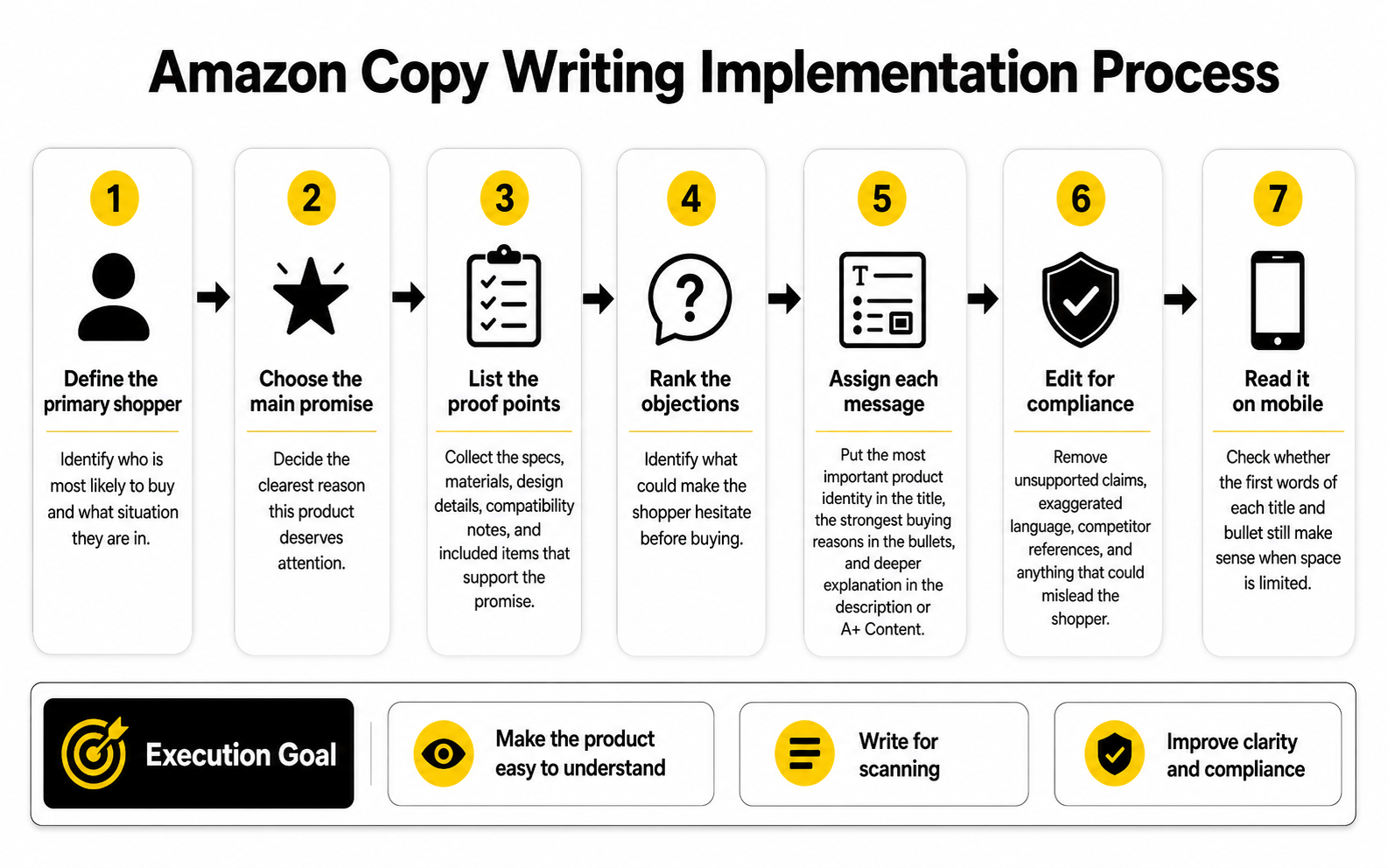
The implementation process should be simple: define the message hierarchy, assign each message to the right page element, write for scanning, then edit for clarity and compliance. Do not start by trying to make the copy sound exciting. Start by making the product easy to understand.
Amazon’s own title requirements now push sellers toward cleaner, more disciplined writing, with most categories limited to titles of 200 characters, restrictions on certain special characters, and rules against repeating the same word more than twice outside common exceptions. That matters because the title is not just a search field. It is often the first promise the shopper sees.
Write The Title Like A Buying Filter
The title should help the right shopper recognize the product quickly. It should answer the basic question first: what is this, and is it the version I need? If the title makes the shopper pause, decode, or reread, it is already creating friction.
A useful title usually includes the brand, the product type, the most important differentiator, and the key variant details that affect the buying decision. Depending on the category, that may include size, quantity, material, color, compatibility, scent, flavor, pack count, or intended use. The point is not to include everything; the point is to include what changes whether the product is relevant.
Avoid treating the title as a storage box for keywords. A keyword-heavy title can still fail if it does not read like a real product name. Clear titles protect trust, support ads, and make the product easier to compare in crowded search results.
Use A Step-By-Step Listing Build
A clean implementation process keeps the listing from becoming a collection of random claims. Start with the buying argument, then build each listing element around a specific job. This makes the finished page easier to write, easier to review, and easier to improve later.
Use this process before writing the final copy:
This is the practical difference between writing and assembling. You are not just creating nice sentences. You are deciding where each piece of information should appear so the shopper gets the right answer at the right moment.
Make The First Bullet Carry The Core Benefit
The first bullet should not waste time. It should explain the product’s strongest buying reason in plain language and connect that benefit to a real feature. If the first bullet says something generic like “premium quality design,” the listing gives away one of its most valuable positions.
A better first bullet starts with what the shopper actually wants. That might be a better fit, faster setup, easier cleaning, safer storage, stronger durability, clearer organization, or more reliable compatibility. Then it should explain why the product can deliver that result.
This is where specificity matters. “Durable construction” is weaker than explaining the material, thickness, coating, reinforcement, or tested use condition when that information is accurate. Amazon copy writing works best when the benefit and the proof sit close together.
Give Every Bullet A Different Job
Each bullet should cover a distinct part of the buying decision. If all five bullets say the product is high quality, convenient, and easy to use, the listing feels padded. Shoppers notice that, even if they do not consciously name it.
A strong bullet structure often follows this order:
This order is not a universal law. Some categories need compatibility earlier, especially electronics, parts, accessories, and replacement items. The real rule is simple: put the shopper’s biggest decision points where they can see them before doubt builds.
Turn Features Into Useful Benefits
A feature is what the product has. A benefit is why that feature matters to the buyer. Good Amazon copy connects both without sounding like a motivational poster.
For example, a material feature only matters when the shopper understands what it changes. Stainless steel may suggest durability, easy cleaning, or resistance to staining, depending on the product. A compact size may suggest portability, easier storage, or better fit for small spaces.
Do not overpromise. If the feature supports a modest benefit, keep the benefit modest. Trust grows when the copy feels accurate, and trust disappears fast when the language sounds bigger than the product can prove.
Handle Objections Before They Become Questions
Shoppers do not always ask questions out loud. They hesitate, scroll, compare, and leave. The listing’s job is to answer the obvious objections before the shopper has to dig for them.
Common objections include size, fit, setup, cleaning, durability, smell, ingredients, compatibility, packaging, warranty, and what is included in the box. If reviews or customer questions show repeated uncertainty around one of these points, the copy should address it clearly. Do not hide critical details in the bottom of the description when they affect purchase confidence.
This is especially important for products where returns are driven by expectation mismatch. If the item is smaller than shoppers may assume, say the dimensions clearly. If it works only with specific models, state that plainly. Clarity may reduce the wrong clicks, but it can protect the right sale.
Write Product Descriptions For Context
The product description should not simply repeat the bullets in paragraph form. It should add context that helps the shopper understand the product more fully. This is a good place to explain the use case, the design logic, the setup flow, or the type of customer the product is best suited for.
A useful description can also smooth out details that feel too dense for bullet points. For example, care instructions, included components, fit guidance, and usage notes can sit naturally in the description when they need more explanation. The goal is not to make the description long; the goal is to make it helpful.
For brands using external education before sending shoppers to Amazon, the same principle applies. A pre-sell page built with a tool like Replo can explain a complex offer before the shopper reaches the marketplace, while the Amazon description should still stand on its own for shoppers who discover the product directly.
Keep Claims Accurate And Defensible
Amazon copy should be confident, but it should not make claims the brand cannot support. Words like best, safest, guaranteed, medical-grade, non-toxic, eco-friendly, clinically proven, or number one can create problems if they are not properly substantiated. Even when a claim feels harmless, it can trigger review issues or customer distrust if the product page does not support it.
Use concrete product facts whenever possible. Materials, dimensions, quantities, compatibility details, included accessories, usage instructions, and care requirements are usually more useful than vague superiority language. Specifics help shoppers compare, and comparison is exactly what they are doing.
This is also why copywriters need product documentation before writing. Guessing creates weak copy and compliance risk. A professional Amazon copy writing process should always include a fact check against product specs, packaging, certifications, and the seller’s internal documentation.
Edit For Scanning, Not Just Grammar
The final edit should focus on how the listing reads in the real Amazon environment. Shoppers are not reading it like a blog post. They are scanning against competitors, images, price, reviews, delivery timing, and their own doubts.
Start each bullet with the clearest idea, then add support. Cut filler words that do not help the decision. Replace broad claims with concrete details, and remove repeated ideas that make the listing feel bloated.
A good final check is to read only the title and the first phrase of each bullet. If that skim tells a coherent story, the listing is probably structured well. If it feels like five disconnected fragments, the copy needs another pass before it goes live.
A+ Content, Brand Story, And Visual Messaging
After the title, bullets, and description are in place, the listing needs a second layer of persuasion. This is where A+ Content, Brand Story, images, comparison modules, and performance data start working together. The goal is not to make the page look prettier; the goal is to make the product easier to trust and easier to choose.
Amazon says A+ Content can use enhanced images, video, and richer listing modules to help boost conversion and increase sales through stronger product detail pages. That does not mean every A+ module automatically improves performance. It means the space gives you more room to explain the product visually, handle objections, and make comparison easier when plain bullets are not enough.
Good Amazon copy writing treats A+ Content as a sales support system. The title and bullets answer the fast questions. A+ Content answers the deeper questions that show up after the shopper starts comparing.
Statistics And Data
Data only matters when it changes what you do next. A random benchmark does not improve a listing. A clear performance signal does, because it tells you whether the problem is visibility, click quality, conversion, pricing, offer strength, creative clarity, or expectation mismatch.
Amazon Brand Analytics gives brand-registered sellers access to dashboards such as Search Query Performance, where sellers can review query volume, impressions, clicks, cart adds, and purchases for the keywords customers use to find their brand. That matters because it turns keyword strategy into a funnel instead of a guess. You can see where shoppers are dropping off and decide whether the copy needs to attract more clicks, convert more of the existing traffic, or clarify the offer before the cart-add stage.
A useful analytics review should separate the funnel into four questions:
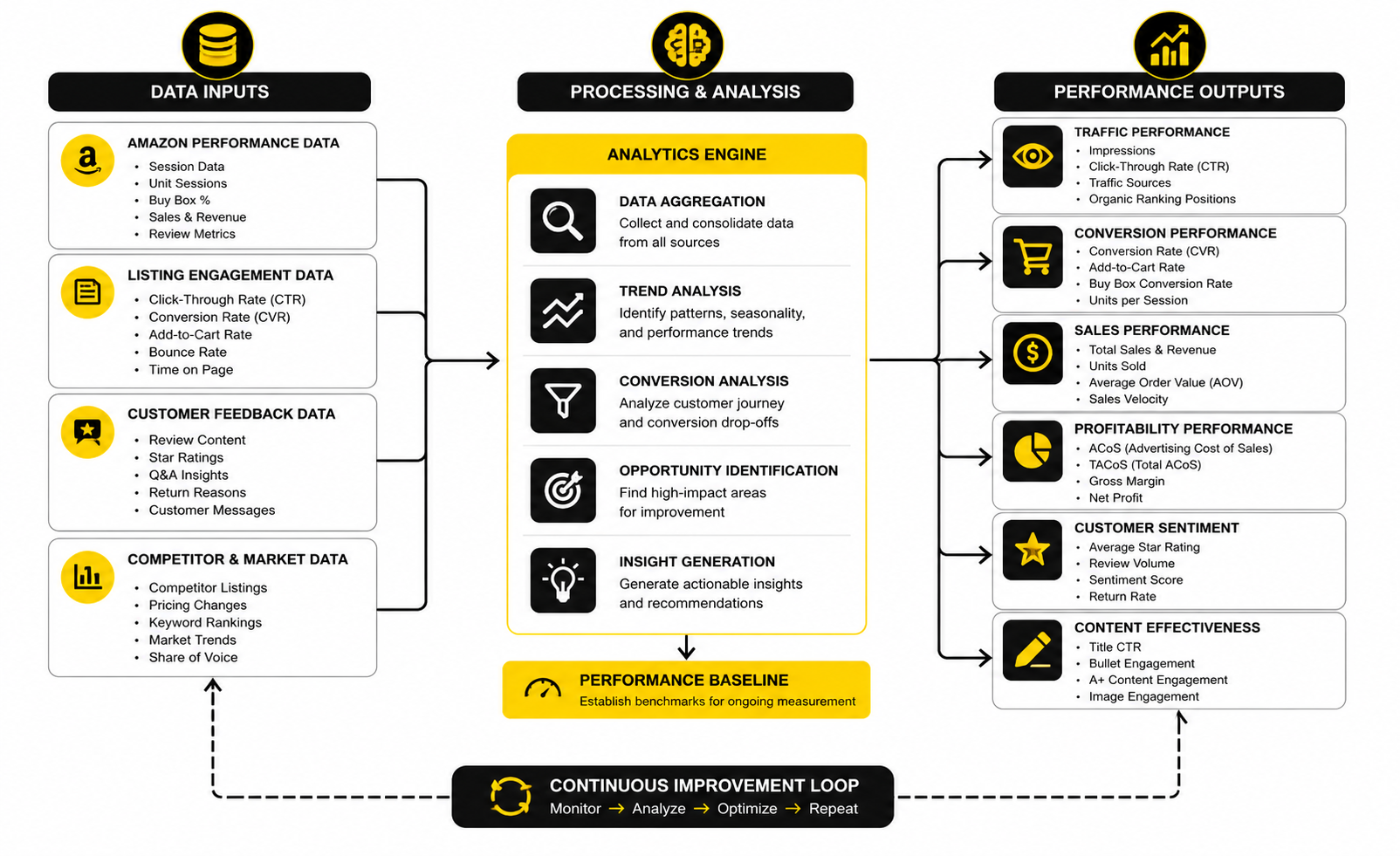
The action depends on where the drop happens. If impressions are low for a relevant term, the listing may need stronger keyword alignment, better indexing support, or more ad coverage. If impressions are strong but clicks are weak, the issue may be the title, main image, price, review count, rating, coupon, or visible offer. If clicks are strong but purchases are weak, the problem is usually deeper on the page: bullets, images, A+ Content, comparison clarity, missing specs, weak proof, or a mismatch between the search promise and the product.
This is the difference between measurement and reporting. Reporting says, “conversion is down.” Measurement asks, “where did the shopper lose confidence, and what should we change first?”
Read Search Query Performance Like A Funnel
Search Query Performance is useful because it connects shopper language to behavior. It does not just tell you that a keyword exists. It shows how that query performs across the buying path, from impressions to clicks to cart adds to purchases.
If a query has strong impressions but weak clicks, the shopper may not see the product as relevant in the search results. That can point to a title problem, a weak hero image, an uncompetitive offer, or a mismatch between the keyword and the product. In that situation, rewriting the A+ Content first would be the wrong move because shoppers are not reaching it often enough.
If a query has decent clicks but weak purchases, the listing is getting a chance and not closing it. That is where Amazon copy writing should focus on the product detail page itself. The bullets may need sharper proof, the images may need clearer use-case demonstrations, or the A+ Content may need to answer the objections that are stopping the sale.
Use Click-Through Rate To Diagnose The Front Door
Click-through rate is a front-door metric. It tells you whether the product looks worth opening when shoppers see it in search results, ads, or other placements. It is heavily influenced by the title, main image, price, rating, review count, Prime eligibility, coupon visibility, and the competitive set around the listing.
Copy can influence click-through rate, but it does not control it alone. A clearer title can help the right buyer recognize the product faster. A cleaner title can also stop the listing from looking spammy in a category where trust matters.
Do not overreact to one short window of click-through data. Seasonality, ad placement, price changes, promotions, competitor coupons, and search mix can all change the number. Look for repeated patterns across relevant queries before deciding the copy is the main issue.
Use Conversion Rate To Diagnose The Detail Page
Conversion rate tells you what happens after the shopper gives the listing a chance. If traffic is relevant and conversion is weak, the detail page probably is not answering the buying decision well enough. This is where bullets, secondary images, A+ Content, comparison tables, and product descriptions become more important.
Amazon’s Manage Your Experiments tool exists because listing content can be tested instead of guessed. Amazon describes it as a way to A/B test product detail page content and identify what drives more sales, with experiments available for elements such as titles, images, A+ Content, and Brand Story depending on eligibility. That is important because opinions about copy are cheap; controlled tests are more useful.
The right test depends on the problem. If shoppers are not clicking from search, test the title or main image when eligible. If shoppers click but do not buy, test image sequencing, A+ modules, comparison content, or the way bullets communicate proof.
Watch Cart Adds For Mid-Funnel Friction
Cart adds sit between interest and purchase. They can show that shoppers like the product enough to consider it but still may not be fully convinced. When cart adds are healthy but purchases lag, the issue may be price, delivery promise, coupon timing, review confidence, stock availability, or final comparison behavior.
Copy still matters here because it shapes expectation and confidence. A listing that creates excitement but leaves practical questions unanswered may earn clicks and cart adds, then lose shoppers before purchase. The buyer gets close, then checks competitors for the missing information.
This is why the lower page should not be treated as decoration. A comparison chart, compatibility table, size guide, care section, or clearer “what’s included” module can remove the last doubt. The best A+ Content often feels boring to the seller and extremely useful to the buyer.
Turn Reviews And Questions Into Copy Signals
Reviews and customer questions are qualitative analytics. They show the language shoppers use after experiencing the product or while hesitating before buying. That makes them one of the most useful sources for improving Amazon copy writing.
Positive reviews reveal what customers value most after purchase. If customers keep praising ease of cleaning, sturdiness, packaging, fit, flavor, comfort, or setup, those themes may deserve more visibility in the listing. The point is not to copy customer phrasing word for word; it is to understand what actually lands.
Negative reviews reveal expectation gaps. If complaints repeat around size, compatibility, color, installation, scent, durability, or missing parts, the copy should either correct the expectation or stop attracting the wrong buyer. Sometimes the best conversion improvement is not making the page more persuasive; it is making the page more honest.
Do Not Chase Benchmarks Blindly
Benchmarks are useful for context, but they can become dangerous when sellers treat them as universal goals. A high-consideration product, a low-priced impulse item, a replenishable consumable, and a technical replacement part will not behave the same way. The customer’s decision process is different, so the data will be different.
Instead of asking whether a number is “good,” ask whether it is improving for the right traffic. A conversion rate can rise because the copy became better, but it can also rise because the listing stopped attracting broad shoppers and started attracting qualified ones. That may be a very good outcome if profit and sales quality improve.
The cleanest benchmark is your own baseline. Measure the listing before changes, document what changed, and compare performance after enough traffic has passed through the page. Amazon’s testing tools can help when the ASIN has enough traffic, but even without a formal experiment, disciplined before-and-after tracking is better than random optimization.
Build A Listing Measurement Routine
A professional measurement routine does not need to be complicated. It needs to be consistent. Review the same metrics on the same cadence, compare them against the same baseline, and write down what changed so you do not confuse copy impact with pricing, inventory, ad spend, or seasonality.
A practical routine can look like this:
This keeps optimization grounded. You are not rewriting because you are bored with the listing. You are improving the page because the data shows a specific friction point.
Connect Amazon Metrics To The Wider Funnel
Amazon does not always show the full story of how a shopper discovered the product. External content, influencer campaigns, email, SMS, social posts, and landing pages can all shape demand before the shopper reaches Amazon. That is why brands running off-Amazon traffic need to connect listing analytics with the broader customer journey.
If a campaign educates shoppers before the click, the Amazon listing may convert differently than cold search traffic. A landing page, quiz, or guided product selector can pre-answer objections before Amazon ever sees the session. Tools like Guideless or Fillout can help structure that kind of guided decision path when the product needs more education than a standard product detail page can carry.
Still, the Amazon listing has to stand on its own. External funnels can warm up the buyer, but they cannot rescue a confusing product page forever. The strongest system is simple: use external touchpoints to create qualified demand, then use Amazon copy, visuals, and proof to convert that demand with as little friction as possible.
PPC, Testing, And Conversion Optimization
At this stage, the listing has a clear keyword strategy, a structured product page, and a measurement system. The next layer is more advanced: deciding what to change, when to test it, and how to avoid breaking what already works. This is where Amazon copy writing moves from one-time setup into ongoing revenue optimization.
Most sellers do this backwards. They rewrite the listing when sales drop, change too many things at once, and then blame the wrong variable when performance moves. A professional approach is calmer: isolate the bottleneck, make one meaningful change, let the data collect, and only then decide whether the new direction deserves a broader rollout.
That discipline matters because Amazon is not a static environment. Competitors change prices, ads shift placement, reviews accumulate, seasonality moves demand, and Amazon updates marketplace rules. A listing that worked six months ago may still be structurally good, but the market around it may have changed.
Make PPC And Copy Work Together
Amazon PPC does not operate separately from listing copy. Ads create exposure, but the listing still has to earn the click and close the sale. If the copy does not match the search term that triggered the ad, the campaign can spend money while teaching the wrong shoppers to ignore the product.
The cleanest PPC and copy alignment starts with search term intent. When a paid search term converts well, it may deserve stronger visibility in the title, bullets, images, or A+ Content if it accurately represents the product. When a search term gets clicks but no sales, the listing may either be underexplaining that use case or attracting shoppers who are not a good fit.
This is where restraint matters. Do not jam every converting ad term into the title. Use ad data to understand what real buyers respond to, then translate that insight into clearer messaging across the listing.
Know When Not To Optimize
Not every performance change means the copy needs to be rewritten. A conversion dip can come from a price increase, a competitor coupon, a review rating change, out-of-stock issues, delivery delays, ad mix shifts, or seasonal demand. If you edit the copy every time the number moves, you create noise and lose the ability to learn.
Before changing copy, check whether the traffic quality changed. If ads expanded into broader terms, conversion may fall even if the listing is still strong for core buyers. If a promotion ended, the offer may look less competitive even though the messaging is clear.
Good optimization starts with diagnosis. Ask what changed around the listing before changing the listing itself. That one habit saves a lot of unnecessary rewrites.
Test One Big Idea At A Time
A good test is not “old listing versus completely new listing.” That kind of test may produce a winner, but it does not tell you why it won. Better testing isolates one major idea, such as a clearer title angle, a stronger first bullet, a different hero image message, or a new A+ comparison structure.
The test should connect to a specific hypothesis. For example, if shoppers click but do not buy, the hypothesis might be that the listing does not make compatibility clear enough. If shoppers see the product but do not click, the hypothesis might be that the title fails to communicate the main differentiator quickly.
This is how you avoid random optimization. You are not testing because testing sounds sophisticated. You are testing because a specific performance signal points to a specific friction point.
Balance SEO And Conversion
There is always a tradeoff between search coverage and readability. More keyword coverage can help the product appear for more terms, but too much visible keyword pressure can make the listing harder to trust. The best Amazon copy writing balances both without making the shopper feel like they are reading a search engine document.
The title usually carries the most pressure in this tradeoff. Sellers want it to rank, but shoppers need it to read clearly. A title that includes the product type, key differentiator, and critical variant information can still be search-aware without becoming a keyword pile.
The same principle applies to bullets. A bullet can include useful search language while still making a real point. If the keyword does not fit inside a helpful sentence, it probably belongs somewhere else or not at all.
Build For Category Expectations
Every category has its own decision pattern. Beauty shoppers may care about ingredients, texture, scent, skin type, and routine fit. Electronics shoppers may care about compatibility, specs, warranty, setup, and included accessories. Home shoppers may care about dimensions, material, style, assembly, and cleaning.
That means the same copy formula will not work across every product. The structure can stay consistent, but the message hierarchy has to adapt to the category. If the buyer’s biggest fear is fit, fit comes early. If the buyer’s biggest fear is safety, proof and compliance language need more weight.
This is where expert-level copy starts to separate itself. It does not just sound polished. It understands the category’s buying anxiety and answers it before the shopper leaves.
Watch The Risk Of Over-Positioning
Positioning is powerful, but over-positioning can shrink the market too aggressively. If the listing frames the product around one narrow use case, it may convert that use case well while losing adjacent buyers who would have purchased with broader language. The decision depends on traffic quality, competitive pressure, and the product’s actual strengths.
For a crowded category, narrow positioning can be a strength because it gives shoppers a clear reason to choose the product. For a product with broad appeal, too much narrowing can reduce discoverability and make the item feel less versatile than it really is. The copy should be specific without boxing the product into an unnecessarily small corner.
A useful rule is to lead with the strongest use case, then support secondary use cases lower on the page. That keeps the main argument sharp while still giving other qualified shoppers a reason to stay.
Avoid Claim Inflation
As competition increases, sellers often respond by making bigger claims. They add words like ultimate, best, premium, professional-grade, unbeatable, or revolutionary. Most of the time, this does not make the listing stronger. It makes the product sound less believable.
Strong copy does not need inflated language when the proof is good. Materials, dimensions, performance details, compatibility notes, before-and-after context, and clear use cases usually do more work than hype. Shoppers trust specifics because specifics help them make a decision.
The risk is not only conversion. Unsupported claims can create compliance problems, customer dissatisfaction, and review friction. If the product cannot prove the claim, the copy should not make it.
Scale Copy Across A Catalog Without Making Everything Generic
Scaling Amazon copy across multiple ASINs is harder than writing one listing. The temptation is to create a template and fill in the blanks. That can save time, but it can also make every product sound the same, even when buyers care about different details.
A better system uses reusable structure, not reusable thinking. Keep the process consistent: intent research, keyword map, message hierarchy, title build, bullet roles, description context, A+ support, and measurement plan. Then customize the actual claims, objections, and proof points for each product.
This approach is slower than copy-pasting, but it scales better. It gives the brand a consistent voice while still making each listing feel specific to the product. That is the balance you want.
Create A Copy Governance System
As a catalog grows, copy governance becomes important. Someone needs to know which claims are approved, which certifications are valid, which specs are current, which words are risky, and which product details cannot be changed casually. Without governance, listings slowly become inconsistent.
A basic governance system can include:
This does not need to be overbuilt. Even a shared document is better than relying on memory. The goal is to keep speed from creating avoidable mistakes.
Use Automation Carefully
Automation can help with research, drafting, organization, and workflow, but it should not replace judgment. Amazon listings are too close to revenue, compliance, and customer expectation to publish generic AI-written copy without review. The tool can speed up the process, but the seller still owns the claim.
For broader marketing operations around Amazon, tools like GoHighLevel can support campaign follow-up, lead capture, and customer journey workflows outside the marketplace. For social planning and distribution, Buffer can help coordinate content that supports product education before shoppers search or click. Those systems are useful when they strengthen the funnel, not when they distract from fixing the actual listing.
The same rule applies to any workflow tool. Use it to remove friction, collect inputs, and keep execution consistent. Do not use it as a substitute for product knowledge, customer insight, or careful editing.
Think In Systems, Not Listing Tweaks
The strongest sellers do not treat Amazon copy as a one-off writing task. They treat it as part of a system that includes product positioning, keyword strategy, PPC, creative, reviews, pricing, inventory, and customer support. The copy is important, but it cannot carry a broken offer by itself.
This is the expert-level shift. Instead of asking, “How do we make this bullet sound better?” ask, “What does the shopper still not believe?” Instead of asking, “Can we add more keywords?” ask, “Are we attracting the buyers most likely to purchase and stay satisfied?”
That mindset produces better decisions. Sometimes the right move is a rewrite. Sometimes it is a new image, a clearer size chart, a price test, a better comparison module, a PPC cleanup, or a product improvement. Good Amazon copy writing makes the offer clearer, but the entire system has to support the promise.
Compliance, Workflow, Tools, And Final System
The final layer of Amazon copy writing is the operating system behind the listing. By this point, the product page should already have a clear strategy, strong page structure, useful A+ Content, and a measurement routine. What keeps that system working is compliance discipline, repeatable workflow, and a clear understanding of who owns each decision.
This matters because Amazon listings are not just marketing assets. They are live marketplace records that affect customer expectations, ad performance, reviews, returns, inventory movement, and brand trust. A sloppy workflow can turn one unsupported claim or outdated spec into a real business problem.
The goal is not to make the process bureaucratic. The goal is to make it reliable. When the product, claims, keywords, images, PPC, and analytics all connect, the listing becomes much easier to improve without creating unnecessary risk.
Keep Compliance Close To The Copy
Compliance should not be the final panic check before publishing. It should be part of the writing process from the start. If the copywriter does not know which claims are allowed, which certifications are documented, and which terms are risky in the category, the first draft can easily move in the wrong direction.
Amazon’s A+ Content guidance makes it clear that sellers should review content against A+ guidelines before submission to avoid rejection and publishing delays. Amazon’s 2025 title update also shows why title writing needs to be clean, concise, and controlled. These are not tiny formatting details; they shape what sellers can safely publish.
A professional process keeps proof close to the claim. If a listing says the product is organic, medical-grade, clinically tested, compostable, hypoallergenic, compatible with a specific model, or safe for a specific use, the team should know where that proof lives. If the proof is not available, the claim should not go live.
Build A Practical Amazon Copy Workflow
A strong workflow turns listing creation into a repeatable process instead of a rushed writing task. Start with the product brief, then move into customer research, keyword mapping, message hierarchy, page copy, visual messaging, compliance review, upload, and measurement. Each step should produce something useful for the next step.
The product brief should include facts, not hopes. It should capture the product’s materials, dimensions, variants, ingredients, compatibility, included items, warranty language, care instructions, certifications, restrictions, and known customer objections. This gives the copy a factual base and keeps the team from inventing details during the writing stage.
The workflow should also define who approves what. Marketing may own positioning, product may own specs, legal or compliance may own restricted claims, and marketplace operations may own final upload standards. Without clear ownership, small listing edits can become messy fast.
Use Tools To Support The System
Tools are useful when they make the workflow clearer, faster, or easier to measure. They are not useful when they create more disconnected work. For Amazon copy writing, the most important tools are usually the ones that help teams collect research, manage briefs, track experiments, coordinate external traffic, and document what changed.
Amazon’s own tools should come first where they apply. Brand Analytics helps sellers connect search behavior to impressions, clicks, cart adds, and purchases. Manage Your Experiments helps eligible sellers test listing elements such as titles, images, bullet points, descriptions, A+ Content, and Brand Story instead of guessing.
Outside Amazon, use tools only when they support a clear job. ManyChat can help with conversational follow-up around campaigns, Brevo can support email and customer communication, and GoHighLevel can help manage broader funnel workflows. The listing still has to convert on Amazon, but a stronger surrounding system can bring in better-prepared shoppers.
Create A Final Listing Quality Checklist
Before publishing or testing a listing, run a quality check that covers both persuasion and risk. This should not be complicated. A short checklist used consistently is more valuable than a long document nobody opens.
Use this final review before a listing goes live:
This checklist keeps the work grounded. It prevents the common mistake of judging copy by whether it sounds good in isolation. Amazon copy only matters if it helps the right shopper make a better buying decision.
What Is Amazon Copy Writing?
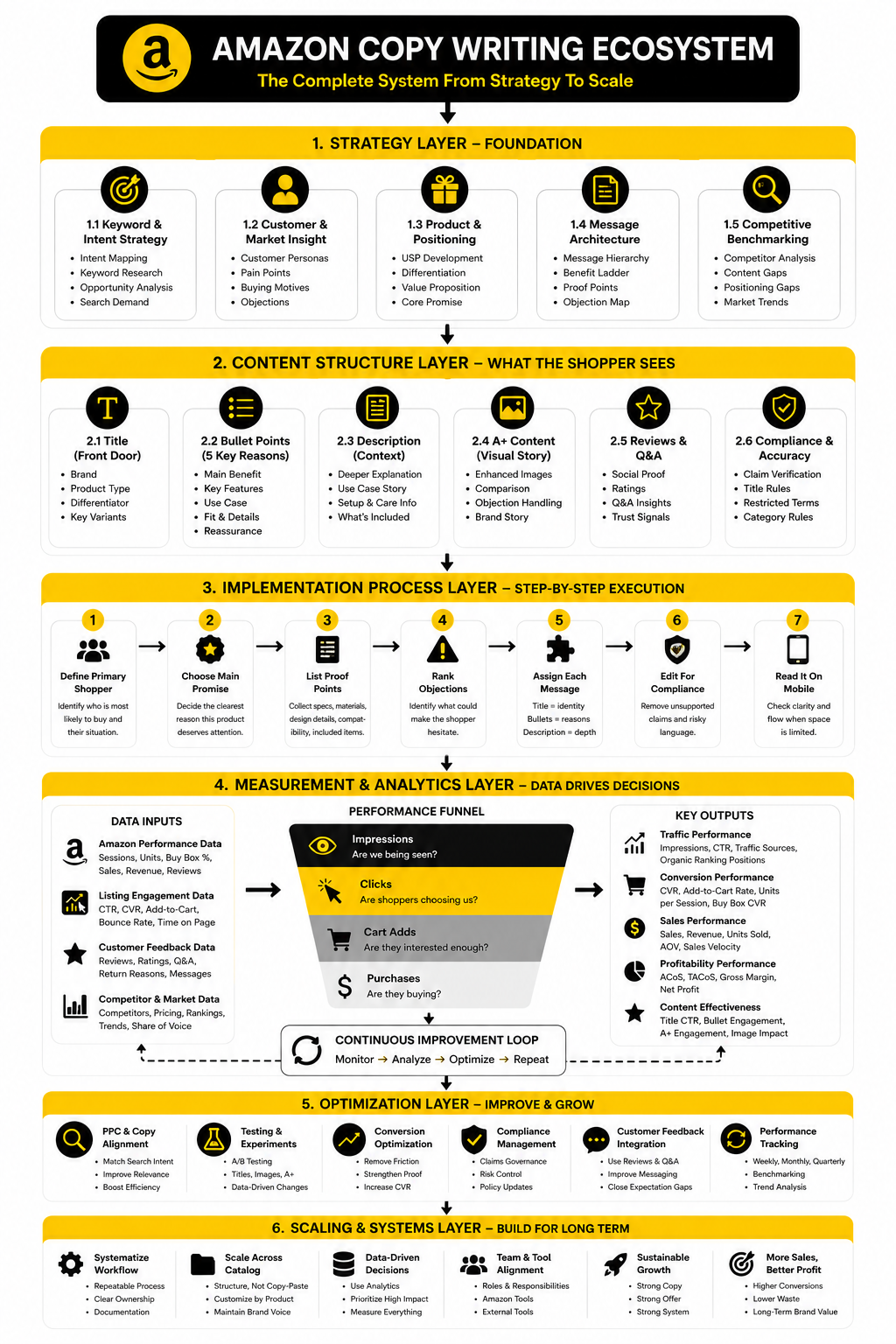
Amazon copy writing is the process of writing marketplace content that helps Amazon shoppers discover, understand, compare, and buy a product. It includes titles, bullet points, descriptions, A+ Content, Brand Story, comparison modules, and the messaging logic behind those assets. The best Amazon copy balances search relevance, shopper clarity, brand positioning, and compliance.
How Is Amazon Copy Writing Different From Normal Ecommerce Copywriting?
Normal ecommerce copywriting often gives brands more control over page layout, checkout flow, and customer journey. Amazon copy writing has to work inside Amazon’s marketplace rules, search behavior, ad placements, category norms, and product detail page structure. That means the copy has to be clear, compliant, and highly practical because shoppers can compare competitors immediately.
Does Amazon Copy Writing Help With SEO?
Yes, but not in the simplistic way many sellers think. Keywords help Amazon understand relevance, but keyword stuffing can damage readability and trust. Good Amazon copy uses search terms naturally while making the product easier for real shoppers to evaluate.
Where Should The Primary Keyword Go In An Amazon Listing?
The primary keyword usually belongs in the title when it accurately describes the product and fits naturally. It can also appear in bullets, description, A+ Content, and backend search terms where appropriate. The key is to place the keyword where it improves clarity, not where it makes the sentence sound forced.
How Long Should Amazon Bullet Points Be?
Amazon bullet points should be long enough to explain the buying reason clearly, but not so long that they become difficult to scan. Each bullet should have a distinct job, such as explaining the main benefit, proving a feature, clarifying use cases, handling fit, or building confidence. If a bullet repeats another bullet, it should be rewritten or removed.
What Makes A Good Amazon Product Title?
A good Amazon product title helps the right shopper identify the product quickly. It usually includes the brand, product type, important differentiator, and key variant details such as size, quantity, material, color, or compatibility. It should follow Amazon’s current title requirements and avoid looking like a keyword dump.
Is A+ Content Worth It?
A+ Content is worth it when the product needs visual explanation, comparison support, brand trust, or deeper education. It is especially useful for products where shoppers need to understand materials, use cases, size, compatibility, or differences between models. It is not automatically valuable if the modules only repeat the bullets with nicer design.
How Often Should Amazon Listings Be Updated?
Amazon listings should be updated when data shows a real reason to change them. Useful triggers include weak click-through rate, poor conversion from relevant traffic, repeated customer questions, recurring review complaints, outdated product details, new compliance requirements, or meaningful competitor shifts. Random rewrites create noise and make performance harder to understand.
Can AI Write Amazon Copy?
AI can help with drafts, research organization, message variations, and workflow speed, but it should not publish Amazon copy without human review. The final copy still needs product accuracy, category judgment, compliance awareness, and real customer insight. AI is a useful assistant, not the person responsible for the claim.
What Is The Biggest Amazon Copy Writing Mistake?
The biggest mistake is writing for keywords before writing for the buying decision. Sellers often collect search terms, push them into every field, and forget that shoppers still need a clear reason to choose the product. Better copy starts with intent, then uses keywords to support that intent naturally.
How Do You Measure Whether Amazon Copy Is Working?
Measure Amazon copy by looking at the full funnel, not just sales. Impressions show whether the product is being seen, clicks show whether shoppers are choosing to open it, cart adds show whether interest is building, and purchases show whether confidence is strong enough to buy. Reviews and customer questions add qualitative insight that numbers alone can miss.
Should Amazon Copy Be Persuasive Or Informational?
It should be both, but information comes first. Amazon shoppers are already close to purchase, so they need useful details that make the decision easier. Persuasion works best when it is built from clear benefits, specific proof, and honest expectation-setting.
What Role Do Images Play In Amazon Copy Writing?
Images carry a large part of the message because shoppers often scan visuals before reading every word. Image copy, callouts, comparison graphics, and lifestyle visuals should support the same promise as the title and bullets. When images and written copy disagree, the listing feels less trustworthy.
How Do You Scale Amazon Copy Across Many Products?
Scale the process, not the exact wording. Use the same workflow for research, keyword mapping, message hierarchy, compliance review, and measurement, but customize the actual copy for each product’s use case, proof points, and objections. This keeps the catalog consistent without making every listing sound generic.
Build a stronger local presence with BAAM AI
Turn your website, Google profile, social channels, and AI visibility into one growth engine
Most businesses do not need more random marketing activity. They need a consistent presence system that helps the right people find them, trust them, and take action. BAAM AI brings strategy, local SEO, website updates, Google Maps visibility, social content, AI-search readiness, media production, and reporting into one practical monthly engine.
If you want your marketing to keep working after the campaign ends, start with a free BAAM AI presence audit. See how your business shows up today and where the fastest visibility wins are at BAAM AI.