
BAAM AI Blog
Alan Sharpe Copywriter: What Modern Marketers Can Learn From His Direct Response Approach
Alan Sharpe copywriter is a useful keyword because it points to more than one thing at once. It points to Alan Sharpe the working B2B technology copywriter, Alan Sharpe the copywriting instructor, and Alan Sharpe the...
Alan Sharpe copywriter is a useful keyword because it points to more than one thing at once. It points to Alan Sharpe the working B2B technology copywriter, Alan Sharpe the copywriting instructor, and Alan Sharpe the old-school direct-response practitioner whose lessons still hold up in a noisy AI-driven marketing world.
That matters because copywriting has become dangerously easy to fake. Anyone can generate headlines, landing page sections, email sequences, and ad copy in seconds, but that does not mean the copy is clear, credible, or persuasive. Sharpe’s body of work is useful because it keeps pulling marketers back to fundamentals: know the buyer, make the message specific, prove the promise, and ask for action.
Alan Sharpe describes his current work as sales enablement copywriting for B2B technology teams, including follow-up email sequences, case studies, lead magnets, sales decks, battlecards, landing pages, and web pages through Sharpe Copy. His teaching profile also positions him as a veteran copywriter who has taught persuasive writing since 1989 through books, workshops, articles, webinars, and online courses on Udemy. So this guide is not about treating him like a celebrity copywriter. It is about extracting the practical framework behind the work.
Why Alan Sharpe Still Matters in Modern Copywriting
Alan Sharpe matters because his approach sits in the uncomfortable place where copy has to do real work. Not “sound good.” Not “fill a content calendar.” Real work means getting attention, holding attention, removing doubt, and moving a buyer closer to a decision.
That is especially relevant in B2B, where the buyer is usually not one person impulsively clicking a button. The buying process is slower, the risk is higher, and the copy has to support sales conversations long before a deal closes. Gartner’s research on the B2B buying journey shows that many buyers now prefer a rep-free experience, yet purely self-service buying can also create regret, which makes clear educational content and timely sales support more important, not less important: B2B buying journey research.
This is where Sharpe’s style is useful. His public positioning is not built around vague brand storytelling. It is built around pipeline support, lead nurturing, sales enablement, and copy that helps buyers understand why a product is relevant, different, and worth considering.
The Framework Overview
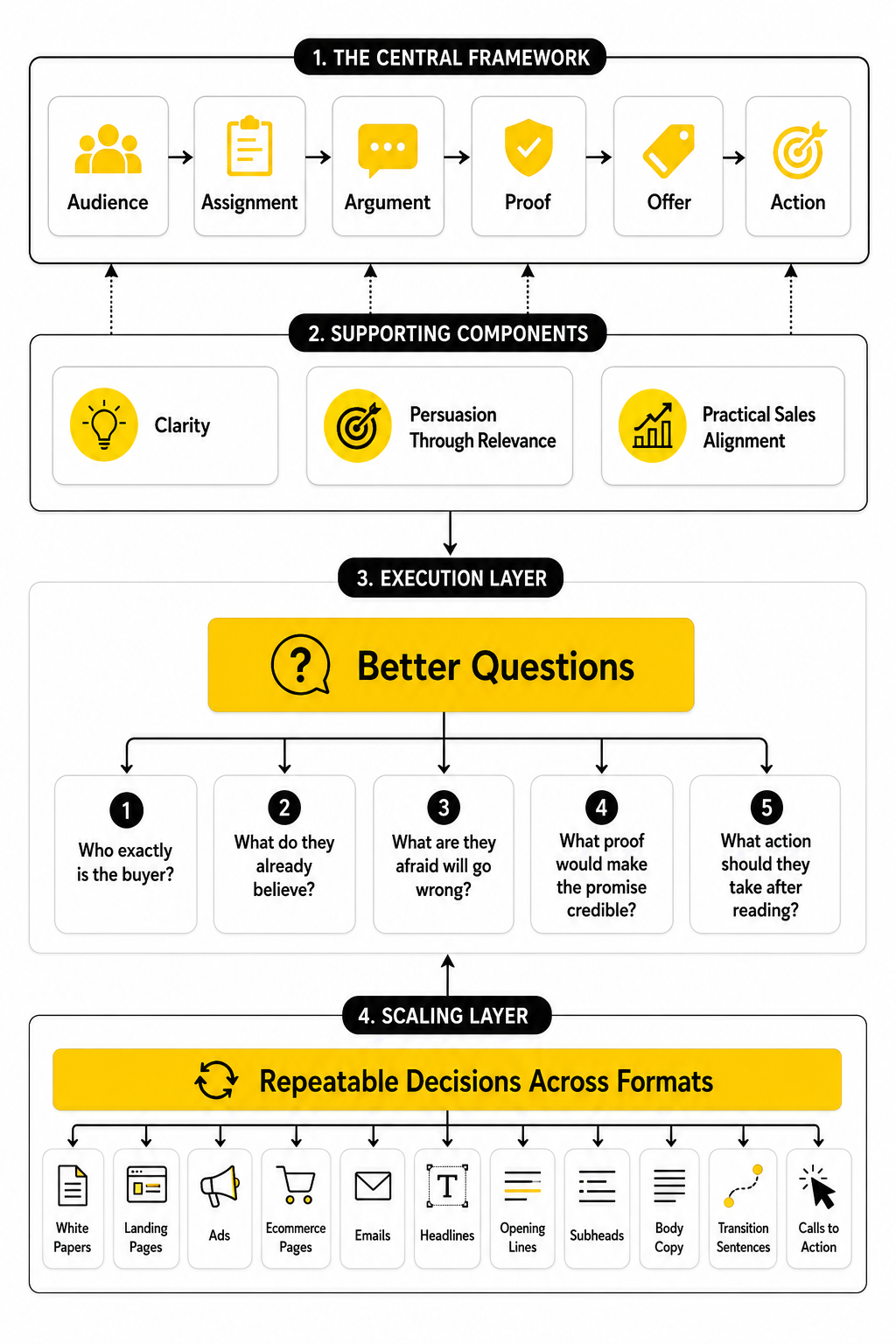
The useful way to study Alan Sharpe copywriter is not to copy his sentences. It is to study the operating system underneath them. That operating system can be reduced to a simple framework: audience, assignment, argument, proof, offer, and action.
Audience comes first because copy is never persuasive in the abstract. A landing page for a cybersecurity buyer, a donor appeal, and a SaaS follow-up email all need different levels of urgency, detail, proof, and tone. Sharpe’s own service positioning makes this clear by focusing on specific B2B technology categories such as martech, cybersecurity, cloud, eCommerce, MedTech, InsurTech, ERP, supply chain, and 3D CAD on his official about page.
Assignment comes next because a copywriter is not simply “writing copy.” A cold email has a different job from a case study. A landing page has a different job from a battlecard. A nurture sequence has a different job from a product page, and treating them all the same is how teams end up with generic copy that looks polished but does not move anyone.
Core Components of the Alan Sharpe Copywriting Approach
The first component is clarity. Buyers should not have to decode what the product is, who it is for, what problem it solves, or what happens next. Nielsen Norman Group’s classic eye-tracking research on the F-shaped reading pattern is a useful reminder that web visitors often scan before they commit, which makes strong headings, front-loaded meaning, and clear structure essential: F-shaped pattern research.
The second component is persuasion through relevance. Good copy does not pressure the reader before it earns the right to ask. It connects the reader’s problem to a specific outcome, then supports the claim with evidence, examples, objections handled, and a clear next step.
The third component is practical sales alignment. Sharpe’s current positioning as a sales enablement copywriter is important because it shows copy as part of the revenue process, not a decorative layer added after strategy is done. Content Marketing Institute’s B2B research continues to show how important content strategy, differentiation, and audience value are for modern B2B teams: B2B content marketing benchmarks.
Professional Implementation Starts With Better Questions
The practical lesson is simple: before you write better copy, ask better questions. Who exactly is the buyer? What do they already believe? What are they afraid will go wrong? What proof would make the promise credible? What action should they take after reading?
That question-led approach is one reason Alan Sharpe’s teaching is useful for beginners and experienced marketers alike. His course materials emphasize assignments such as white papers, landing pages, ads, ecommerce pages, emails, headlines, opening lines, subheads, body copy, transition sentences, and calls to action on his copywriting masterclass page. That range matters because professional copywriting is not one skill. It is a set of repeatable decisions across different formats.
The rest of this guide will unpack those decisions in order. First, we will look at Sharpe’s background and why his career path matters. Then we will break down the direct-response principles behind his work and turn them into a practical system you can apply to modern B2B copy.
The Alan Sharpe Copywriting Background
Alan Sharpe is best understood as a practitioner first and an instructor second. His current positioning is clear: he works as a sales enablement copywriter for B2B technology companies, writing follow-up email sequences and sales content that helps educate prospects, differentiate offers, and support pipeline movement through Sharpe Copy. That matters because his advice is not built only around theory or personal branding. It comes from the kind of copywriting where the message has to survive contact with skeptical buyers, busy sales teams, and real commercial pressure.
His teaching background also gives his work more weight. On Udemy, Sharpe describes himself as a veteran copywriter who has taught persuasive writing since 1989 through workshops, copywriting classes, seminars, webinars, trade journal articles, newsletters, blog posts, and books. That long teaching arc explains why his material tends to be structured, practical, and assignment-based. He is not just saying “write better copy.” He is breaking the craft into repeatable pieces.
The important part is the combination. Plenty of copywriters can write, and plenty of instructors can teach, but fewer have spent decades moving between client work, direct response, B2B writing, and copywriting education. That is why the phrase Alan Sharpe copywriter keeps showing up in searches from people who want a practical entry point into persuasive writing rather than another vague marketing philosophy.
From Offline Copy to Digital Content
Sharpe’s career is useful because it crosses the line between older direct-response copywriting and modern digital marketing. In one of his B2B content writing course descriptions, he says he wrote his first piece of content in 1988, before the internet and before content marketing became a formal category, then moved from offline to online, from print to digital, and from copy to content through his B2B content writing course. That shift is important because the tools changed, but the buyer’s mental process did not change nearly as much as marketers like to pretend.
Print ads, direct mail, brochures, sales letters, landing pages, email sequences, and lead magnets all live in different formats. But they still need a clear promise, a relevant audience, a reason to believe, and a next step. When you look at Sharpe’s background through that lens, the point is not nostalgia for old-school copywriting. The point is that old-school discipline can make modern campaigns much sharper.
This is especially relevant now because marketers have more channels than ever and less patience from buyers than ever. A weak message can be distributed across email, ads, social, landing pages, chatbots, and sales decks at scale, but scale only makes weak copy fail faster. Sharpe’s background is a reminder that copywriting is not channel management. It is thinking clearly before the channel ever gets involved.
Why His B2B Focus Changes the Conversation
A lot of copywriting advice online is built around consumer offers, creator products, ecommerce pages, and quick-conversion funnels. That world has its place, but B2B copy has a different rhythm. Buyers compare vendors, involve teams, justify decisions internally, and often need content that helps them build confidence long before they speak to sales.
Sharpe’s current service list reflects that reality. He offers lead follow-up email sequences, case studies, lead magnets, landing pages, sales decks, battlecards, and web pages for B2B technology companies through Sharpe Copy. Those are not random deliverables. They are the pieces that support a buying journey where prospects need education, proof, differentiation, and reassurance.
That is the practical reason his work is relevant for marketers, founders, consultants, and agencies. If you sell something complex, expensive, or trust-sensitive, you cannot rely only on clever hooks. You need copy that helps a real buyer understand the business case, reduce perceived risk, and explain the decision to other people.
Teaching the Building Blocks of Persuasion
Sharpe’s teaching is built around the parts of copy that working marketers actually touch every day. His copywriting masterclass covers headlines, opening lines, subheads, body copy, transition sentences, calls to action, product and service copy, lead generation copy, and lead cultivation copy through Alan Sharpe’s copywriting masterclass. That matters because copywriting is rarely one big dramatic act. Most of the work happens in small decisions that either keep the reader moving or lose them.
Headlines carry the first burden because they decide whether the reader gives the copy a chance. Openings have to make the reader feel understood quickly, not slowly. Subheads need to keep the argument moving, body copy has to develop the promise, and calls to action must make the next step feel obvious rather than awkward.
This is where beginners often get copywriting wrong. They look for magic phrases, swipe-file tricks, or formulas that promise conversion without thinking. Sharpe’s structure points in a better direction: learn the parts, understand the job of each part, and then assemble them into a message that fits the buyer and the assignment.
What Makes His Background Useful Today
The most useful thing about Sharpe’s background is not that he has been around for a long time. Longevity alone does not make someone worth studying. The useful thing is that his career connects direct-response discipline with modern B2B execution, which is exactly where many marketing teams struggle.
Modern teams often have tools, data, automation, and templates, but they still ship copy that sounds interchangeable. That is the gap Sharpe’s approach helps expose. Good copy is not just “content” and it is not just “words.” It is a structured sales argument written in the language of the buyer.
This is why studying Alan Sharpe as a copywriter is more useful than simply consuming another list of copywriting tips. His background shows the bigger pattern: write with a commercial purpose, respect the reader’s intelligence, structure the message carefully, and make every line earn its place. That sets up the next part of the article, where we can look more closely at the direct-response principles behind his work.
The Direct Response Principles Behind His Work
The strongest thread running through Alan Sharpe’s copywriting background is direct response. That does not mean every piece of copy has to be loud, aggressive, or packed with hype. It means the copy has a job, and the writer knows what response the reader should take after reading it.
That distinction matters. A brand paragraph can sound elegant and still do nothing. A direct-response paragraph has to move the reader from one mental state to another: from unaware to curious, from skeptical to interested, from interested to convinced, or from convinced to ready to act.
Sharpe’s teaching reflects this practical mindset. His copywriting masterclass focuses on the building blocks of effective copy, including headlines, opening lines, subheads, body copy, transition sentences, captions, and calls to action through his Udemy course. Those pieces are not decoration. They are the mechanics that keep a reader moving through the argument.
Start With the Assignment, Not the Sentence
The first implementation lesson is simple: define the assignment before writing a single line. A cold email should not try to do the job of a landing page. A landing page should not try to do the job of a white paper. A sales battlecard should not read like a blog post.
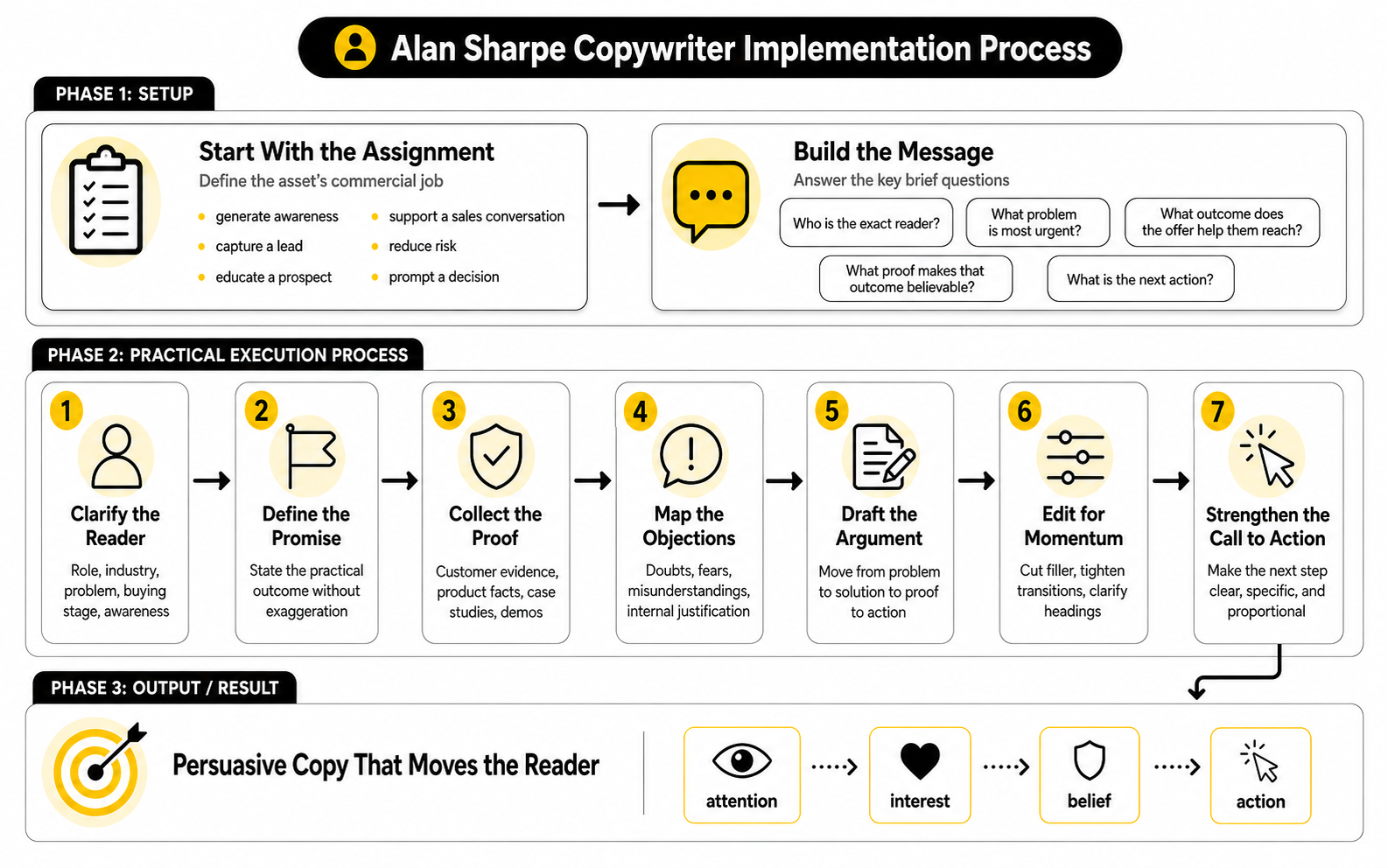
This is where many marketers create weak copy without realizing it. They open a blank document, start writing sentences, and hope the structure appears along the way. A better process starts by naming the commercial job of the asset: generate awareness, capture a lead, educate a prospect, support a sales conversation, reduce risk, or prompt a decision.
Sharpe’s portfolio is useful here because it organizes sales content by buyer journey stage, including awareness assets such as cold emails, landing pages, lead magnets, and blog posts; consideration assets such as follow-up emails, case studies, sales collateral, and buying guides; and decision-stage assets such as sales enablement pillar pages and webpages on his portfolio page. That is the right way to think. The format should follow the buying moment.
Build the Message Before You Polish the Copy
Once the assignment is clear, the next step is building the message. This is where direct-response copywriting becomes more strategic than most people expect. The copywriter has to know what the reader wants, what the offer promises, what proof exists, what objections are likely, and what action should happen next.
This matters even more in B2B because buyers often research quietly before talking to sales. Recent Gartner research found that 61% of B2B buyers prefer an overall rep-free buying experience, which means the copy has to answer more questions without relying on a rep to fix confusion later. That does not make salespeople irrelevant. It makes clear digital copy more important.
A useful message brief should answer five questions before drafting begins:
A Practical Execution Process
The Alan Sharpe copywriter approach can be turned into a practical process without making it complicated. First, identify the reader and the buying stage. Then define the asset’s job, gather proof, draft the argument, sharpen the structure, and only then polish the language.
That order matters. If you polish too early, you end up improving sentences that may not belong in the piece at all. If you structure too late, you force the reader to do the work of connecting scattered ideas.
A strong process looks like this:
This process works because it respects how people actually read. They do not reward copy for being clever. They reward it for being useful, timely, credible, and easy to act on.
Headlines Carry the First Decision
A headline is not just a label. It is the reader’s first decision point. The reader is asking, “Is this for me, and is it worth my time?”
That is why Alan Sharpe’s teaching emphasis on headlines still matters. His course material covers offline headlines, online headlines, email headlines, and ad headlines, which makes sense because every channel has its own pressure. An email subject line has to earn an open. A landing page headline has to orient the visitor. A sales page headline has to make the offer feel relevant fast.
The practical rule is this: write the headline after you understand the reader, not before. A headline written too early usually reflects the writer’s excitement. A headline written after proper research reflects the buyer’s concern, desire, or decision point.
Body Copy Must Keep Earning Attention
Once the headline gets attention, the body copy has to keep it. This is where weak copy falls apart. It starts with a decent promise, then drifts into generic benefits, vague claims, and paragraphs that could belong to almost any competitor.
Strong body copy develops the argument one step at a time. It explains the problem in the reader’s language, introduces the solution without overclaiming, supports the promise with proof, and handles the obvious doubts before they become reasons to leave. The copy should feel like a guided sales conversation, not a brochure pretending to be persuasive.
This is also where transitions matter. Sharpe’s masterclass includes transition sentences for a reason: readers need help moving from one idea to the next. When transitions are missing, the copy feels jumpy, even if each individual sentence is fine.
Calls to Action Should Match Buyer Readiness
The call to action is where many marketers get either too timid or too aggressive. They either hide the next step behind weak language like “learn more,” or they push for a commitment before the reader has enough confidence. Neither approach is ideal.
A direct-response mindset does not mean every CTA must ask for the sale immediately. In B2B, the right action may be downloading a guide, booking a demo, comparing options, watching a walkthrough, joining a workshop, or starting a trial. The next step should match the reader’s stage of awareness and the level of trust already built.
This is where modern tools can support the process, as long as the message comes first. For example, a sales team building follow-up systems may use GoHighLevel to manage funnels, automations, and outreach, while a lean founder might use Systeme.io to launch a simple funnel without overbuilding. The tool is not the strategy. The copy strategy decides what the tool should deliver.
Proof Makes the Promise Believable
Direct response works only when the promise feels believable. A claim without proof is just marketing noise. A claim with relevant proof gives the reader a reason to keep going.
Proof can take many forms. It can be a case study, testimonial, product demonstration, comparison, data point, customer quote, security certification, integration list, implementation detail, or a simple explanation of how the mechanism works. The key is that the proof must support the exact promise being made.
This is where B2B copy should be especially disciplined. Buyers are not just asking whether the product sounds good. They are asking whether it will work in their environment, whether their team can implement it, whether the vendor is credible, and whether the decision will make them look smart later.
The Real Implementation Lesson
The real lesson from studying Alan Sharpe as a copywriter is that professional copywriting is not a burst of inspiration. It is a sequence of decisions. You decide who the reader is, what job the asset has, what promise is credible, what proof is available, what objections matter, and what action should come next.
That is why the process feels almost boring when it is done correctly. There is no magic trick. There is just disciplined thinking turned into clear persuasive writing.
And that is exactly the point. In a market full of AI-generated sameness, the advantage goes to the marketer who can think before writing, structure before polishing, and persuade without sounding desperate.
Statistics and Data
Data should make copy sharper, not noisier. The point is not to collect impressive numbers and drop them into a page because they sound credible. The point is to understand what buyers are doing, where the copy is losing them, and which message changes are likely to improve the next step.
This is where the Alan Sharpe copywriter mindset stays practical. Direct response has always cared about response, but modern teams have more signals than old-school direct mail ever had. Opens, clicks, scroll depth, demo requests, form fills, reply rates, lead quality, sales acceptance, and closed revenue can all tell you something, but only if you know what question each metric is answering.
The danger is measuring the wrong thing too confidently. A high open rate does not prove the email persuaded anyone. A high landing page view count does not prove the offer is strong. A campaign can look busy in the dashboard and still fail to move buyers forward.
What the Numbers Actually Mean
The most important measurement question is not “What is the benchmark?” The better question is “What decision should this number help us make?” Benchmarks are useful only when they give you context, not when they become a lazy substitute for thinking.
For example, Gartner reported that 61% of B2B buyers prefer a rep-free buying experience. That number matters because it tells you the copy has to carry more of the education burden before a buyer talks to sales. It does not mean sales is dead. It means your website, landing pages, emails, case studies, comparison pages, and sales enablement assets need to answer buyer questions earlier and more clearly.
That changes how you judge copy performance. If buyers want to research independently, then shallow copy becomes a real revenue problem. You need to measure whether the copy helps buyers understand the offer, trust the claim, compare options, and take the next appropriate step.
The Measurement System for Better Copy
A useful analytics system should follow the buyer’s movement, not just the marketer’s activity. Start with attention, then measure engagement, then conversion, then sales quality. When those layers are separated, it becomes much easier to see where the copy is working and where it is failing.
Attention metrics tell you whether the promise is strong enough to earn the first look. Engagement metrics tell you whether the page or email held interest long enough to make the argument. Conversion metrics tell you whether the offer and call to action matched the buyer’s readiness. Sales quality metrics tell you whether the copy attracted the right people or just created empty activity.
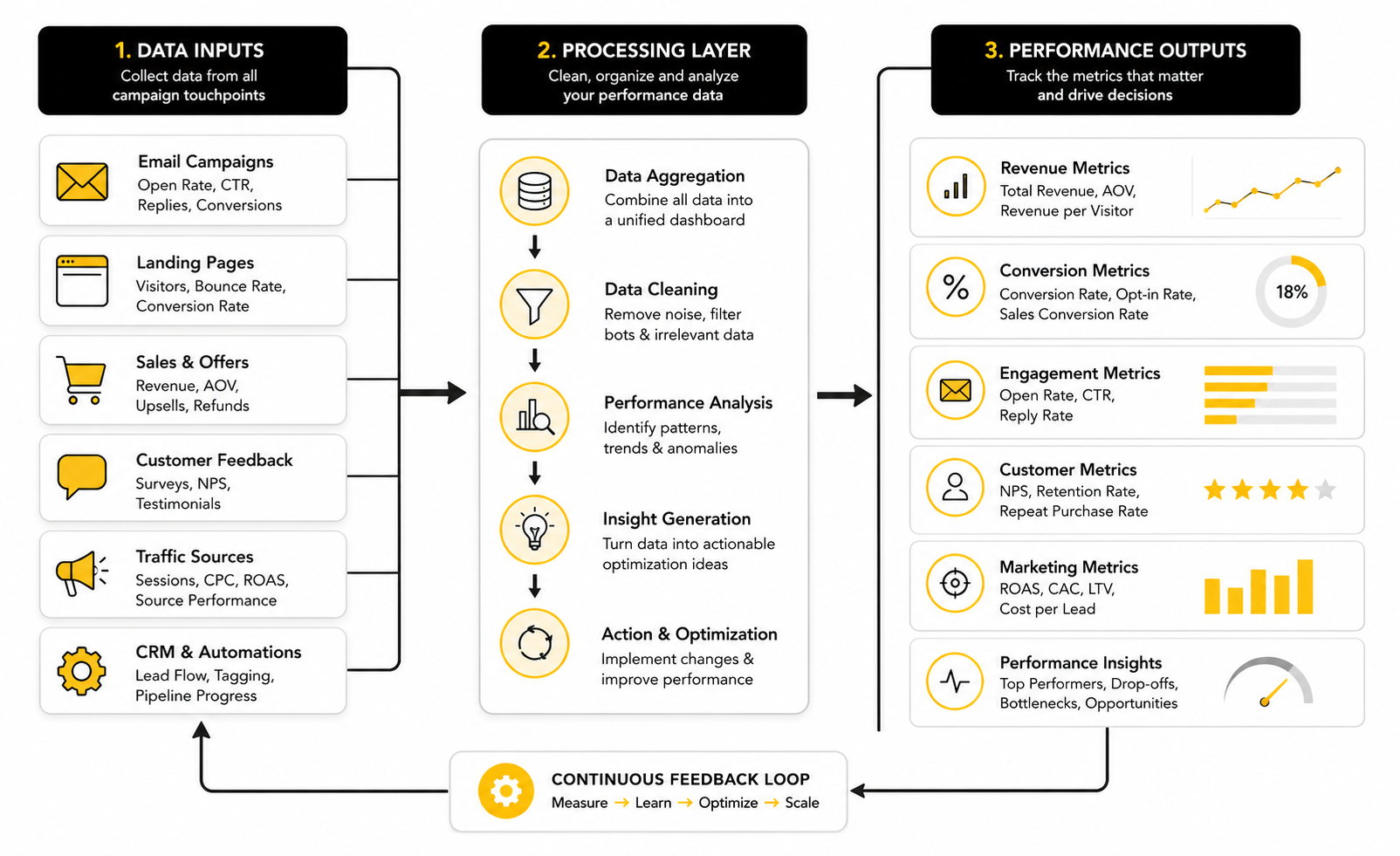
A simple measurement system can look like this:
This is the part most teams skip. They measure conversion, but they do not measure learning. If you only ask whether the copy converted, you miss the more useful question: what did the copy reveal about buyer motivation, friction, and trust?
Benchmarks Are Context, Not Targets
Benchmarks can help you avoid panic and false confidence. If your landing page converts below a broad industry average, that may be a warning sign. But it may also reflect colder traffic, a higher-ticket offer, a longer buying cycle, or a call to action that asks for more commitment than the visitor is ready to make.
Email benchmarks work the same way. A broad 2025 benchmark report from MailerLite analyzed more than 3.6 million campaigns from 181,000 approved accounts and separates open rate, click rate, click-to-open rate, and unsubscribe rate across industries and regions on its email marketing benchmarks page. That kind of data is useful because it reminds you that one universal “good open rate” is too simplistic. The industry, list source, relationship strength, send frequency, and offer all change the meaning of the number.
For copywriters, the lesson is direct. Do not optimize one metric in isolation. A subject line that increases opens but attracts the wrong expectation can hurt clicks, replies, and trust. A landing page that increases form fills by weakening qualification can waste sales time.
The Copy Metrics That Matter Most
For a direct-response copy system, the best metrics are the ones tied to buyer movement. You want to know whether the message moved someone from attention to interest, from interest to belief, and from belief to action. That is more useful than staring at vanity numbers.
For email, look beyond open rate. Opens are affected by subject lines, sender reputation, inbox behavior, Apple Mail Privacy Protection, timing, and list quality. Clicks, replies, booked calls, and downstream qualified opportunities usually tell you more about whether the message worked.
For landing pages, look beyond pageviews. Pageviews tell you traffic arrived. Conversion rate tells you something happened. But scroll depth, CTA clicks, form-start rate, form-completion rate, and post-conversion lead quality help you diagnose why people acted or disappeared.
For sales enablement copy, look beyond downloads. A case study, battlecard, or buying guide should be judged by whether it helps buyers and sales teams move conversations forward. That means tracking usage by sales, influence on opportunities, objections reduced, and whether the asset appears in deals that progress.
How to Read Weak Performance
Weak performance is not automatically a copy problem. Sometimes the traffic is wrong. Sometimes the offer is weak. Sometimes the product category has low urgency. Sometimes the page asks for too much too soon.
But copy is often the easiest place to start diagnosing the problem. If attention is low, test the promise, headline, subject line, lead, or hook. If engagement is low, improve the opening, structure, specificity, proof, and readability. If conversions are low, check the offer, objections, call to action, form friction, and trust signals.
The key is to match the metric to the likely cause:
This is where disciplined copywriting beats random testing. You do not test button colors because you are bored. You test the part of the message most likely connected to the performance gap.
What Data Should Change in the Copy
Data should lead to specific copy decisions. If analytics show people leave before the offer is explained, move the core promise higher. If visitors scroll but do not click, strengthen the proof and CTA. If prospects click but do not complete the form, reduce friction or make the value exchange stronger.
If sales keeps hearing the same objection, the copy should handle that objection before the call. If buyers compare you against the same competitor, create clearer differentiation. If demos attract poor-fit leads, the page should qualify more honestly instead of trying to please everyone.
That is the professional implementation angle. You are not just “optimizing copy.” You are tightening the connection between buyer behavior, message clarity, and business outcome.
Practical Tools for Measuring Copy Performance
You do not need an overbuilt tech stack to measure copy well. You need a clean way to see where people come from, what they read or click, what action they take, and whether those actions create real business value. The simpler the system, the more likely the team will actually use it.
For funnel-heavy teams, GoHighLevel can be useful because landing pages, forms, CRM activity, automations, and follow-up can live closer together. For creators or lean operators who want a simpler setup, Systeme.io can support basic funnels, emails, and offers without turning the measurement process into a software project. For landing pages that need fast iteration, Replo can help ecommerce and growth teams test page experiences more quickly.
The tool still comes second. A messy message inside a sophisticated dashboard is still a messy message. The Alan Sharpe copywriter lesson is that performance starts with the thinking behind the copy, and analytics simply show where that thinking needs to get sharper.
The Measurement Rule That Keeps You Honest
The best copy metric is the one closest to the asset’s real job. A cold email should not be judged the same way as a sales page. A lead magnet should not be judged the same way as a demo page. A battlecard should not be judged the same way as a blog post.
This keeps the team honest because every asset gets measured against its purpose. If the job is to start conversations, replies matter. If the job is to educate, engagement and assisted pipeline may matter. If the job is to convert high-intent buyers, qualified conversion rate matters more than raw traffic.
That is how you use data without becoming mechanical. Measure the buyer’s movement, interpret the friction, improve the message, and test again. Good copywriting is not guessing forever. It is persuasion improved by evidence.
Tools, Workflows, and Modern Implementation
The next challenge is scale. It is one thing to write one strong landing page, one follow-up sequence, or one case study. It is much harder to keep the same level of clarity across campaigns, funnels, sales decks, comparison pages, onboarding emails, retargeting ads, and CRM follow-up.
This is where the Alan Sharpe copywriter lesson becomes more strategic. His work points back to fundamentals, but fundamentals become even more important when more people, tools, and channels get involved. Without a clear system, every new asset starts from zero, and every writer invents a slightly different version of the message.
A mature copy workflow does not make the writing robotic. It gives the team a shared way to think before they write. That is what keeps the copy consistent without making it dull.
The Scaling Problem Most Teams Miss
Scaling copy is not the same as producing more content. More output can actually create more confusion if the positioning is weak. A company can publish weekly blog posts, launch ads, send email campaigns, and build new pages while still leaving the buyer unsure what the product does or why it is different.
That problem gets worse with AI. McKinsey’s 2025 State of AI research shows that AI use continues to spread across business functions, with marketing and sales remaining among the areas where adoption is common on its State of AI page. The takeaway is not that teams should avoid AI. The takeaway is that faster production makes message discipline non-negotiable.
If your core argument is weak, AI helps you generate weak variations faster. If your positioning is sharp, AI can help with research organization, first drafts, repurposing, and campaign adaptation. The difference is not the tool. The difference is whether a human has already done the thinking.
Build a Copy System Before You Build More Assets
A strong copy system starts with a message foundation. This should be a practical working document, not a brand manifesto that nobody uses. It should define the audience, pain points, promise, proof, objections, differentiators, tone, and approved language.
Once that foundation exists, every asset becomes easier to produce. The landing page does not invent a new promise. The sales email does not invent a new objection. The case study does not invent a new value proposition. Everything pulls from the same strategic source while adapting to the format.
A useful copy foundation should include:
This is not busywork. It is how you prevent content chaos. When the foundation is clear, execution becomes faster and better.
Use AI Without Letting It Flatten the Message
AI can help copywriters move faster, but it also creates a serious risk: sameness. Generic prompts create generic copy. Generic copy creates weak differentiation. Weak differentiation makes buyers feel like every vendor is saying the same thing.
That is why human judgment matters more, not less. AI can draft variations, summarize interviews, organize objections, and create first-pass email structures. But it should not decide the positioning, invent unsupported proof, or replace direct knowledge of the buyer.
The practical rule is simple: use AI for acceleration, not authority. Let it help with volume, structure, and alternative angles, but make the final message earn its place through research, proof, and buyer relevance. This lines up well with the direct-response discipline behind Alan Sharpe’s work because the copy still has to persuade a real person, not just pass a writing-quality check.
The Strategic Tradeoff Between Clarity and Sophistication
Advanced copywriting often means making the message simpler, not more complex. That can feel uncomfortable, especially in B2B technology. Product teams want every feature included, sales teams want every objection handled, founders want the full vision explained, and marketers want the page to convert quickly.
The tradeoff is real. If you make the copy too simple, you may undersell the depth of the product. If you make it too complete, you may bury the one idea the buyer needed most.
The best solution is layered clarity. Put the core message first. Then let the reader go deeper through proof, use cases, comparison sections, FAQs, demos, and sales collateral. This respects the buyer’s attention while still giving serious prospects enough substance to keep evaluating.
Match the Asset to the Buying Stage
The most common scaling mistake is using the same message at every stage. A buyer who just discovered the problem does not need the same copy as a buyer comparing vendors. A buyer trying to educate their team does not need the same asset as a buyer ready to request pricing.
This is where Sharpe’s sales enablement focus becomes useful again. The job is not to write one perfect piece of copy. The job is to support the buyer’s progress through different moments of uncertainty.
A practical buying-stage workflow looks like this:
This is also where automation tools can be useful. A team can use GoHighLevel to organize follow-up workflows, pipeline stages, and CRM-based messaging. A smaller operator can use Brevo or Moosend for email campaigns and segmentation. But again, automation only helps when the message matches the buyer’s stage.
Watch the Risk of Over-Optimization
Once analytics enter the picture, teams often start optimizing whatever is easiest to measure. They test subject lines, buttons, hero sections, and form placements. That can be useful, but it can also distract from deeper problems.
A tiny increase in click-through rate does not matter if the leads are worse. A higher form-fill rate does not matter if sales rejects the leads. A clever headline does not matter if it creates expectations the product cannot meet.
Over-optimization happens when the team forgets the commercial purpose of the copy. The goal is not to win a dashboard. The goal is to help the right buyer take the right next step with enough confidence to keep moving.
Make Proof Easier to Reuse
The best copy systems have a proof library. This sounds basic, but it is one of the fastest ways to improve quality across a team. Without a proof library, writers either reuse the same two testimonials forever or make claims that sound unsupported.
A good proof library should be searchable and specific. It should include customer quotes, case studies, product screenshots, demo clips, performance data, analyst mentions, security credentials, integration details, and sales-call insights. Each proof point should be tagged by buyer type, use case, objection, funnel stage, and claim supported.
This matters because proof is not interchangeable. A technical buyer may need implementation detail. A financial buyer may need risk reduction. A founder may need speed. A manager may need team adoption evidence. The sharper the proof match, the stronger the copy feels.
Keep the Voice Human as You Scale
Scaling can quietly kill voice. The more templates, tools, approvals, and AI drafts enter the workflow, the more copy starts to sound like it was written by a committee. That is a problem because buyers can feel it.
A human voice does not mean casual slang or forced personality. It means the copy sounds like a clear person is helping the reader make a decision. It uses plain language, direct transitions, specific claims, and honest confidence.
This is where studying Alan Sharpe as a copywriter is useful for advanced teams. His direct-response foundation pushes the writer to respect the reader’s time. Say what matters. Prove what you claim. Remove what does not help. Ask for the next step clearly.
The Expert-Level Test
The expert test is not whether the copy sounds impressive. It is whether the copy can survive real buyer scrutiny. Can a skeptical buyer understand the promise quickly? Can a sales rep use the language in a conversation? Can the proof support the claim? Can the CTA match the buyer’s readiness?
If the answer is yes, the copy is doing its job. If the answer is no, more polish will not save it. You need clearer positioning, stronger proof, better segmentation, or a more realistic offer.
That is the point of advanced implementation. You are not trying to make more words. You are building a system where every asset helps the buyer move forward with less confusion and more confidence.
Lessons, Mistakes to Avoid, and Final Takeaways
The biggest lesson from studying Alan Sharpe as a copywriter is that persuasion is not decoration. It is not clever wording added after the strategy is finished. It is the strategy expressed clearly enough that a real buyer can understand it, believe it, and act on it.
That sounds simple, but most weak copy fails right there. It tries to sound impressive before it becomes useful. It talks about the company before it understands the reader. It pushes for action before it earns trust.
The better path is disciplined and practical. Know the buyer, define the job of the asset, build the argument, support the promise, remove friction, and make the next step obvious. That is the thread running through the Alan Sharpe copywriter approach, and it is still relevant because buyer behavior keeps moving toward self-education, comparison, and digital-first research.
Common Mistakes That Weaken Copy
The first mistake is writing before thinking. This is especially common when teams are under pressure to publish, launch, or fill a campaign calendar. They start drafting before they know the reader, the buying stage, the objection, or the action they want.
The second mistake is confusing clarity with simplicity. Clear copy can still be sophisticated, but it does not make the reader work hard to understand the point. The buyer should know what is being offered, why it matters, how it works, and what to do next without rereading the page three times.
The third mistake is relying on unsupported claims. Words like “powerful,” “smooth,” “innovative,” and “best-in-class” do not persuade unless the copy proves what they mean. Better copy uses specifics, examples, mechanisms, comparisons, and proof that connect directly to the buyer’s concern.
How to Keep Improving as a Copywriter
Improvement comes from studying copy, writing copy, measuring response, and revising based on evidence. You do not get better by collecting formulas forever. You get better by seeing how structure, proof, tone, and calls to action affect real behavior.
That is why Sharpe’s teaching style is useful for serious learners. His public course materials focus on practical assignments such as landing pages, emails, white papers, ads, ecommerce pages, and calls to action through Alan Sharpe’s copywriting masterclass. This matters because professional copywriters are rarely paid to “write words.” They are paid to solve communication problems inside specific commercial formats.
The fastest way to improve is to review every piece of copy against a short checklist. Who is the reader? What do they already believe? What promise is being made? What proof supports it? What objection remains unanswered? What action should happen next?
The Final System
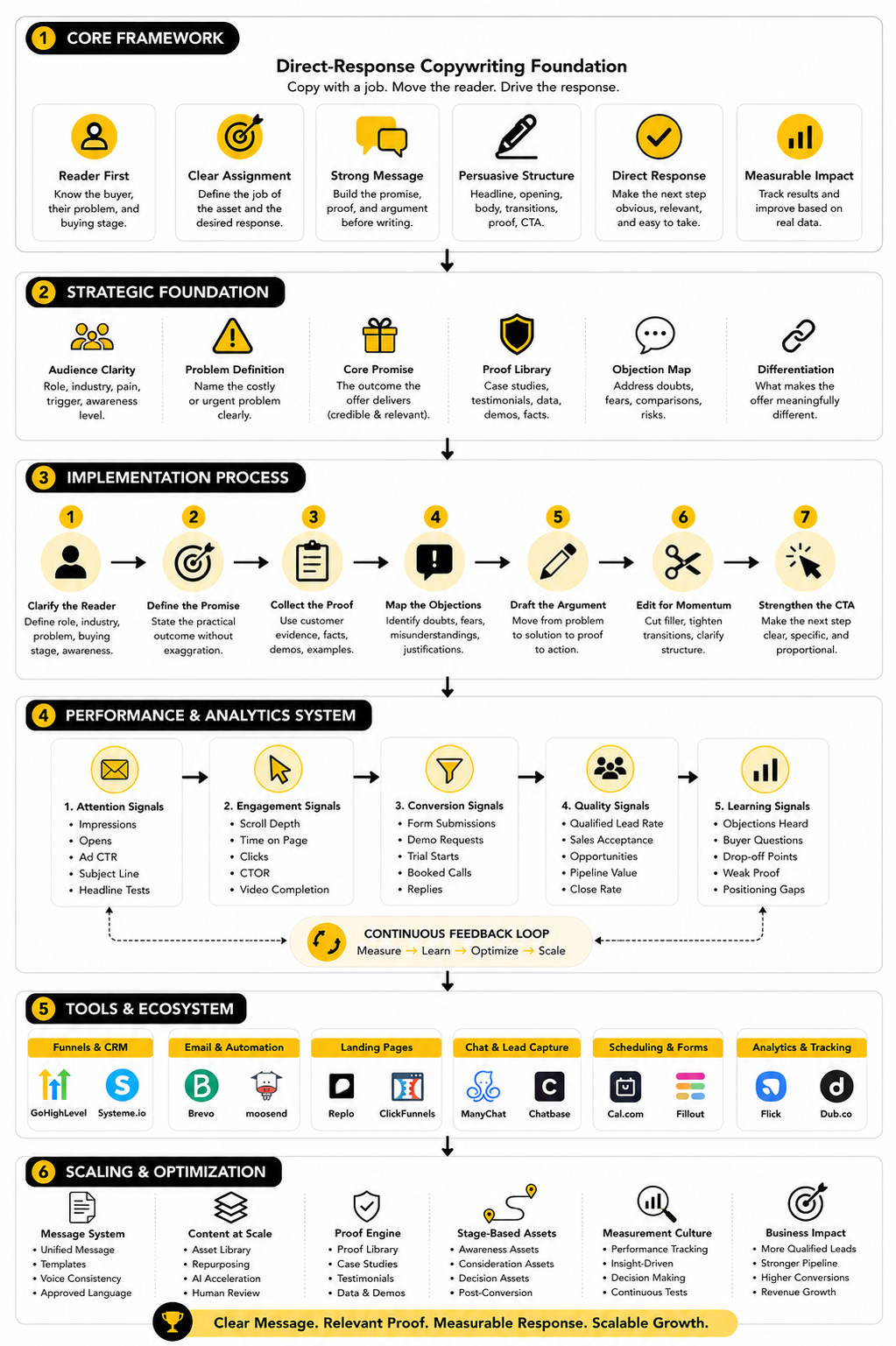
The final system is not complicated. Start with the buyer, define the business goal, choose the right asset, write the message, add proof, reduce risk, publish, measure, and improve. That sequence works whether you are writing a landing page, nurture email, case study, product page, or sales enablement asset.
The reason this system holds up is that it respects how people make decisions. Buyers do not move because your copy sounds polished. They move because the copy helps them understand a problem, trust a solution, and feel confident taking the next step.
This is the practical value of studying Alan Sharpe as a copywriter. You are not trying to imitate his career or memorize his exact lines. You are learning the discipline behind professional persuasion: useful thinking, clear structure, relevant proof, and direct action.
Who is Alan Sharpe?
Alan Sharpe is a sales enablement copywriter and copywriting instructor. His current work focuses on helping B2B technology sales teams with lead follow-up email sequences and sales content through Sharpe Copy. He is also known for teaching copywriting through courses, workshops, books, articles, and online training.
Why do people search for Alan Sharpe copywriter?
People usually search for Alan Sharpe copywriter because they want practical copywriting instruction, direct-response guidance, or information about his professional background. His name is connected with B2B copywriting, sales enablement, persuasive writing, and online copywriting education. That makes the search intent broader than just biography.
Is Alan Sharpe mainly a B2B copywriter?
Yes, his current positioning is strongly B2B-focused. His website describes his work as sales enablement copywriting for B2B technology teams, including lead follow-up emails and content that helps prospects move through the pipeline. That B2B angle is important because the copy has to educate, differentiate, and reduce risk, not just create quick attention.
What can marketers learn from Alan Sharpe?
Marketers can learn to treat copy as a structured sales argument rather than a writing exercise. His approach points toward clear assignments, strong headlines, logical body copy, relevant proof, and calls to action that match buyer readiness. The deeper lesson is that persuasive copy starts before writing, with research and strategy.
Is Alan Sharpe’s copywriting approach still relevant with AI?
Yes, because AI has made message discipline more important, not less important. AI can help create drafts, variations, summaries, and outlines, but it cannot replace buyer insight, positioning judgment, or proof quality. If the strategy is weak, AI simply helps produce weak copy faster.
What is direct-response copywriting?
Direct-response copywriting is copy written to produce a specific response from the reader. That response might be a click, reply, signup, download, demo request, purchase, or booked call. The key is that the copy has a measurable job and is judged by whether it moves the reader toward that job.
How is B2B copywriting different from consumer copywriting?
B2B copywriting usually deals with longer buying cycles, more stakeholders, higher risk, and more internal justification. The buyer often needs proof, comparison, implementation clarity, and confidence before taking action. Consumer copy can also require proof, but B2B copy usually has to support a more complex decision.
What makes copy persuasive?
Copy becomes persuasive when it connects a real reader problem to a credible outcome. It needs a clear promise, strong relevance, believable proof, and a next step that feels appropriate. Persuasion fails when the copy is vague, unsupported, self-centered, or disconnected from the buyer’s actual concern.
What metrics should copywriters track?
Copywriters should track metrics that match the job of the asset. For email, that may include replies, clicks, booked calls, and qualified opportunities, not just opens. For landing pages, useful signals include conversion rate, form completion, scroll depth, CTA clicks, and lead quality.
Why are benchmarks not enough?
Benchmarks give context, but they do not explain the full situation. A low conversion rate might mean weak copy, but it might also mean poor traffic quality, a high-friction offer, or a long buying cycle. Smart marketers use benchmarks as a starting point, then diagnose the actual buyer behavior behind the number.
Should beginners study Alan Sharpe?
Yes, especially if they want structured, practical copywriting education. His course materials break copywriting into concrete assignments and parts of the page, such as headlines, openings, body copy, transitions, and calls to action. That is useful for beginners because it makes the craft less mysterious.
Can agencies use the Alan Sharpe copywriter approach?
Agencies can use the approach to create better systems for client work. Instead of starting every project from scratch, they can build message briefs, proof libraries, objection maps, CTA ladders, and asset-specific templates. That helps scale production while keeping the copy grounded in strategy.
What is the biggest mistake new copywriters make?
The biggest mistake is trying to sound persuasive before they understand the reader. They reach for formulas, power words, urgency, or clever hooks without knowing the buyer’s real problem. Strong copy starts with relevance, not performance.
How should a marketer apply these lessons today?
Start by choosing one asset that matters commercially, such as a landing page, follow-up sequence, or sales page. Clarify the reader, buying stage, promise, proof, objections, and call to action before rewriting anything. Then improve the structure, publish the stronger version, measure buyer movement, and keep refining.
Build a stronger local presence with BAAM AI
Turn your website, Google profile, social channels, and AI visibility into one growth engine
Most businesses do not need more random marketing activity. They need a consistent presence system that helps the right people find them, trust them, and take action. BAAM AI brings strategy, local SEO, website updates, Google Maps visibility, social content, AI-search readiness, media production, and reporting into one practical monthly engine.
If you want your marketing to keep working after the campaign ends, start with a free BAAM AI presence audit. See how your business shows up today and where the fastest visibility wins are at BAAM AI.