
BAAM AI Blog
Adwords PPC: A Practical Guide To Building Paid Search Campaigns That Actually Convert
Adwords PPC is still one of the fastest ways to put an offer in front of people who are already searching for a solution. The name has changed from Google AdWords to Google Ads, but the core idea has not changed: you...
Adwords PPC is still one of the fastest ways to put an offer in front of people who are already searching for a solution. The name has changed from Google AdWords to Google Ads, but the core idea has not changed: you bid for visibility, pay when someone clicks, and turn that traffic into leads, sales, bookings, trials, or pipeline.
The hard part is not launching ads. Anyone can open an account, choose a few keywords, write a headline, and spend money by tomorrow morning. The hard part is building a system where the keyword, ad, landing page, offer, tracking, budget, bidding, and follow-up all work together instead of fighting each other.
That is where most PPC campaigns break. The account looks busy, the dashboard has data, and the clicks keep coming in, but the business cannot clearly answer the only question that matters: are these clicks turning into profitable customers? this guide will treat Adwords PPC as a complete growth system, not just a traffic source.
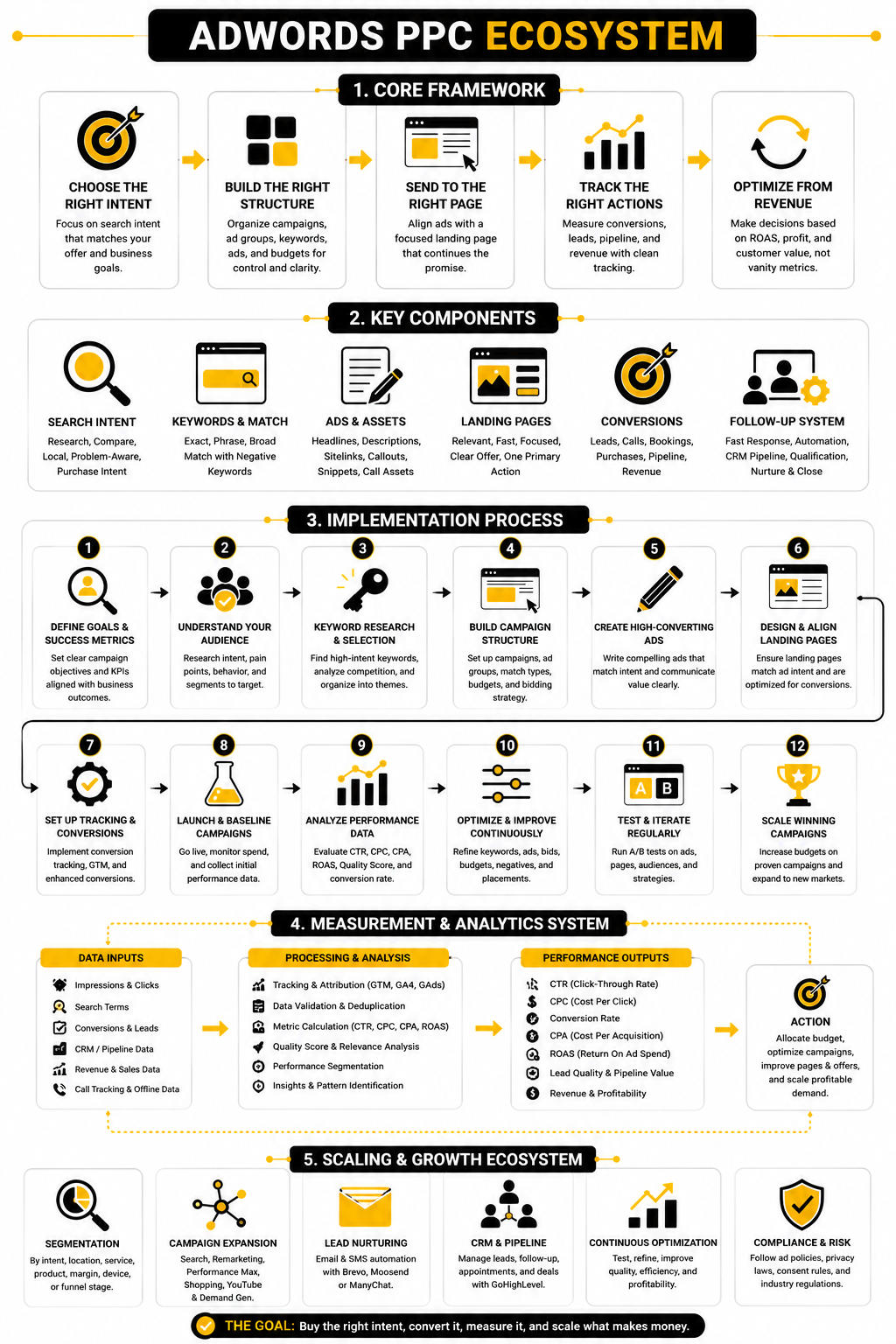
Here is the structure we will use across the full article:
Why Adwords PPC Still Matters
Adwords PPC matters because search advertising captures intent at the moment it becomes visible. A person searching for “emergency plumber near me,” “best CRM for agencies,” or “buy running shoes size 11” is not passively scrolling. They are raising their hand, and a well-built campaign can meet that demand immediately.
That immediacy is the main reason PPC remains valuable even when organic search, social media, email, and AI discovery are all part of the marketing mix. SEO can compound beautifully, but it usually takes time. Social can create demand, but it often reaches people before they are ready to act. Adwords PPC sits closer to the decision point, which makes it especially useful when the offer, tracking, and sales process are already strong.
The mistake is treating PPC like a magic machine. Paid clicks amplify what already exists. If the offer is weak, the landing page is confusing, or the follow-up is slow, Adwords PPC will expose those problems quickly and expensively. If the funnel is clear, the sales process is tight, and the economics make sense, PPC can become one of the most controllable channels in the business.
The Adwords PPC Framework
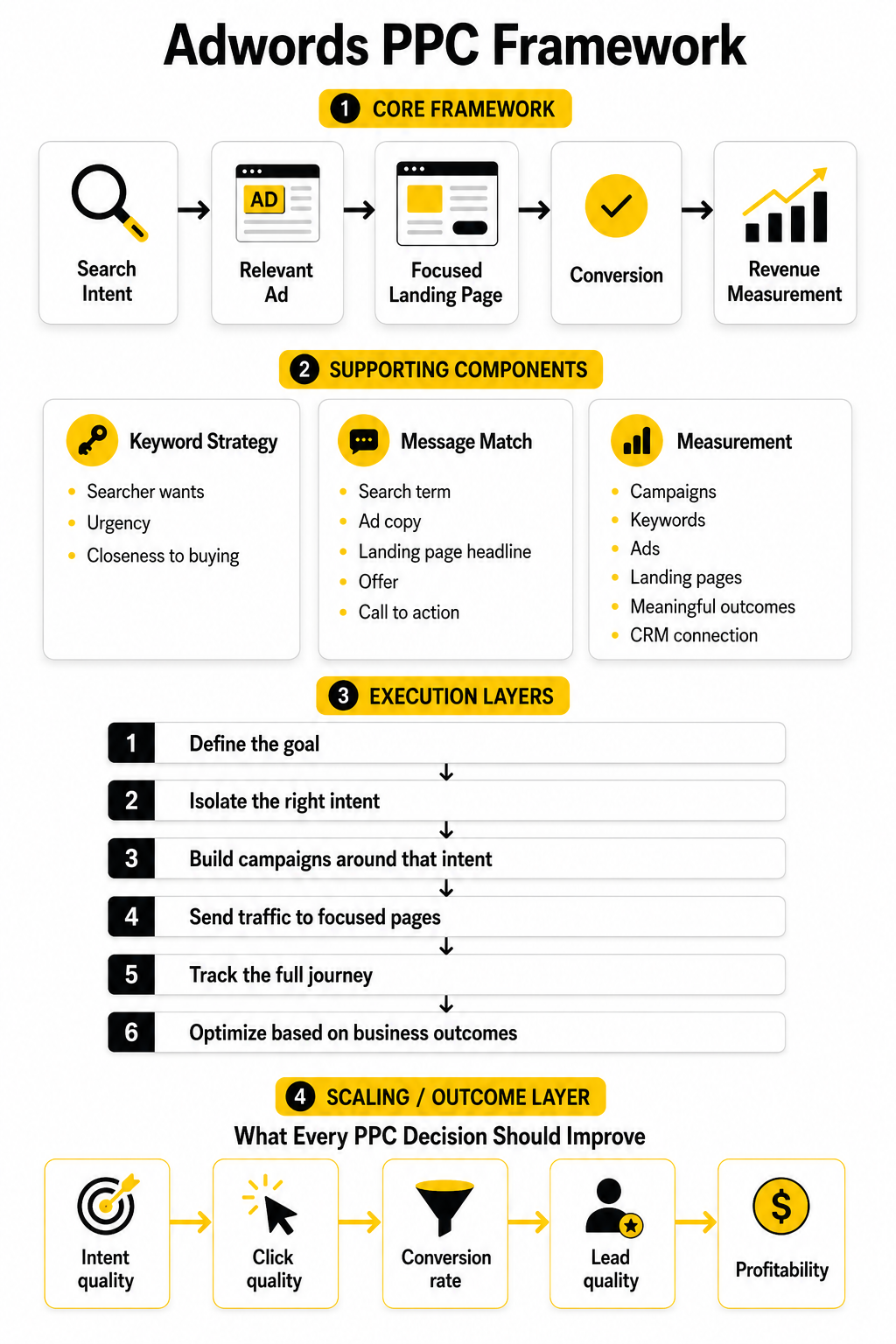
A profitable Adwords PPC campaign starts with a simple chain: search intent leads to a relevant ad, the ad leads to a focused landing page, the landing page creates a conversion, and the conversion is measured against revenue. Every serious PPC decision should improve one part of that chain. If a change does not improve intent quality, click quality, conversion rate, lead quality, or profitability, it is probably noise.
This framework keeps campaigns grounded. It stops you from obsessing over surface-level metrics like impressions or clicks without asking whether those clicks are commercially useful. A high click-through rate can still lose money if the search terms are too broad, the landing page attracts the wrong people, or the sales team cannot close the leads.
The same framework also explains why tools alone do not fix PPC. A landing page builder like Replo can help ecommerce teams create sharper pages, and a CRM and automation platform like GoHighLevel can help service businesses manage follow-up. But the tool only helps when the campaign logic is already clear.
Core Components Of Adwords PPC
The first core component is the keyword strategy. Keywords are not just words in an account; they are clues about what the searcher wants, how urgent the need is, and how close that person may be to buying. A campaign built around vague keywords will usually need more filtering, more negative keywords, and more patience than a campaign built around high-intent searches.
The second component is message match. The search term, ad copy, landing page headline, offer, and call to action should feel like one continuous conversation. When someone clicks an ad for a specific problem and lands on a generic homepage, momentum dies. When the page continues the promise from the ad and makes the next step obvious, conversion becomes much easier.
The third component is measurement. PPC without clean tracking is just paid guessing. You need to know which campaigns, keywords, ads, and landing pages create meaningful outcomes, not just form fills or button clicks. For lead generation, that often means connecting the ad account to a CRM so you can separate cheap leads from qualified opportunities and actual customers.
Professional Implementation
Professional Adwords PPC implementation is less about clever tricks and more about disciplined control. You define the goal, isolate the right intent, build campaigns around that intent, send traffic to focused pages, track the full journey, and optimize based on business outcomes. That sounds basic, but most failing accounts skip at least one of those steps.
A professional setup also respects the learning phase. You do not need to change everything every day just because the dashboard moved. You need enough clean data to understand what is happening, then you make specific adjustments: tighten search terms, improve ad relevance, test landing page angles, adjust bids, shift budget, and refine conversion quality.
The rest of this guide will build that system step by step. First, we will clarify why Adwords PPC still deserves budget in a modern marketing plan. Then we will move into the framework, keyword strategy, campaign structure, conversion tracking, optimization, and the practical tools that make implementation easier without turning the campaign into a mess.
Why Adwords PPC Still Matters
Adwords PPC still matters because it gives you access to demand that already exists. You are not interrupting someone who has no idea they need you. You are showing up when they are actively searching, comparing, pricing, troubleshooting, or preparing to buy.
That changes the quality of the conversation. A cold audience may need education before they care. A search audience often needs clarity, proof, and a strong next step. That is why PPC can work so well for service businesses, ecommerce brands, SaaS companies, local providers, coaches, consultants, and agencies when the campaign is built around real intent instead of random traffic.
The channel has also changed. Modern Google Ads is more automated, more AI-assisted, and more dependent on good inputs than the old AdWords era. That does not make strategy less important. It makes strategy more important, because the machine can only optimize well when you feed it clean goals, relevant pages, strong creative, and conversion data that reflects real business value.
Paid Search Captures Active Demand
The biggest advantage of Adwords PPC is timing. Search ads can appear when someone is already describing the problem in their own words. That is very different from pushing a message into a feed and hoping the right person happens to care at that moment.
This is why keyword intent matters so much. A person searching “what is PPC” is in a learning mode. A person searching “Google Ads agency for dentists” is much closer to a commercial decision. Both searches may be useful, but they should not be treated the same way, sent to the same page, or measured with the same expectations.
Strong PPC strategy starts by separating curiosity from buying intent. Informational searches can support education and retargeting, but they usually need a softer conversion path. High-intent searches deserve tighter ads, more direct landing pages, and faster follow-up because the searcher is already moving toward action.
PPC Makes Growth More Measurable
Adwords PPC is not perfectly measurable, but it is more controllable than many marketing channels. You can see which campaigns spend, which search terms trigger ads, which pages receive traffic, and which conversions happen after the click. That visibility gives you a faster feedback loop than waiting months to understand whether a broader marketing campaign is working.
The key is measuring the right thing. A campaign can look healthy if you only watch clicks, impressions, or even form submissions. It can still be unhealthy if those leads never answer the phone, never qualify, or never buy.
For service businesses and agencies, this is where the follow-up system becomes part of the ad strategy. If leads are coming in from paid search, they need to be contacted quickly, tracked properly, and moved through a pipeline. A platform like GoHighLevel fits naturally here because PPC lead generation becomes much easier to manage when forms, calls, messages, appointments, automations, and pipeline stages are connected in one place.
PPC Exposes Weak Offers Fast
One uncomfortable benefit of Adwords PPC is that it tells the truth quickly. If the ad gets impressions but no clicks, the message is probably weak or mismatched. If the clicks arrive but nobody converts, the landing page, offer, audience, or trust signals may be the problem. If conversions happen but revenue does not follow, the issue may be lead quality, pricing, sales process, or retention.
That feedback can sting, but it is useful. Organic channels often hide these problems because traffic grows slowly and attribution is messy. PPC puts pressure on the whole funnel immediately because every click has a visible cost.
This is why paid search should not be judged only as an acquisition channel. It is also a diagnostic tool. A clean Adwords PPC campaign can show you whether the market understands your offer, whether your landing page is persuasive, and whether your business can turn intent into revenue.
The Economics Have To Make Sense
No PPC strategy works if the unit economics are broken. You need to understand what a lead is worth, what a customer is worth, how often leads become customers, and how much margin remains after fulfillment. Without those numbers, bidding becomes emotional.
A simple example makes the point. If a customer is worth 1,000 in gross profit and one in ten leads becomes a customer, a lead may be worth up to 100 before other costs. That does not mean you should happily pay 100 per lead, but it gives you a ceiling. Without that ceiling, you are either underinvesting because clicks feel expensive or overspending because conversions look exciting.
This is also why low cost per click is not always the goal. Cheap clicks from weak searches can drain budget quietly. Expensive clicks from serious buyers can be profitable if the conversion rate and customer value support them. Adwords PPC rewards businesses that know their numbers and punish businesses that guess.
Search Ads Support The Rest Of The Funnel
PPC does not have to work alone. In many businesses, paid search is the entry point that connects to landing pages, email follow-up, SMS reminders, retargeting, sales calls, demos, and checkout flows. The ad gets the click, but the system earns the money.
That matters because most buyers do not behave in a perfectly straight line. They may click an ad, leave the page, compare alternatives, ask a colleague, return through branded search, and then convert later. A campaign that only thinks about the first click will miss the bigger journey.
For funnel-heavy offers, tools like ClickFunnels or Systeme.io can help turn ad traffic into structured conversion paths. The important part is not the tool itself. The important part is giving paid traffic a focused path instead of dumping visitors onto a page that tries to do everything.
AI Has Not Replaced PPC Strategy
Google Ads now leans heavily into automation, broad matching, Smart Bidding, Performance Max, and AI-assisted campaign features. That shift can make PPC feel less manual than it used to be. But automation does not remove the need for judgment.
The machine can test combinations, expand reach, and adjust bids faster than a human can. It cannot fully understand your positioning, your margins, your sales team’s capacity, your fulfillment constraints, or the difference between a lead that looks good in the ad account and a customer that actually pays. That part still belongs to the business.
This is the practical mindset: let automation help with execution, but do not outsource strategy to the platform. Your job is to define the market, choose the right conversion goals, protect the budget from bad intent, build strong pages, and judge performance by profit. That is where Adwords PPC becomes a business asset instead of a gambling machine.
The Adwords PPC Framework
The framework is simple: choose the right intent, build the right campaign structure, send clicks to the right page, track the right actions, and optimize from revenue instead of ego metrics. That is the whole game. When Adwords PPC feels chaotic, it is usually because one of those pieces is missing or disconnected.
The best campaigns do not start inside Google Ads. They start with the business model. Before touching keywords, you need to know what you are selling, who should buy it, what the conversion path looks like, how fast your team can follow up, and how much you can afford to pay for a lead, sale, booking, or trial.
Once those basics are clear, implementation becomes much easier. You are no longer guessing which buttons to press. You are building a controlled system where every campaign has a job, every ad group has a theme, every landing page has one next step, and every conversion action helps you make a more carefully decision.
Step 1: Define The Commercial Goal
Start with the outcome you actually want. For ecommerce, that may be profitable purchases. For a local service business, it may be booked appointments or qualified calls. For SaaS, it may be demos, trials, activated users, or pipeline value.
Do not treat every conversion as equal. A newsletter signup, quote request, phone call, booked consultation, and paid checkout can all be valuable, but they do not carry the same business weight. If you optimize Adwords PPC around the easiest action instead of the most meaningful action, the account may look better while the business gets worse.
This is why deeper funnel tracking matters. If your CRM can show which leads became opportunities and which opportunities became customers, your campaign decisions become sharper. For agencies and local businesses, GoHighLevel can be useful here because the ad click, form submission, call, appointment, follow-up, and pipeline stage can live closer together.
Step 2: Map The Search Intent
Search intent is the reason behind the keyword. Two people can use similar words and still want very different things. One searcher may want a definition, another wants a comparison, and another is ready to buy today.
For Adwords PPC, you want to separate intent into practical groups before building campaigns. The easiest categories are research intent, comparison intent, local intent, problem-aware intent, and purchase intent. These groups help you decide what kind of ad to write, what page to use, and how aggressively to bid.
Do not rush this step. A messy intent map creates messy campaigns. If you mix beginner research searches with high-value buyer searches inside the same structure, performance data becomes harder to read and budget gets pulled in too many directions.
Step 3: Build Campaigns Around Control
A clean campaign structure gives you control over budget, bidding, search terms, messaging, and reporting. That does not mean you need hundreds of tiny campaigns. It means each campaign should have a clear purpose that matches the business goal.
For many accounts, the first structure should separate brand search, high-intent non-brand search, competitor or comparison search, remarketing, and broader testing. This keeps your best demand from being hidden inside experimental traffic. It also makes budget allocation easier because you can protect what already works while testing new opportunities in a controlled way.
Ad groups should stay tightly themed. If the keywords inside one ad group cannot share a natural ad and a natural landing page, the ad group is probably too broad. Relevance still matters because the search term, ad, and page need to feel connected from the user’s point of view.
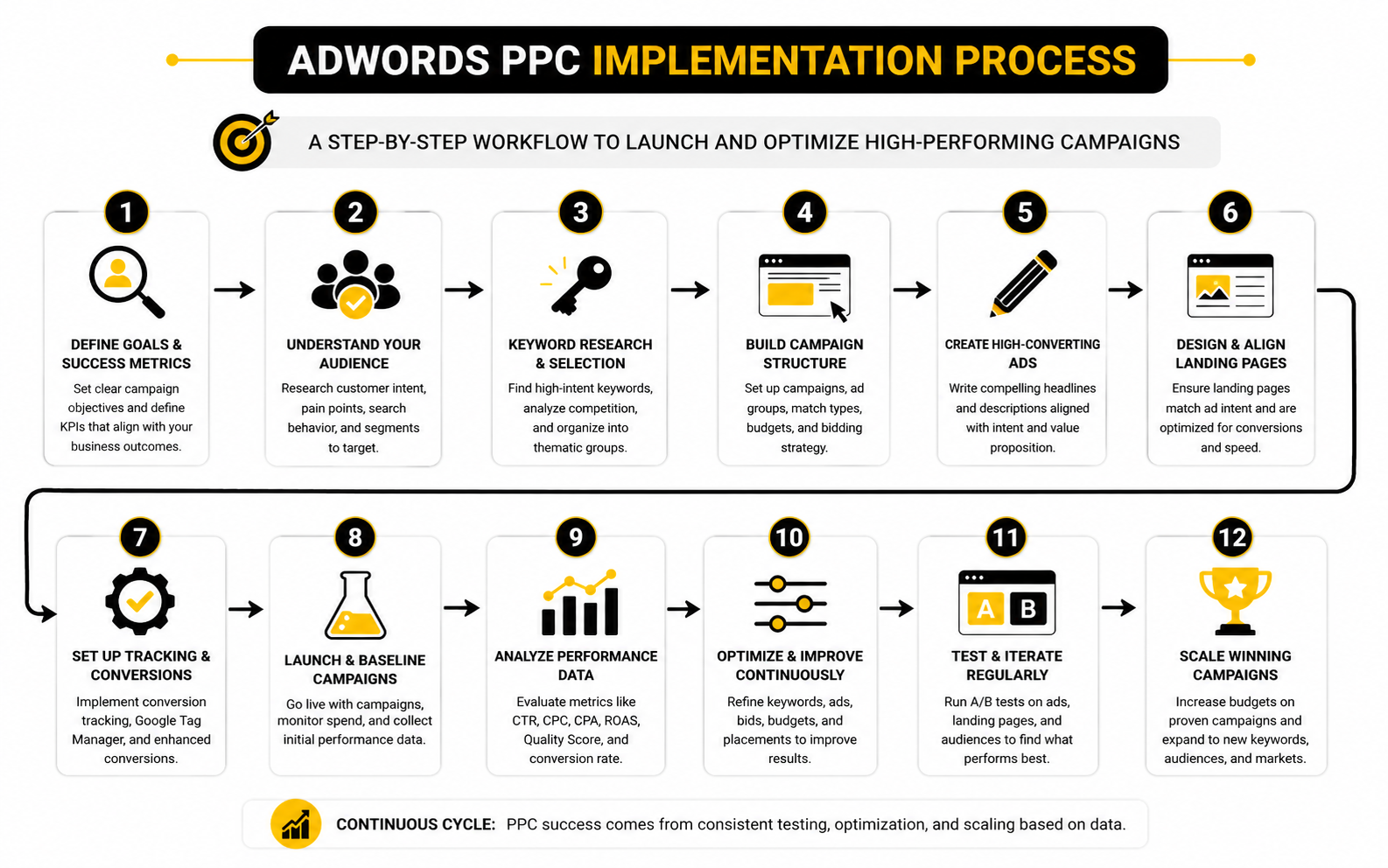
Step 4: Choose Keywords And Match Types Carefully
Keyword selection is not about collecting every phrase that might be related to the business. It is about choosing searches that signal useful intent. A smaller keyword list with clearer buying intent is often a stronger starting point than a massive list full of vague searches.
Match types control how closely a search needs to relate to your keyword. Exact match gives more control, phrase match gives moderate flexibility, and broad match gives the system more room to find related searches. Broad match can work, especially with strong conversion tracking and smart bidding, but it can also waste budget quickly when the account is new or the offer is not clearly defined.
Negative keywords are just as important. They tell the platform what you do not want. If you sell premium consulting, you may need to filter searches around free templates, jobs, salaries, definitions, or DIY instructions. If you serve one location, you may need to exclude irrelevant cities, regions, or service terms that look close but do not match your actual offer.
Step 5: Write Ads That Match The Moment
Good PPC ads are not clever for the sake of being clever. They are specific, relevant, and easy to understand. The searcher should immediately feel that the ad matches what they were looking for.
A strong search ad usually reflects the problem, the solution, the differentiator, and the next step. That does not mean stuffing every headline with the same keyword. It means using the language of the search while still sounding like a real business that understands the buyer.
Assets also matter. Sitelinks, callouts, structured snippets, lead forms, call assets, and location assets can increase the amount of useful information shown with the ad. Use them to help the searcher make a decision, not to fill space with generic claims.
Step 6: Send Traffic To A Focused Landing Page
The landing page has one job: continue the promise from the ad and make the next step obvious. If the ad promotes a specific service, the page should focus on that service. If the ad targets a specific audience, the page should make that audience feel seen.
A homepage can work for branded search, but it is often too general for non-brand Adwords PPC. Paid traffic needs clarity fast. The page should explain the offer, show why it matters, reduce risk, answer key objections, and guide the visitor toward one primary action.
For ecommerce teams, a focused product page or campaign page built with Replo can help align paid traffic with a sharper shopping experience. For lead generation and info products, ClickFunnels or Systeme.io can be useful when the campaign needs a simple funnel instead of a full website experience.
Step 7: Launch With A Testing Plan
Do not launch Adwords PPC with twenty random experiments at once. Launch with a clear testing plan. Decide which campaign, audience intent, ad message, landing page, and conversion action you are testing first.
The first goal is not perfection. The first goal is clean learning. You want to know which search terms are showing, which ads earn qualified clicks, which pages convert, and whether the conversions have any real sales value.
Give the campaign enough room to collect useful data before making emotional edits. Daily checking is fine. Daily panic is not. Look for patterns, not single-click drama, and make changes based on evidence rather than impatience.
Step 8: Connect Follow-Up Before Scaling
Lead generation campaigns do not end at the form submission. The money is usually made after the conversion, when the lead is contacted, qualified, booked, nurtured, and closed. If that part is slow or messy, the ad account gets blamed for a problem the sales process created.
Before scaling spend, make sure every lead has a clear path. Someone should know when a form is submitted, how fast to respond, what message to send, how to book the next step, and where the lead sits in the pipeline. Automation can help, but only if the process itself makes sense.
This is where the implementation becomes real. Adwords PPC is not just keywords and bids. It is a full path from search to sale, and every weak link reduces the value of the click.
Tracking, Bidding, Budgets, And Optimization
Tracking is where Adwords PPC becomes a business system instead of a spending habit. Without clean measurement, the account can only optimize toward whatever looks easiest to count. That is dangerous because the easiest conversion to generate is not always the one that produces revenue.
The goal is not to track everything just because you can. The goal is to track the actions that prove commercial progress. For ecommerce, that usually means purchases, revenue, average order value, and repeat purchase behavior. For lead generation, it means qualified leads, booked calls, show-up rates, closed deals, and customer value.
This is where many campaigns quietly lose money. The ad account may report conversions, but the sales team may know those conversions are weak. If the platform is optimizing for low-quality form fills, it will try to find more of them. That is not a Google Ads problem. That is a measurement design problem.
Statistics And Performance Data
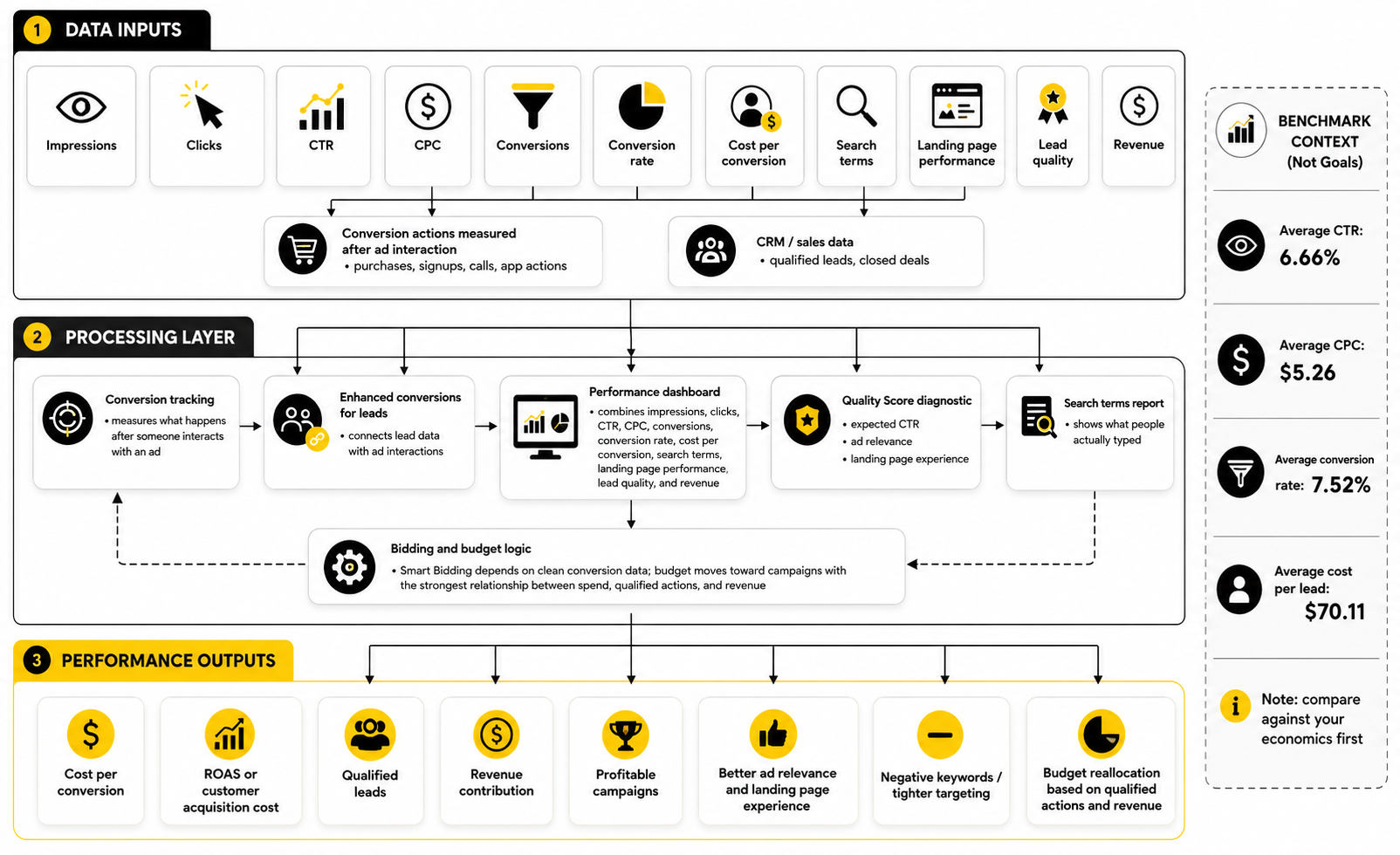
Benchmarks are useful, but only when you treat them as context rather than commandments. Recent search advertising benchmark data shows an average search ad click-through rate around 6.66%, average cost per click around $5.26, average conversion rate around 7.52%, and average cost per lead around $70.11. Those numbers help you understand the market, but they do not tell you whether your campaign is good.
The same CPC can be cheap for one business and terrible for another. A $25 click may be profitable for a lawyer, surgeon, enterprise software company, or high-ticket consultant. A $2 click may be too expensive for a low-margin product if the conversion rate and order value are weak.
This is the correct way to read PPC data: compare your numbers against your economics first, then against benchmarks second. A campaign below the industry average may still be excellent if it produces profitable customers. A campaign above the industry average may still be broken if the leads never close.
The Metrics That Actually Matter
The most important Adwords PPC metrics are not isolated numbers. They are connected signals. Click-through rate tells you whether the ad is earning attention, conversion rate tells you whether the page and offer are working, cost per conversion tells you how efficiently the campaign creates an action, and return on ad spend or customer acquisition cost tells you whether the business can afford to scale.
Do not judge these metrics separately. A high click-through rate with poor conversion quality may simply mean the ad is too broad or too tempting. A low conversion rate may not be a landing page problem if the search terms are weak. A high cost per lead may be acceptable if the leads are qualified and close at a high rate.
You want a dashboard that connects the full chain. At minimum, track impressions, clicks, CTR, CPC, conversions, conversion rate, cost per conversion, search terms, landing page performance, lead quality, and revenue. For lead generation, a CRM like GoHighLevel can help connect ad-driven leads to appointments, pipeline stages, and closed revenue so you are not optimizing from the ad account alone.
Why Conversion Tracking Comes First
Conversion tracking should be set up before serious budget goes live. Google’s own documentation explains that conversion tracking measures what happens after someone interacts with an ad, such as purchases, signups, calls, or app actions through Google Ads conversion tracking. That setup gives the platform the data it needs to report results and support automated bidding.
For lead generation, basic form tracking is only the first layer. The better layer is importing qualified lead and sales data back into the ad platform. Google supports this through features such as enhanced conversions for leads, which helps connect lead data with ad interactions in a privacy-conscious way.
This matters because Smart Bidding can only optimize toward the signals it receives. If every form fill counts as equal, the algorithm has no reason to prefer a high-value buyer over a low-quality inquiry. If qualified leads and closed deals are passed back correctly, the system has a better chance of finding people who resemble real customers.
Quality Score Is A Diagnostic Signal
Quality Score should not be treated like a magic number, but it is still useful. Google describes Quality Score as a diagnostic tool based on expected click-through rate, ad relevance, and landing page experience through its official Quality Score explanation. In plain English, it helps you see whether the keyword, ad, and landing page are aligned.
A low Quality Score does not automatically mean the campaign is doomed. It means you should inspect the relationship between the search intent, ad copy, and page experience. If the ad promises one thing and the page delivers something broader or slower or less relevant, the user feels that disconnect immediately.
The action is practical. Improve ad relevance by matching the message to the search. Improve expected CTR by making the promise clearer and more specific. Improve landing page experience by making the page useful, fast, focused, and consistent with what the ad said.
Cost Per Click Is Not The Enemy
Many people panic when CPC rises, but cost per click is not the real enemy. Unprofitable cost per acquisition is the enemy. A higher CPC can still work if the traffic converts better, produces better customers, or leads to larger orders.
This is why you should never optimize only for cheap traffic. Cheap clicks often come from vague searches, loose match types, irrelevant locations, or people with low purchase intent. They make the dashboard feel active while quietly wasting budget.
A better question is simple: how much can you pay for a qualified visit based on the value of the customer? Once you know that number, CPC becomes easier to interpret. You can tolerate more expensive clicks when they come from searches that consistently produce profitable outcomes.
Conversion Rate Needs Context
Conversion rate is one of the most misunderstood Adwords PPC metrics. A campaign with a 3% conversion rate is not automatically bad, and a campaign with a 15% conversion rate is not automatically good. The value of the conversion matters.
For example, a high conversion rate on a weak lead magnet may produce a full CRM and no sales. A lower conversion rate on a high-intent demo request may produce fewer leads but better revenue. The correct metric is not just conversion rate; it is conversion rate multiplied by lead quality, close rate, and customer value.
Landing page intent also changes the expected result. A direct “book a call” page will usually convert fewer people than a free checklist or quiz. That does not make it worse. It simply means the page is asking for a more serious commitment.
Budget Allocation Should Follow Proof
Budget should move toward campaigns with the clearest evidence of profitable intent. That does not always mean the campaign with the most conversions. It means the campaign with the strongest relationship between spend, qualified actions, and revenue.
A simple budget review should ask three questions. Which campaigns produce the most valuable conversions? Which campaigns waste money on poor search terms or weak lead quality? Which campaigns have enough promise to deserve a controlled test rather than a full scale-up?
This keeps optimization calm. You are not cutting campaigns because of one bad day or scaling campaigns because of one lucky lead. You are moving budget based on patterns that show commercial value.
Bidding Strategy Depends On Data Quality
Manual bidding gives more direct control, but it requires active management. Automated bidding can work well when the account has enough clean conversion data and the conversion goal reflects real value. The wrong move is using advanced bidding strategies while feeding the platform shallow or misleading conversions.
Maximize Conversions can be useful when the goal is volume and the conversion action is reliable. Target CPA can help when you know what you can afford to pay per conversion. Target ROAS is better suited when revenue values are tracked accurately, especially for ecommerce or offers with clear transaction values.
The practical rule is simple. Use automation when your tracking is strong enough to support it. If the data is messy, fix the measurement before expecting the bidding strategy to save the account.
Search Terms Reveal The Truth
The search terms report is one of the most valuable places to inspect an Adwords PPC account. Keywords show what you asked Google to target. Search terms show what people actually typed before clicking.
This report helps you find waste, discover new opportunities, and understand how the market describes the problem. If irrelevant searches keep appearing, you may need tighter match types, better negative keywords, or a cleaner campaign structure. If strong search terms appear repeatedly, they may deserve their own ad group, landing page, or budget.
Do not ignore this step just because automation is popular. Search term analysis is where strategy meets reality. It shows whether your account is buying the demand you actually wanted or drifting into traffic that only looks related on the surface.
Advanced Implementation, Tools, And Scaling
Once the basics are working, the next challenge is not simply spending more money. The next challenge is scaling without losing control. Adwords PPC can grow quickly, but careless scaling can turn a profitable campaign into a noisy account full of weak search terms, shallow conversions, and rising acquisition costs.
Advanced implementation means you stop thinking in isolated campaign tweaks and start thinking in systems. Search campaigns, landing pages, CRM stages, follow-up messages, bidding strategies, audience signals, and reporting all need to support the same commercial goal. If one part changes, the rest of the system may need to change with it.
This is where experience matters. Beginners often ask, “How do I get more clicks?” Better operators ask, “Which type of demand can we profitably capture next?” That one shift changes the entire strategy.
Scaling Starts With Better Segmentation
Scaling does not mean taking one campaign and increasing the budget until something breaks. It means finding the parts of the account that already show strong intent and giving them more room. That usually starts with segmentation.
You may segment by location, service line, product category, margin, customer type, device, funnel stage, or search intent. The goal is not to create complexity for fun. The goal is to isolate meaningful differences so budget, bidding, copy, and landing pages can be matched to the opportunity.
A local home services company should not treat emergency searches the same way it treats research searches. An ecommerce brand should not treat high-margin products the same way it treats low-margin products. A SaaS company should not treat “free template” traffic the same way it treats “book demo” traffic. Segmentation lets the account make those distinctions instead of averaging everything together.
Broad Match Requires Strong Guardrails
Broad match can be powerful, but only when the rest of the account is ready for it. It gives Google more freedom to match your ads with related searches, which can uncover opportunities you would not have manually listed. The tradeoff is obvious: more reach also creates more room for irrelevant traffic.
The guardrails matter. Broad match works best when conversion tracking is clean, Smart Bidding has useful data, negative keywords are maintained, and the campaign has enough budget to learn without burning through cash blindly. Without those conditions, broad match can become an expensive discovery tool.
Use broad match as a controlled expansion layer, not as a lazy replacement for strategy. Start with your strongest themes, monitor search terms closely, and compare lead quality against tighter match types. If broad match brings in qualified demand at an acceptable acquisition cost, keep refining it. If it floods the account with weak intent, pull back and fix the inputs.
Performance Max Needs Clear Inputs
Performance Max can be useful, especially for ecommerce, local goals, and accounts that benefit from reach across multiple Google channels. But it is not a magic campaign type. It needs strong creative, clean conversion goals, useful audience signals, and enough business context to avoid optimizing toward low-value actions.
The mistake is launching Performance Max with generic assets and expecting it to understand the business. Asset groups should be organized around real product categories, services, customer segments, or offer themes. Creative should match the promise, the page should match the creative, and the conversion goal should reflect revenue or qualified pipeline as closely as possible.
For ecommerce, the product feed becomes a major part of the campaign. Titles, descriptions, images, pricing, availability, and category structure affect how well the system can match products to demand. For lead generation, the bigger issue is usually conversion quality, because a form submission alone may not tell the platform whether the lead was worth anything.
Landing Page Testing Should Be Strategic
Landing page testing is not about changing button colors and hoping for a miracle. It is about testing the elements that affect buying confidence. The headline, offer, proof, page structure, objection handling, form friction, and call to action usually matter far more than tiny visual changes.
Start by testing the message. Does the page speak to the same intent as the keyword and ad? Then test the offer. Is the next step clear enough and valuable enough for the visitor to act now? After that, test friction. Are you asking for too much information too early, or are you making the visitor work too hard to understand what happens next?
The right tool depends on the business model. Ecommerce teams that need high-converting campaign pages may prefer Replo. Lead generation businesses that need simple funnels, order forms, upsells, or appointment paths may prefer ClickFunnels or Systeme.io. The tool is secondary. Message match is the priority.
Lead Quality Is The Scaling Constraint
For many service businesses, the limiting factor is not traffic volume. It is lead quality. Adwords PPC can generate inquiries all day, but the business only grows if those inquiries become conversations, appointments, proposals, and customers.
This is why the sales process needs to be measured with the same seriousness as the ad account. How fast are leads contacted? How many answer? How many book? How many show up? How many close? How much revenue comes from each campaign?
If those numbers are invisible, scaling becomes guesswork. A CRM and automation setup like GoHighLevel can help because it gives paid search leads a structured path after the click. The real advantage is not just automation. It is visibility into which campaigns create pipeline instead of just activity.
Attribution Will Never Be Perfect
Attribution is useful, but it will never tell the full story with perfect accuracy. Buyers use multiple devices, clear cookies, compare options, click ads more than once, return through organic search, and sometimes convert after offline conversations. Privacy changes and consent requirements also affect how much user-level data platforms can see.
That does not mean you should ignore attribution. It means you should use it with judgment. Platform data, analytics data, CRM data, call tracking, sales notes, and revenue reports all show part of the picture.
The practical move is to build a measurement system that is good enough to make better decisions, then keep improving it. Do not wait for perfect attribution before optimizing. But do not blindly trust one dashboard either.
Compliance And Policy Risk Need Attention
Adwords PPC is not just a creative and financial system. It also operates inside ad policies, privacy laws, consent requirements, trademark rules, industry restrictions, and platform review processes. Ignoring those constraints can create disapprovals, limited serving, account suspensions, or measurement gaps.
Sensitive categories need extra care. Finance, health, legal, housing, employment, supplements, personal hardship, and certain local services may face stricter rules or higher scrutiny. Even ordinary businesses should be careful with claims, guarantees, before-and-after language, testimonials, and data collection.
Privacy is part of performance now. Consent banners, tag behavior, first-party data, CRM imports, and lead tracking all affect what you can measure and optimize. A campaign can have strong keywords and ads, but if the tracking setup is broken or non-compliant, the account will make weaker decisions.
When To Expand Beyond Search
Search is usually the best starting point because intent is clear. But once profitable demand is being captured, expansion can make sense. The next move may be remarketing, Performance Max, YouTube, Demand Gen, Shopping, or paid social depending on the offer and buyer journey.
The question is not “Which channel is popular?” The question is “Where does the buyer need another touchpoint?” If people compare heavily before buying, remarketing and video may help. If the product is visual, Shopping and creative-led campaigns may matter more. If the sale requires education, a follow-up sequence and content-assisted funnel may do more than another search campaign.
This is also where email and messaging become more valuable. Tools like Brevo, Moosend, or ManyChat can help continue the conversation after the first click, especially when the decision is not instant.
The Risks That Quietly Kill PPC Accounts
The biggest PPC risks are usually boring. Poor tracking. Too many primary conversions. Broad targeting without negatives. Generic landing pages. Slow follow-up. Unclear economics. Budget increases made before the account has stable proof.
Another common risk is making decisions too quickly. One bad day does not mean the campaign is broken. One good day does not mean it is ready to scale. Adwords PPC needs enough data to show patterns, but it also needs human judgment to understand what those patterns mean.
The final risk is platform dependency. If all revenue depends on one ad account, one campaign type, or one landing page, the business is fragile. Paid search can be a powerful acquisition engine, but the healthiest businesses use it as part of a broader system that includes brand, organic demand, email, referrals, retention, and sales process improvement.
What Expert-Level Optimization Looks Like
Expert optimization is calm, specific, and tied to the business model. It does not chase every recommendation blindly. It asks whether a change improves the quality, efficiency, or scale of profitable demand.
A strong optimization rhythm includes search term reviews, negative keyword updates, ad testing, landing page analysis, conversion quality checks, CRM pipeline reviews, bid strategy evaluation, and budget reallocation. Each action has a reason. Each change is judged against the outcome it was supposed to improve.
That is the mature version of Adwords PPC. Not hacks. Not panic. Not random button pushing. Just a clear system for buying intent, converting it, measuring it, and scaling what actually makes money.
Bringing The System Together
At this point, Adwords PPC should look less like a campaign checklist and more like a connected operating system. The keyword creates the entry point. The ad frames the promise. The landing page earns the conversion. The CRM or checkout records the outcome. The optimization loop decides what gets more budget and what gets cut.
That is the difference between casual PPC and professional PPC. Casual PPC buys clicks and hopes the numbers work out. Professional PPC buys intent, measures the journey, improves the weak points, and scales only when the economics support it.
The final system does not need to be complicated, but it does need to be honest. If the data shows weak search intent, fix the keywords and match types. If the data shows strong clicks but poor conversions, fix the page and offer. If the data shows conversions but no revenue, fix lead quality, follow-up, qualification, pricing, or sales execution.
What Is Adwords PPC?
Adwords PPC is paid search advertising where businesses pay when someone clicks an ad, usually through Google Ads. The older name was Google AdWords, but many marketers still use “Adwords PPC” when talking about Google search campaigns. The basic idea is simple: choose searches you want to appear for, write relevant ads, send visitors to a useful page, and measure whether those clicks turn into valuable outcomes.
Is Adwords PPC The Same As Google Ads?
Adwords PPC usually refers to Google Ads, especially search campaigns that used to live under the Google AdWords brand. Google changed the name from AdWords to Google Ads, but the phrase still gets used because many businesses and marketers learned the channel under the old name. In practice, when someone says Adwords PPC today, they usually mean pay-per-click advertising inside Google’s ad platform.
How Much Should I Spend On Adwords PPC?
Your starting budget should be based on your cost per click, expected conversion rate, and the value of a customer. A tiny budget may not generate enough clicks to learn anything useful, while a large budget can waste money quickly if tracking and targeting are weak. A smart starting point is enough spend to collect meaningful data from high-intent searches while keeping the campaign small enough to control.
What Is A Good Cost Per Click?
A good cost per click depends on your market, margin, and conversion rate. Recent benchmark data puts the average search advertising CPC around $5.26 across industries, but that number is only context. A higher CPC can be excellent if the clicks turn into profitable customers, and a lower CPC can still be bad if the traffic never converts.
What Is A Good Conversion Rate For Adwords PPC?
A good conversion rate depends on the offer and the type of conversion you are measuring. A free download will usually convert at a higher rate than a booked consultation, purchase, or enterprise demo. Recent benchmark data shows an average search ad conversion rate around 7.52% across industries, but your own economics matter more than the average.
Why Are My PPC Leads Low Quality?
Low-quality PPC leads usually come from weak intent, loose match types, broad targeting, unclear ad copy, or a conversion action that is too easy. If the platform is told that every form fill is valuable, it will try to generate more form fills, not necessarily better customers. The fix is to review search terms, tighten targeting, improve the landing page promise, and connect qualified lead or revenue data back into your reporting.
Should I Use Broad Match Keywords?
Broad match can work, but it needs guardrails. It is better when your conversion tracking is clean, your negative keywords are maintained, and your bidding strategy has meaningful data to optimize from. If your account is new, your budget is tight, or your conversion data is shallow, start with more controlled keyword matching before giving the platform more freedom.
Do I Need A Landing Page For Adwords PPC?
You do not always need a dedicated landing page, but you usually need a focused page. Sending non-brand paid search traffic to a generic homepage often creates a disconnect between the ad and the next step. For lead generation, a funnel builder like ClickFunnels or Systeme.io can help when you need a clear conversion path instead of a broad website experience.
How Long Does Adwords PPC Take To Work?
Adwords PPC can generate traffic quickly, but profitable learning takes longer than launching the campaign. You need enough clicks and conversions to understand which searches, ads, pages, and follow-up steps are working. The first phase should be treated as controlled learning, not instant scaling.
What Is The Biggest Mistake Beginners Make With PPC?
The biggest mistake is launching campaigns before the business knows what a valuable conversion looks like. Many beginners optimize for clicks, cheap leads, or surface-level conversions because those numbers are easy to see. Better PPC starts with the business outcome, then builds the campaign around intent, conversion quality, and revenue.
Should I Use Smart Bidding?
Smart Bidding can be useful when the account has enough clean conversion data and the conversion action reflects real business value. If you feed the system weak conversions, it may optimize efficiently toward the wrong thing. Use automation when your measurement setup is strong enough to support it, not because you hope automation will fix a messy strategy.
How Do I Track PPC Leads After The Click?
You should track the full path from ad click to lead, appointment, opportunity, sale, and revenue whenever possible. Basic conversion tracking tells you that an action happened, but CRM tracking tells you whether that action became commercially valuable. For service businesses, agencies, and local companies, GoHighLevel can help connect paid search leads to follow-up, appointments, pipelines, and closed deals.
Is Adwords PPC Better Than SEO?
Adwords PPC and SEO do different jobs. PPC can create visibility quickly for targeted searches, while SEO can compound over time if you build authority and useful content. The strongest strategy often uses both: PPC captures demand now, and SEO builds a lower-cost demand engine over the long term.
When Should I Scale My PPC Budget?
Scale when you have evidence that the campaign can produce profitable outcomes, not just conversions. Look for stable search terms, acceptable acquisition costs, qualified leads, strong close rates, and clear revenue contribution. If the account is still producing noisy traffic or weak leads, fix the system before increasing spend.
Build a stronger local presence with BAAM AI
Turn your website, Google profile, social channels, and AI visibility into one growth engine
Most businesses do not need more random marketing activity. They need a consistent presence system that helps the right people find them, trust them, and take action. BAAM AI brings strategy, local SEO, website updates, Google Maps visibility, social content, AI-search readiness, media production, and reporting into one practical monthly engine.
If you want your marketing to keep working after the campaign ends, start with a free BAAM AI presence audit. See how your business shows up today and where the fastest visibility wins are at BAAM AI.