
BAAM AI Blog
Advertising Using Social Media: A Practical Framework For Turning Attention Into Revenue
Advertising using social media is not just about boosting posts, chasing likes, or hoping one viral video saves the quarter. It is a paid growth system that uses platforms like Facebook, Instagram, TikTok, LinkedIn...
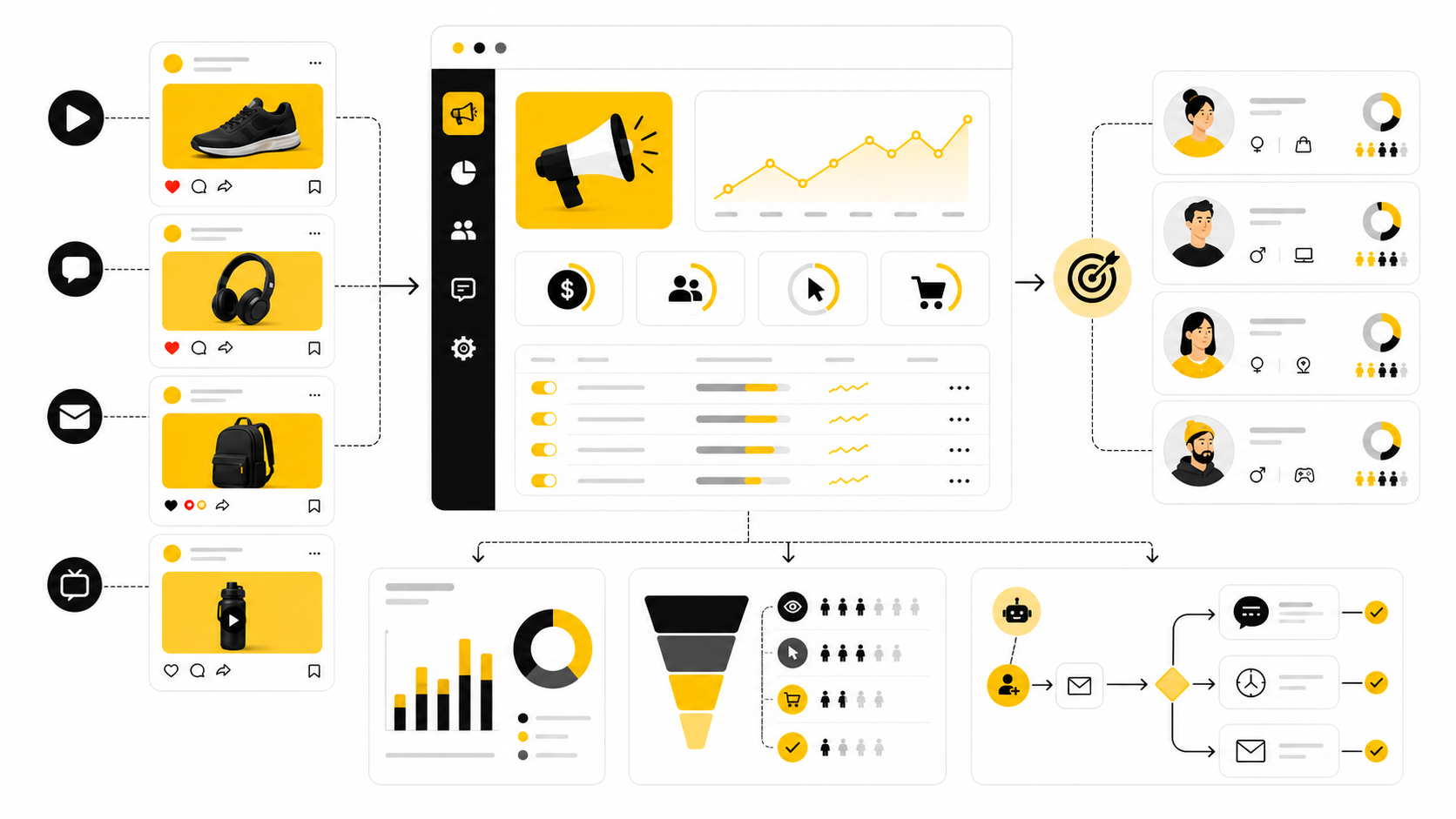
Advertising using social media is not just about boosting posts, chasing likes, or hoping one viral video saves the quarter. It is a paid growth system that uses platforms like Facebook, Instagram, TikTok, LinkedIn, YouTube, Pinterest, and others to put a specific offer in front of a specific audience with a measurable business goal. Done well, it connects creative, targeting, landing pages, follow-up, and reporting into one machine.
That matters because social platforms now sit in the middle of how people discover products, compare options, ask for recommendations, and decide who feels trustworthy. The opportunity is big, but so is the noise. If your ads look like generic brand announcements, they get ignored. If your tracking is weak, your budget gets wasted. If your offer is unclear, even good traffic will not convert.
The goal of this guide is to give you a complete, practical structure for building social media advertising that can actually support sales. Not theory. Not fluffy “post consistently” advice. A real operating framework you can use whether you are running ads for an ecommerce brand, a local service business, a SaaS company, a creator-led offer, or a B2B pipeline.
Here is how the full article will be structured across six parts:
Why Advertising Using Social Media Matters
Advertising using social media matters because attention has shifted from search-only buying journeys into messy, multi-touch discovery journeys. Someone may see a TikTok video, check Instagram comments, click a retargeting ad, visit a landing page, ignore the first offer, and then convert after a follow-up message or email. That is not a clean funnel, but it is how modern buying behavior often works.
The mistake many businesses make is treating social ads as a traffic source only. Traffic is part of it, but the real value comes from controlled repetition, creative testing, audience learning, and conversion feedback. Social ads let you test messages quickly, learn what people respond to, and turn the best angles into repeatable acquisition assets.
This is also why “just run ads” is bad advice. The ad is only one part of the system. Your offer, your creative, your landing page, your CRM, your lead response speed, and your retargeting all affect whether the campaign becomes profitable or expensive noise.
The Social Media Advertising Framework
A strong social media advertising strategy needs four layers: market clarity, campaign architecture, conversion infrastructure, and optimization rhythm. Market clarity answers who you are targeting and why they should care. Campaign architecture decides which platforms, objectives, budgets, audiences, and creatives you will test. Conversion infrastructure handles landing pages, forms, checkout, booking, messaging, and follow-up. Optimization rhythm turns data into decisions without panicking after every slow day.
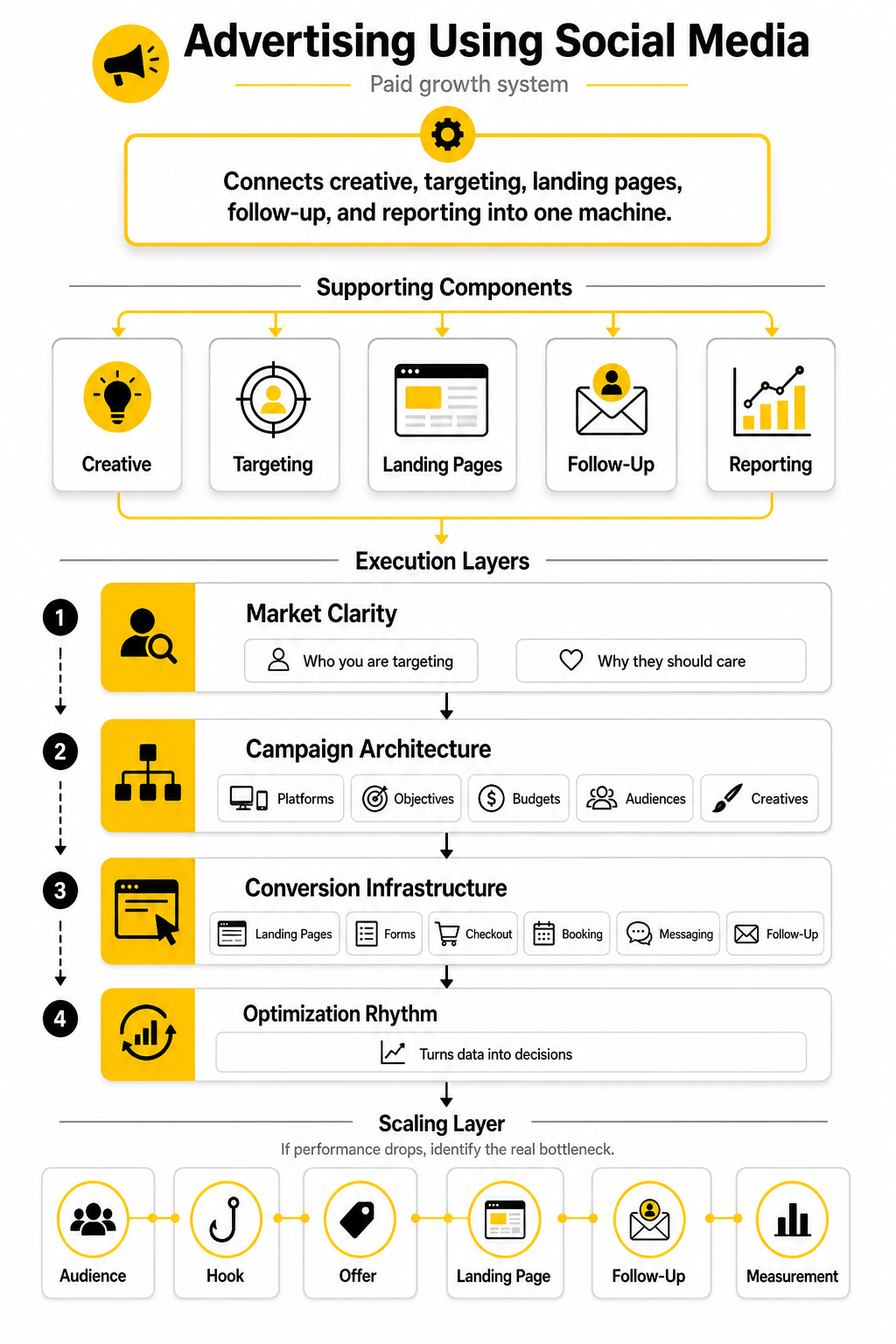
This framework keeps you from making the classic beginner mistake: changing everything at once. If performance drops, you need to know whether the problem is the audience, the hook, the offer, the landing page, the follow-up, or the measurement. Without a framework, every campaign feels like guesswork.
The rest of this guide will build that system step by step. First, we will define the strategic foundation behind advertising using social media. Then we will move into audience research, offer design, creative production, campaign setup, landing pages, automation, measurement, and scaling.
The Social Media Advertising Framework
The easiest way to make advertising using social media expensive is to treat every platform like a slot machine. You put money in, hope something hits, and then blame the algorithm when the results are weak. A better approach is to build around a simple framework: audience, offer, creative, conversion path, follow-up, and measurement.
This matters because social media advertising has become too large and too competitive for casual guessing. In the U.S. alone, social media ad revenue reached $117.7 billion in 2025, growing 32.6% year over year. Meta also reported 3.58 billion daily active people across its family of apps in December 2025, which shows why Facebook, Instagram, Messenger, and WhatsApp remain central to many paid social strategies.
But scale does not automatically create profit. Big platforms give you reach, targeting, creative formats, and machine learning. Your job is to give the system clear inputs, strong creative, a compelling offer, and a conversion process that does not leak money at every step.
Start With The Business Goal
Before choosing a platform or writing a single ad, define what the campaign is supposed to do for the business. Not “get awareness” in a vague way. Be specific about whether the campaign should generate leads, book calls, sell products, grow a waitlist, drive app installs, increase repeat purchases, or support a launch.
This one decision changes everything. A local service business that needs booked consultations should not build the same campaign as an ecommerce brand trying to scale product sales. A B2B company selling high-ticket software will usually need a longer journey than a creator selling a low-cost digital product.
The goal also shapes what you measure. If you want booked calls, cost per lead is not enough because low-quality leads can make the dashboard look good while wasting the sales team’s time. If you want product sales, return on ad spend matters, but so do margin, average order value, refund rate, and repeat purchase behavior.
Match The Platform To The Buying Journey
Each social platform has a different role in the buying journey. Instagram and TikTok are strong for visual discovery, creator-style content, short demonstrations, and fast message testing. LinkedIn is usually better when the buying context is professional, the audience is job-title specific, or the offer requires business credibility. YouTube can work well when education, comparison, and trust-building matter before the click.
This is why copying the same ad across every platform is usually lazy strategy. The same offer may need a different angle on each channel. A TikTok ad might open with a raw problem statement, while a LinkedIn ad might lead with a business consequence, and a YouTube ad might need more context before asking for action.
The practical move is to pick one primary platform and one support platform first. Build enough data to understand what is working before spreading the budget thin. Once the winning message is clear, expansion becomes much easier because you are adapting a proven idea instead of guessing from scratch.
Build Around The Offer, Not The Ad
A weak offer makes every ad work harder than it should. The hook may get attention, the creative may earn clicks, and the targeting may be accurate, but people still will not act if the offer feels unclear, risky, boring, or poorly timed. This is where many campaigns quietly fail.
A strong offer answers a simple question in the prospect’s mind: why should I act now instead of ignoring this? That answer might come from a valuable lead magnet, a limited-time promotion, a free audit, a product bundle, a demo, a trial, a workshop, or a clear transformation. The format matters less than the relevance.
For service businesses and agencies, this is where tools like GoHighLevel can fit naturally because the ad is only the first step. You still need forms, calendars, pipelines, reminders, email follow-up, SMS follow-up, and lead tracking. If those pieces are disconnected, advertising using social media becomes harder to manage and easier to misread.
Separate Cold, Warm, And Hot Audiences
Cold audiences do not know you yet. Warm audiences have engaged with your content, visited your site, watched your videos, opened emails, or interacted with your brand in some measurable way. Hot audiences are closer to purchase because they have taken stronger actions, such as viewing pricing, starting checkout, submitting a form, booking a call, or messaging your business.
You should not speak to all three groups the same way. Cold audiences often need problem awareness, proof, education, or a sharp hook that makes them stop scrolling. Warm audiences usually need comparison, objection handling, social proof, or a clearer reason to take the next step. Hot audiences often need urgency, reassurance, a reminder, or a simple path back to the action they already considered.
This segmentation keeps your messaging clean. It also prevents you from wasting budget by showing aggressive sales ads to people who barely understand the problem. A campaign becomes stronger when each audience sees the message that matches their current level of trust.
Use Creative As Market Research
Creative is not just decoration. In social media advertising, creative is often the targeting. The words, visuals, first three seconds, format, proof points, and offer framing all tell the platform who is likely to respond.
That is why serious advertisers test angles before they obsess over tiny button changes. One angle might focus on saving time. Another might focus on avoiding wasted spend. Another might focus on replacing manual work, getting faster response times, or making the buyer look good internally. The winning angle tells you what the market cares about enough to click, watch, or buy.
This is also where content planning becomes operationally important. A lightweight scheduler like Buffer can help keep organic and paid ideas organized, especially when your team is testing multiple hooks across channels. The point is not to post for the sake of posting. The point is to create a repeatable system for finding messages that earn attention before you put serious budget behind them.
Design The Conversion Path Before Scaling
The conversion path is everything that happens after the click. It includes the landing page, form, checkout, calendar, thank-you page, email sequence, SMS sequence, sales handoff, retargeting audience, and reporting setup. If that path is weak, scaling traffic only scales the weakness.
A strong conversion path is simple, specific, and consistent with the ad. If the ad promises a free consultation, the page should make booking obvious. If the ad promotes a product, the page should answer the buyer’s main objections quickly. If the ad offers a guide or checklist, the form should not feel heavier than the value being offered.
This is where many businesses need to slow down before spending more. If people click but do not convert, the problem may not be the ad. It may be the page, the offer, the form, the mobile experience, the trust signals, or the follow-up process after submission. Scaling should come after the path proves it can turn attention into action.
Audience, Offer, And Positioning
Once the framework is clear, the next step is implementation. This is where advertising using social media moves from strategy into actual campaign planning. Before you build ads, landing pages, automations, or reports, you need to know exactly who you are speaking to, what you are asking them to do, and why your offer deserves attention now.
This is not branding fluff. It is the difference between a campaign that finds buyers and a campaign that attracts random clicks. Social platforms can distribute your message quickly, but they cannot fix a vague offer or a confused audience definition.
The practical order is simple: define the buyer, sharpen the offer, choose the platform, map the funnel, then create the campaign assets. If you skip that order, you usually end up rewriting ads, rebuilding pages, and changing audiences after the budget is already spent.
Define The Buyer Before You Define The Campaign
The first job is not to pick interests, hashtags, or placements. The first job is to understand the buyer’s situation. What problem are they actively trying to solve? What have they already tried? What makes them hesitate? What outcome would feel valuable enough to click, submit a form, book a call, or buy?
This matters because social media audiences are not sitting there waiting for your ad. They are scrolling, watching, comparing, saving, ignoring, and occasionally acting when something feels relevant. With the typical internet user spending more than 2.5 hours per day on social and video platforms, the opportunity is huge, but attention is still earned one message at a time.
A useful buyer profile should go deeper than demographics. Age, location, income, job title, and interests can help with planning, but they rarely produce strong ads on their own. Better inputs include pain points, buying triggers, objections, desired outcomes, alternative solutions, and the emotional language buyers already use when describing the problem.
Build A Buyer Research File
Before launching, create a simple research file for the campaign. Pull language from sales calls, customer support messages, reviews, comments, survey responses, Reddit threads, YouTube comments, competitor ads, and internal CRM notes. The goal is to collect real wording, not invent clever phrases in a vacuum.
This file should answer four practical questions:
Those answers become raw material for hooks, headlines, landing page sections, video scripts, email follow-up, and retargeting angles. This is also where a lot of weak campaigns can be rescued. When the messaging starts sounding like the buyer’s real world, performance usually has a better chance.
Shape The Offer Around A Clear Next Step
A social media ad should not ask people to think too hard. The offer needs to make the next step obvious. Download the guide, claim the discount, book the audit, start the trial, join the workshop, get the quote, watch the demo, or message the business.
The more expensive or complex the product, the more trust the offer usually needs to build before asking for the sale. A $29 template can often go straight to checkout if the creative and page are strong. A $5,000 service may need a diagnostic call, a webinar, a case study page, or a consultation flow before the buyer is ready.
This is why advertising using social media works best when the offer matches the buyer’s stage of awareness. Cold audiences may respond better to education, problem framing, or a useful tool. Warm audiences may respond better to proof, comparison, and objection handling. Hot audiences may only need a reminder, bonus, deadline, or easier path back to the decision.
Turn The Offer Into A Campaign Promise
The campaign promise is the simple idea your ad is built around. It is not a slogan. It is the clear value exchange between the buyer’s attention and your offer.
For example, a weak promise sounds like “grow your business with our marketing solution.” A stronger promise sounds like “see which part of your follow-up process is costing you booked calls.” The second version is more specific, more believable, and easier to connect to a lead-generation offer.
A good campaign promise usually has three parts:
This is where positioning becomes practical. You are not just saying your offer is good. You are showing why it is relevant, why it is different, and why the buyer should care now.
Map The Implementation Process
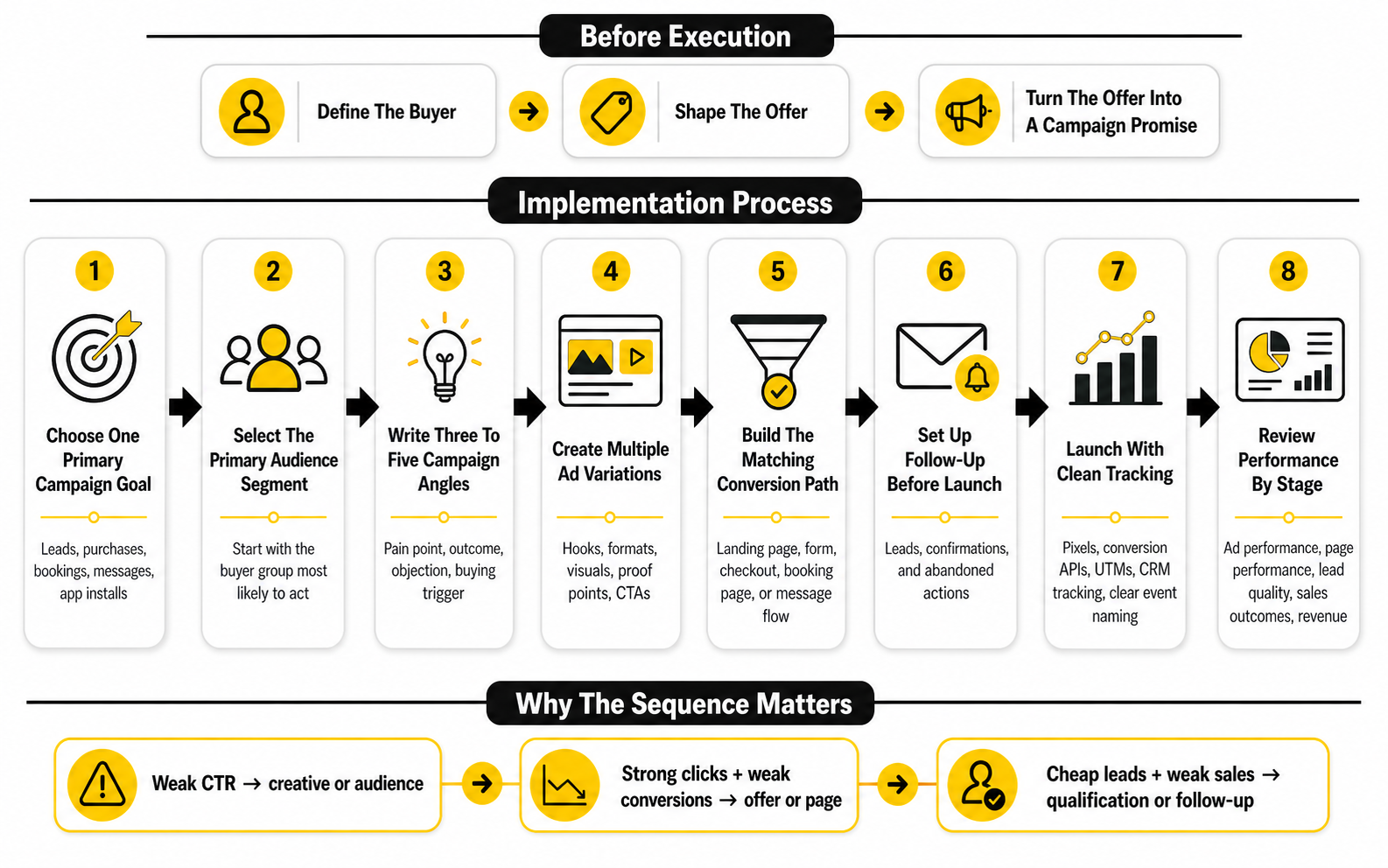
Once the buyer and offer are clear, you can turn the strategy into an execution process. Keep this simple. A messy launch process creates messy data, and messy data makes optimization painful.
Use this sequence:
This process makes the campaign easier to diagnose. If click-through rate is weak, the creative or audience may need work. If clicks are strong but conversions are weak, the offer or page may be the issue. If leads are cheap but sales are bad, qualification and follow-up need attention.
Choose The Right Funnel Type
Not every campaign needs the same funnel. The funnel should match the complexity of the offer and the level of trust required. This is where many businesses overbuild or underbuild.
For a simple ecommerce product, the funnel may be ad to product page to checkout to post-purchase email. For a local service, it may be ad to landing page to form to calendar to SMS reminders. For a B2B offer, it may be ad to guide, retargeting to case study, then booking page. For a creator or coach, it may be short-form content to webinar registration to email sequence to offer page.
If you need a fast way to build direct-response pages, tools like ClickFunnels or Systeme.io can make sense when the goal is to launch a focused campaign without waiting on a full website rebuild. The key is to keep the page aligned with the ad promise. A funnel builder will not save a weak offer, but it can remove technical friction when the strategy is already clear.
Make Follow-Up Part Of The Campaign
A lot of businesses treat follow-up like an administrative task. That is a mistake. Follow-up is part of the advertising system because many people do not convert the first time they click.
For lead-generation campaigns, the first few minutes after submission matter because intent is still fresh. For ecommerce, abandoned carts, product view retargeting, and post-purchase flows can improve the economics of paid traffic. For message-based campaigns, automated replies can qualify interest quickly before a human takes over.
A tool like ManyChat can fit naturally when the campaign uses Instagram, Messenger, or chat-based entry points. For email-heavy journeys, platforms like Brevo or Moosend can help turn ad clicks into longer-term nurture instead of one-shot interactions.
Keep The First Launch Controlled
The first launch should prove the system, not impress anyone with complexity. Start with a focused budget, a limited number of audiences, a clear offer, and enough creative variation to learn something useful. You do not need twenty campaigns if you do not yet know which message works.
A controlled launch also protects you from false conclusions. If you test too many variables at once, you may see results but not understand why they happened. That makes the next decision harder.
The better approach is to test deliberately. Compare angles. Watch where people drop off. Read the comments. Review lead quality. Check the sales notes. Advertising using social media gets much stronger when campaign data and human feedback are used together instead of treated as separate worlds.
Statistics And Data
The numbers in advertising using social media are useful only when they help you make better decisions. A benchmark can tell you whether your cost per click is unusually high, but it cannot tell you whether your offer is weak. A platform report can show that ad inventory is growing, but it cannot tell you whether your specific audience is ready to buy.
That is why measurement needs to be practical. You are not collecting data to make a dashboard look impressive. You are collecting data so you can decide what to keep, what to cut, what to fix, and what to scale.
Social media advertising is clearly not a small channel anymore. U.S. social media ad revenue reached $117.7 billion in 2025, up 32.6% year over year, which shows how much budget is moving into social platforms. Globally, social platforms remain massive attention environments, with 5.66 billion social media user identities reported in the Digital 2026 Global Overview Report. Those numbers matter because more advertisers are competing in the same feeds, stories, reels, shorts, and inboxes.
Treat Benchmarks As Context, Not Targets
Benchmarks are helpful, but they are not your business model. If a report says your industry has a certain average CPC, CPM, CTR, conversion rate, or cost per lead, that gives you a reference point. It does not automatically mean your campaign is good or bad.
A high CPC can still be profitable if the leads are qualified and the offer has strong margins. A low CPC can still be useless if the traffic never converts. A strong click-through rate can look exciting, but it may only mean the creative is good at attracting curiosity rather than buyers.
Use benchmarks to ask better questions. If your CPM is much higher than expected, check audience size, competition, seasonality, placement mix, and creative quality. If your CTR is low, review the hook, visual, promise, and audience match. If your conversion rate is weak, stop blaming the platform first and inspect the landing page, offer, load speed, form friction, and trust signals.
Know What Each Metric Actually Tells You
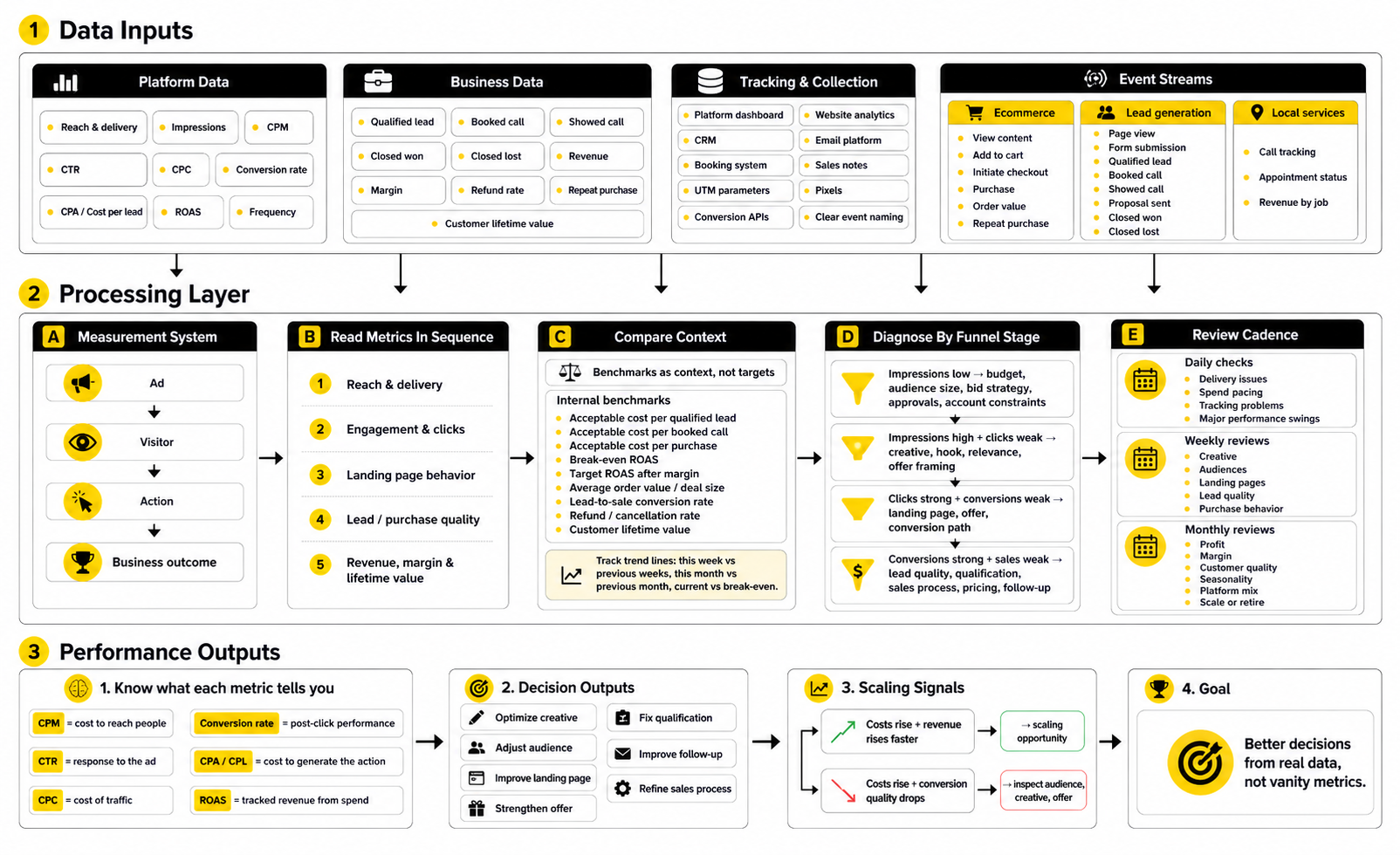
Every metric has a job. CPM tells you how expensive it is to reach people. CTR tells you whether people are responding to the ad enough to click. CPC tells you the cost of that traffic. Conversion rate tells you whether the post-click experience is doing its job. CPA or cost per lead tells you what it costs to generate an action. ROAS tells you how much tracked revenue came back from the spend.
The problem starts when people use one metric to explain the whole campaign. A campaign with a bad CTR may still produce profitable buyers if the message filters out poor-fit clicks. A campaign with a great ROAS may still be hard to scale if the audience is too small. A campaign with cheap leads may still fail if the sales team cannot close them.
This is why you should read metrics in sequence, not isolation. First, look at reach and delivery. Then check engagement and clicks. Then inspect landing page behavior. Then review lead quality or purchase quality. Finally, compare revenue, margin, and lifetime value against the cost of acquisition.
Build A Simple Measurement System
A strong measurement system does not need to be complicated. It needs to connect the ad, the visitor, the action, and the business outcome. That means your platform dashboard, website analytics, CRM, email platform, booking system, and sales notes should tell the same story as much as possible.
Start with clean naming. Campaign names should show the platform, objective, audience, offer, market, and date. Ad names should show the angle, format, hook, and creative version. Landing pages should use clear UTM parameters so you can tell which ads created which visits, leads, bookings, or purchases.
Then connect the important events. For ecommerce, that may include view content, add to cart, initiate checkout, purchase, order value, and repeat purchase. For lead generation, that may include page view, form submission, qualified lead, booked call, showed call, proposal sent, closed won, and closed lost. For local services, you may also need call tracking, appointment status, and revenue by job.
Separate Platform Data From Business Data
Platform data is useful, but it is not the final truth. Meta, TikTok, LinkedIn, Pinterest, YouTube, and other platforms each use their own attribution methods. They can help you understand campaign performance, but they may over-credit or under-credit certain actions depending on the journey.
Business data gives you the more grounded answer. Did the lead answer the phone? Did the booked call show up? Did the customer pay? Did the order have enough margin? Did the buyer refund? Did they buy again?
This is especially important when advertising using social media for high-ticket offers or longer sales cycles. The ad platform might optimize for form submissions because that is the easiest conversion event to see. Your business may care about qualified opportunities, closed deals, or retained customers. If those two goals are not aligned, the campaign can look good while the business outcome stays weak.
Watch Cost Trends Without Panicking
Ad costs move because markets move. Competition changes, creative fatigue builds, seasonal demand rises, privacy rules shift, and platform algorithms evolve. Meta reported that its ad impressions increased 12% for full-year 2025 while average price per ad increased 9%, which is a useful reminder that both inventory and pricing can rise at the same time.
That does not mean you should panic every time CPM goes up. Higher CPMs can still be acceptable if conversion quality improves or average order value increases. Lower CPMs can still be bad if the platform is finding cheap attention from people who never buy.
The better move is to track your own trend lines. Compare this week against the previous few weeks, this month against the previous month, and current performance against your break-even numbers. If costs rise but revenue rises faster, you may have a scaling opportunity. If costs rise while conversion quality drops, you need to inspect the audience, creative, and offer before adding more budget.
Use Industry Benchmarks Carefully
Industry reports can help you avoid flying blind. The WordStream 2025 Facebook ads benchmarks break down KPIs like CTR, CPC, conversion rate, and cost per lead by industry and campaign objective. The Triple Whale Meta ads benchmark analysis reviewed performance across nearly 35,000 brands for 2025, which is useful for ecommerce operators comparing metrics like CPA, CPM, AOV, ROAS, and conversion rate. The Gupta Media 2025 social media ads cost report looks at social ad costs using tens of billions of impressions, which can help with CPM expectations across platforms.
Still, benchmarks should not become excuses. If your numbers are worse than the benchmark, do not assume the platform is the problem. If your numbers are better than the benchmark, do not assume the campaign is ready to scale. The only benchmark that truly matters is your profitable acquisition range.
A good internal benchmark includes:
These numbers turn vague optimization into real decision-making. Without them, you are just reacting to dashboard colors.
Diagnose Performance By Funnel Stage
When performance drops, do not change everything at once. Break the campaign into stages and find the bottleneck. This is where a simple diagnostic process saves a lot of money.
If impressions are low, the issue may be budget, audience size, bid strategy, approvals, or account constraints. If impressions are high but clicks are weak, the issue is usually creative, hook, relevance, or offer framing. If clicks are strong but conversions are weak, the landing page or conversion path needs attention. If conversions are strong but sales are weak, the lead quality, qualification, sales process, pricing, or follow-up may be the real problem.
This is also where tools matter. A landing page builder like Replo can help ecommerce teams test product page and landing page variations faster. A form tool like Fillout can help reduce friction in lead capture flows. A CRM and automation platform like GoHighLevel can help connect leads, appointments, reminders, pipelines, and revenue so the campaign is measured beyond the first form fill.
Measure Creative Fatigue Before It Gets Expensive
Creative fatigue happens when the audience has seen the same ad too often and stops responding. You may see frequency rise, CTR fall, CPC increase, comments become repetitive, or conversion rate drop. Sometimes the campaign still spends, but the quality of attention gets worse.
Do not wait until the ad is completely dead. Watch creative performance by version, not only by campaign. A campaign can look stable while one winning ad is quietly carrying everything. When that ad slows down, the whole account can feel like it “suddenly” broke.
The fix is not to make random new ads. Build creative around proven angles. Keep the core promise, but test new hooks, openings, visuals, formats, proof points, and objections. This keeps the learning intact while giving the platform fresh assets to work with.
Turn Data Into Decisions
Data should lead to action. If a metric does not change a decision, it probably does not deserve much attention. A clean reporting rhythm helps you avoid emotional optimization and random budget changes.
Daily checks should focus on delivery issues, spend pacing, obvious tracking problems, and major performance swings. Weekly reviews should compare creative, audiences, landing pages, lead quality, and purchase behavior. Monthly reviews should look at profit, margin, customer quality, seasonality, platform mix, and what should be scaled or retired.
The best operators do not worship dashboards. They use dashboards to find questions, then use business context to answer them. That is the real point of measurement in advertising using social media: not more data, but better decisions.
Advanced Scaling Considerations
Once the campaign is working, the next challenge is not simply spending more money. Scaling advertising using social media means increasing volume without destroying the economics that made the campaign work in the first place. That is where many advertisers get impatient, push budget too hard, and watch performance collapse.
The goal is controlled expansion. You want more reach, more conversions, and more revenue, but you also need to protect margin, lead quality, creative freshness, and measurement accuracy. Scaling is not one big move. It is a series of careful decisions that compound when the system is built properly.
This is where the strategy becomes more advanced. You are no longer asking, “Can this campaign work?” You are asking, “Can this campaign keep working as the audience gets bigger, the spend increases, the creative ages, and competitors react?”
Scale The System, Not Just The Budget
Raising the daily budget is the most obvious way to scale, but it is not always the smartest first move. If the campaign only works at a small spend level, increasing budget can force the platform to find less qualified traffic. That usually shows up as higher CPAs, weaker lead quality, lower ROAS, or more inconsistent days.
Before increasing spend aggressively, look at the parts of the system that support scale. Do you have enough creative variety? Is the offer still converting outside the easiest audience segment? Can your landing page handle more traffic? Can your sales team respond quickly? Can your follow-up sequence keep leads engaged when volume rises?
A campaign is ready for more budget when the whole path can absorb more demand. If the ad account is strong but the sales process is slow, scaling will expose that weakness fast. If the page converts well but the creative library is thin, fatigue will hit sooner than expected.
Expand In Layers
Scaling works best when you expand in layers instead of changing everything at once. The first layer is usually budget expansion on the winning campaign. The second layer is creative expansion around proven angles. The third layer is audience expansion into broader segments, lookalikes, new geographies, or adjacent buyer groups. The fourth layer is platform expansion.
This order matters because each layer carries risk. Budget expansion can increase volatility. Creative expansion can dilute the message if the team chases novelty instead of proven demand. Audience expansion can bring in people who are less ready to act. Platform expansion can create tracking and production complexity.
A simple rule helps: scale what has already shown signal before testing what is completely unknown. If one pain point is clearly driving qualified leads, make more creative around that pain point before jumping to a totally different message. If one landing page is converting, create variations from that structure before rebuilding the whole funnel.
Protect Creative Quality As Volume Increases
Creative becomes harder to manage as spend grows. At low budgets, one or two strong ads can carry the campaign. At higher budgets, the audience sees your ads more often, fatigue appears faster, and the platform needs more creative options to find new pockets of demand.
TikTok’s own ad guidance emphasizes native-feeling creative, clear messaging, and frequent creative refreshes in its ads best practices. That matters beyond TikTok because the same principle applies across modern paid social. People do not want to feel like they are being interrupted by generic ads. They respond better when the creative fits the platform, earns attention quickly, and makes the next step obvious.
Treat creative production like an operating system, not a last-minute task. Build a backlog of hooks, objections, proof points, product demonstrations, founder videos, customer questions, comparison angles, and offer explanations. Then test them in a structured way so you learn what the market is actually rewarding.
Balance Automation With Human Judgment
Social ad platforms are moving deeper into automation. Meta’s Advantage+ products, TikTok’s automated optimization tools, and similar systems across other platforms can make targeting, bidding, placement, and creative delivery more efficient. That is useful, but it does not remove the need for strategy.
Automation works best when you feed it strong inputs. Clear conversion events, clean tracking, strong creative, enough budget, relevant landing pages, and a real offer give the system something useful to optimize toward. Weak inputs create weak outputs faster.
The danger is trusting automation blindly. If the platform optimizes for cheap leads, it may find people who fill out forms but never buy. If it optimizes for low-cost purchases, it may favor discounted buyers who never come back. If it optimizes from incomplete tracking, it may make decisions based on a partial view of reality.
Think Beyond Last-Click Attribution
Last-click attribution is comfortable because it feels simple. Someone clicked an ad and converted, so the ad gets credit. The problem is that social media often influences people before they are ready to click or buy.
A person might watch three videos, visit the profile, search the brand later, click a Google result, and then purchase. In a last-click report, search may get the credit while social looks weaker than it really is. That does not mean social deserves unlimited credit, but it does mean you should be careful before cutting campaigns that are creating demand earlier in the journey.
This is why advanced teams compare several views of performance. They look at platform data, analytics data, CRM data, post-purchase surveys, branded search trends, direct traffic, email growth, and sales feedback. None of those signals is perfect alone, but together they give a more realistic picture of what advertising using social media is doing.
Manage Privacy And Tracking Risk
Privacy changes have made measurement harder, and that is not going away. Browser limits, consent requirements, app tracking restrictions, cookie loss, and platform attribution changes all affect what advertisers can see. The practical response is not to complain about tracking. It is to build a more resilient measurement setup.
Server-side tracking, conversion APIs, first-party data, UTM discipline, CRM hygiene, and clean event naming all matter more now. The IAB has pushed for stronger conversion API adoption in measurement because server-to-server data sharing can help advertisers connect ad exposure to outcomes in a more privacy-safe way, especially as measurement becomes more fragmented across channels like CTV and social media advertising. The same logic applies to paid social: the closer your tracking is to real business events, the better your decisions become.
You also need to respect consent and data quality. Do not collect data you do not need. Do not create messy audiences from unreliable events. Do not assume the platform dashboard sees everything. Better tracking is not about spying on people. It is about measuring real actions responsibly enough to make better business decisions.
Watch The Tradeoff Between Efficiency And Growth
There is always tension between efficiency and growth. A small retargeting campaign may show a beautiful ROAS because it reaches people who already know the brand. A broader prospecting campaign may look less efficient because it is doing the harder job of creating new demand. Both can be useful, but they should not be judged the same way.
If you only optimize for the highest short-term ROAS, you may over-invest in warm audiences and starve the top of the funnel. If you only chase reach and growth, you may spend too much on people who never convert. The balance depends on the maturity of the business, the sales cycle, the market size, and the cash flow reality.
A practical paid social account usually needs both. Prospecting brings in new people. Retargeting captures existing interest. Follow-up converts people who need more time. The mistake is pretending one campaign type should carry the whole business.
Build A Real Testing Cadence
Random testing is not strategy. Changing the headline today, the audience tomorrow, the landing page next week, and the offer after one bad day will not teach you much. You need a cadence that separates learning from reacting.
A useful testing cadence might include weekly creative tests, biweekly landing page reviews, monthly offer reviews, and quarterly platform mix reviews. The exact timing depends on spend and conversion volume. The principle is what matters: test the highest-impact variables with enough consistency to trust the result.
For landing page testing, a focused page builder like ClickFunnels or Systeme.io can help move faster when the campaign needs a dedicated funnel instead of a full site rebuild. For ecommerce teams that need more flexible product and landing page experiments, Replo can fit better. The tool is not the strategy, but speed matters when you are testing serious traffic.
Prepare For Operational Bottlenecks
Paid social can create demand faster than the business can handle it. That sounds like a good problem until leads go unanswered, booked calls no-show, inventory runs out, shipping slows down, or customer support gets overwhelmed. Then the campaign gets blamed for problems that are really operational.
Before scaling, check the fulfillment side. Can the business handle more orders? Can the team respond to more inquiries? Are appointment reminders in place? Are sales reps following a consistent process? Are refund reasons being tracked?
This is where automation can protect performance. A platform like GoHighLevel can help service businesses connect forms, calendars, pipelines, reminders, and follow-up so leads do not fall through the cracks. For campaigns built around chat or social messaging, ManyChat can help qualify and route conversations before the team gets involved.
Do Not Confuse More Channels With More Strategy
Adding platforms can be smart, but only when the core message is already working. Too many businesses jump from Meta to TikTok to LinkedIn to YouTube because they are frustrated, not because they have a clear expansion plan. That usually creates scattered spend and shallow learning.
Each platform needs its own creative style, audience logic, reporting expectations, and conversion path. LinkedIn traffic may cost more but produce stronger B2B intent. TikTok may require more native creative volume. YouTube may need more education and stronger retention. Instagram may reward visual clarity and social proof.
The strategic question is not, “Should we be everywhere?” The question is, “Where does this buyer pay attention, and what kind of message fits that environment?” When you answer that honestly, platform expansion becomes cleaner and less emotional.
Know When To Stop Scaling
Not every campaign deserves more budget. Some campaigns are profitable only because they are small. Some offers work for a narrow audience but break when pushed broader. Some products do not have enough margin to support aggressive paid acquisition.
Stopping is not failure. Pausing a campaign that has reached its ceiling is often the responsible move. You can then use what you learned to improve the offer, create a new angle, build a better funnel, increase average order value, strengthen retention, or move into a more suitable channel.
The best advertisers are not addicted to spend. They are disciplined about profit. Advertising using social media should create leverage for the business, not pressure the business into chasing vanity growth.
Measurement, Optimization, Scaling, And FAQ
At this stage, advertising using social media should no longer feel like a collection of disconnected campaigns. The audience, offer, creative, landing page, follow-up, and measurement system should all point in the same direction. That is when paid social becomes easier to manage because every part of the system has a job.
The final layer is making the system durable. You need a way to keep testing creative, improve conversion paths, protect lead quality, and understand what your data is actually telling you. You also need to know when to scale, when to pause, and when to rebuild the offer instead of blaming the platform.
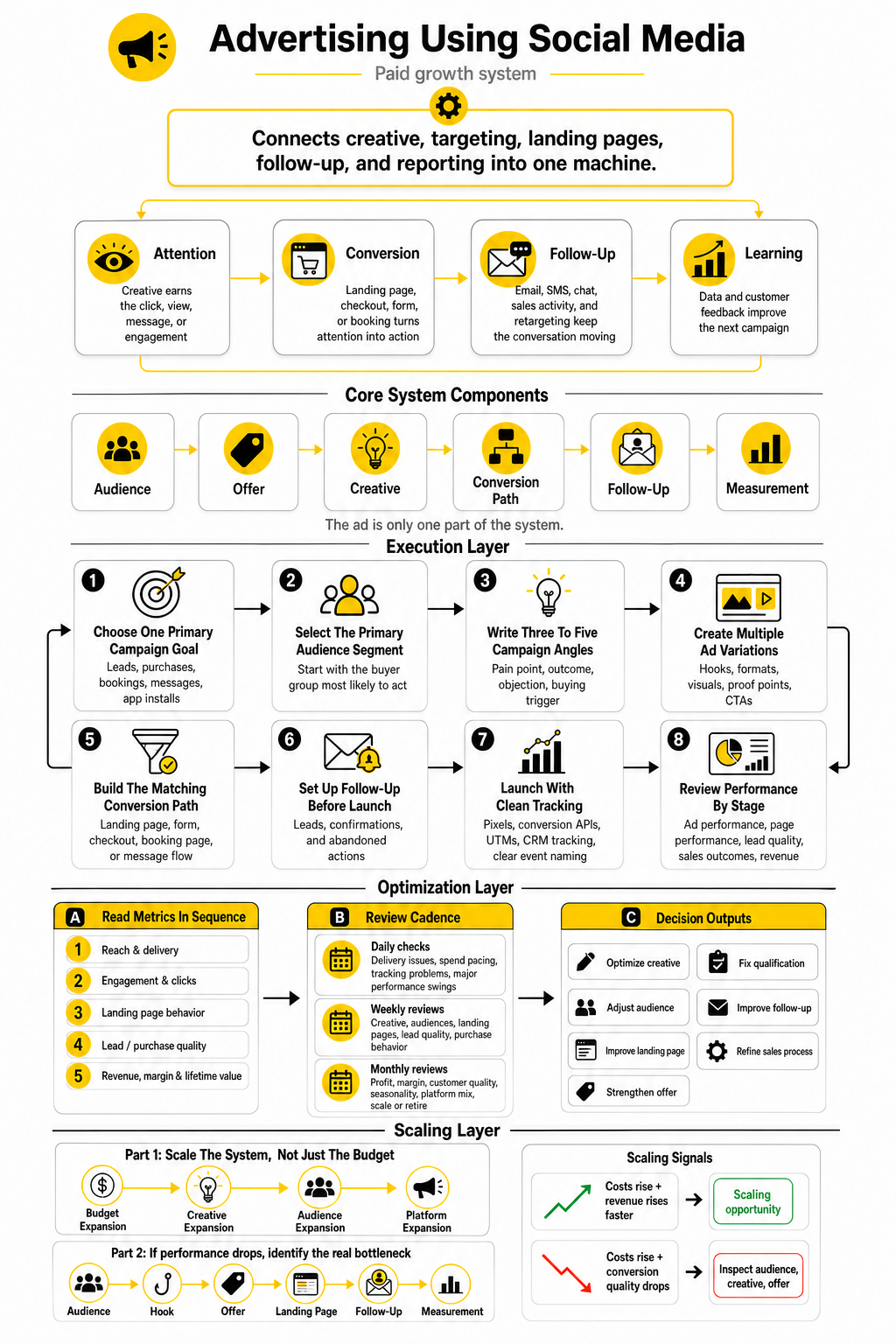
The businesses that win with social ads are usually not the ones with the fanciest dashboards. They are the ones that keep the fundamentals tight for longer than their competitors. They know their buyer, they test clear messages, they follow up quickly, and they make decisions from revenue data instead of ego.
Build A Complete Paid Social Ecosystem
A complete paid social ecosystem has four loops. The first loop is attention, where creative earns the click, view, message, or engagement. The second loop is conversion, where the landing page, checkout, form, or booking flow turns attention into action. The third loop is follow-up, where email, SMS, chat, sales activity, and retargeting keep the conversation moving. The fourth loop is learning, where data and customer feedback improve the next campaign.
Most weak campaigns break because one of these loops is missing. The ads may get clicks, but the page does not convert. The page may generate leads, but nobody follows up fast enough. The follow-up may happen, but the CRM does not show which ad created the best customers. When the loops are disconnected, the whole system becomes harder to scale.
This is why advertising using social media should be treated as a business process, not just a media buying task. A media buyer can manage campaigns, but the business still needs offer clarity, sales discipline, customer insight, and operational follow-through. The better those pieces work together, the less fragile the ad account becomes.
Create A Practical Optimization Rhythm
Optimization should not mean touching campaigns every few hours because a metric looks uncomfortable. That kind of behavior usually creates noise. You need a rhythm that gives campaigns enough time to learn while still catching problems before they waste serious budget.
Daily checks should focus on obvious issues: rejected ads, broken links, tracking errors, spend pacing, sudden delivery drops, and major cost spikes. Weekly checks should focus on creative performance, landing page conversion, lead quality, sales notes, and budget allocation. Monthly checks should focus on bigger decisions like offer changes, funnel improvements, platform expansion, audience strategy, and profit.
The key is to separate monitoring from decision-making. Monitoring tells you what is happening. Decision-making tells you what to do next. If every small movement becomes a decision, the campaign never gets a fair test.
Know What To Fix First
When results are weak, fix the biggest constraint first. If the ad is not getting clicks, the creative or audience match needs attention. If clicks are happening but conversions are poor, the page, offer, or form is the likely bottleneck. If leads are coming in but sales are weak, the follow-up, qualification, pricing, or sales process needs work.
This sounds simple, but it is where many advertisers waste time. They change targeting when the offer is the issue. They redesign landing pages when the sales team is slow. They cut campaigns that are creating good leads because the CRM is not tracking them properly.
A better diagnostic order is:
That order keeps you grounded. It also prevents random optimization, which is one of the fastest ways to ruin a campaign that could have worked.
Make The Next Campaign Easier Than The Last One
Every campaign should leave behind reusable assets. Winning hooks should become new ad scripts. Strong objections should become landing page sections. Good sales call notes should become retargeting angles. Common questions should become email sequences, chat flows, and new creative ideas.
This is where paid social becomes more efficient over time. The first campaign may require a lot of research, setup, and testing. The next campaign should be faster because you now understand more about the buyer, the message, the offer, and the conversion path.
Do not throw away learning just because one campaign ends. Build a small internal library of tested angles, creative concepts, audience notes, page variants, objections, proof points, and performance takeaways. That library becomes a serious advantage when competitors are still starting every launch from a blank page.
What is advertising using social media?
Advertising using social media means paying social platforms to show ads to targeted audiences based on goals like sales, leads, bookings, app installs, messages, traffic, or awareness. It includes the ad creative, audience strategy, campaign setup, landing page, follow-up, tracking, and optimization. The strongest campaigns treat all of those pieces as one system instead of judging the ad alone.
Which social media platform is best for advertising?
The best platform depends on the buyer, the offer, and the buying journey. Meta can be strong for broad consumer reach, retargeting, ecommerce, local services, and lead generation. TikTok can be powerful for native short-form creative and fast message testing. LinkedIn often makes more sense for B2B campaigns where job role, company type, or professional context matters.
How much should a business spend on social media ads?
A useful starting budget should be large enough to generate meaningful data without putting the business under pressure. For small campaigns, that may mean testing a focused offer with a controlled daily budget until you can see whether people click, convert, and become qualified leads or buyers. The right number depends on average order value, sales cycle, margin, conversion rate, and how quickly you need results.
Why do social media ads fail?
Social media ads usually fail because the system is weak, not because the platform is impossible. Common problems include vague targeting, boring creative, unclear offers, slow landing pages, too much form friction, weak follow-up, poor tracking, and unrealistic expectations. If the buyer does not understand why they should act now, the campaign will struggle no matter how much budget you add.
What metrics matter most in social media advertising?
The most important metrics depend on the campaign goal, but you usually want to watch CPM, CTR, CPC, conversion rate, cost per lead, cost per purchase, ROAS, lead quality, close rate, margin, and customer lifetime value. The mistake is judging everything from one number. A cheap lead is not useful if it never becomes revenue, and a high CPC is not automatically bad if the traffic converts into profitable customers.
How long should I run a social media ad test?
Run a test long enough to collect useful signal, not just emotional reactions. If the budget is tiny, you may need more time before the data means anything. If the campaign spends enough to generate conversions quickly, you can make decisions sooner. The key is to test one clear variable at a time whenever possible so you know what actually caused the change.
Should I use a landing page or send traffic to my website?
Use a dedicated landing page when the campaign has one specific offer and one desired action. A normal website can work when it is already built for conversion, but many websites have too many distractions for paid traffic. If the ad promises a specific result, the page should continue that same promise immediately and make the next step obvious.
Do I need automation for social media advertising?
You do not need automation to start, but you usually need it to scale properly. Leads need confirmations, reminders, follow-up messages, qualification steps, sales handoffs, and retargeting audiences. Tools like GoHighLevel, ManyChat, Brevo, and Moosend can help when follow-up becomes too important to manage manually.
How often should I refresh ad creative?
Refresh creative when performance signals show fatigue or when the audience has seen the same message too often. Signs include rising frequency, falling CTR, increasing CPC, weaker conversion rates, and lower-quality engagement. The best approach is not random replacement. Keep the proven angle and test new hooks, visuals, formats, openings, objections, and proof points.
Is retargeting still worth using?
Retargeting is still useful, but it should not be your whole strategy. It works because it reaches people who already showed interest, but the audience is naturally limited. If you rely only on retargeting, growth eventually slows because not enough new people are entering the funnel. Use retargeting to capture existing demand, and use prospecting to create new demand.
What is the biggest mistake beginners make with social media ads?
The biggest mistake is launching before the offer and conversion path are ready. Beginners often spend too much time inside the ad manager and not enough time sharpening the message, page, form, checkout, calendar, or follow-up. The platform can deliver traffic, but it cannot make a weak offer feel urgent or make a confusing page convert.
Can social media ads work for B2B companies?
Yes, but B2B campaigns usually need a more thoughtful journey. The buyer may need education, proof, comparison, internal buy-in, and a clear business case before taking action. LinkedIn can be useful for professional targeting, while Meta, YouTube, and TikTok can still support awareness, retargeting, founder-led content, and demand creation depending on the market.
Should I use AI in social media advertising?
AI can help with research, ideation, draft variations, workflow speed, reporting summaries, and customer support, but it should not replace strategic thinking. The best use is to speed up production while a human still controls positioning, claims, compliance, and final creative judgment. Tools like GoHighLevel AI, Chatbase, and Wispr Flow can support parts of the workflow when used carefully.
What should I do before increasing ad spend?
Before increasing spend, confirm that the campaign is profitable or at least moving toward a clear target. Check creative fatigue, lead quality, conversion rate, sales close rate, average order value, margin, and follow-up capacity. Scaling too early can turn a small working campaign into a larger expensive problem.
What is the best way to start advertising using social media?
Start with one clear buyer, one strong offer, one primary platform, one conversion path, and a small set of creative angles. Keep the launch focused enough that you can understand what is working. Once you see reliable signals, improve the weakest part of the system before expanding budget, audience, or platform mix.
Build a stronger local presence with BAAM AI
Turn your website, Google profile, social channels, and AI visibility into one growth engine
Most businesses do not need more random marketing activity. They need a consistent presence system that helps the right people find them, trust them, and take action. BAAM AI brings strategy, local SEO, website updates, Google Maps visibility, social content, AI-search readiness, media production, and reporting into one practical monthly engine.
If you want your marketing to keep working after the campaign ends, start with a free BAAM AI presence audit. See how your business shows up today and where the fastest visibility wins are at BAAM AI.