
BAAM AI Blog
Advertising Through Social Media: A Practical Framework For Turning Attention Into Revenue
Advertising through social media is no longer just a way to “get visibility.” It is a full commercial system that connects audience research, creative testing, paid distribution, retargeting, conversion tracking, and...
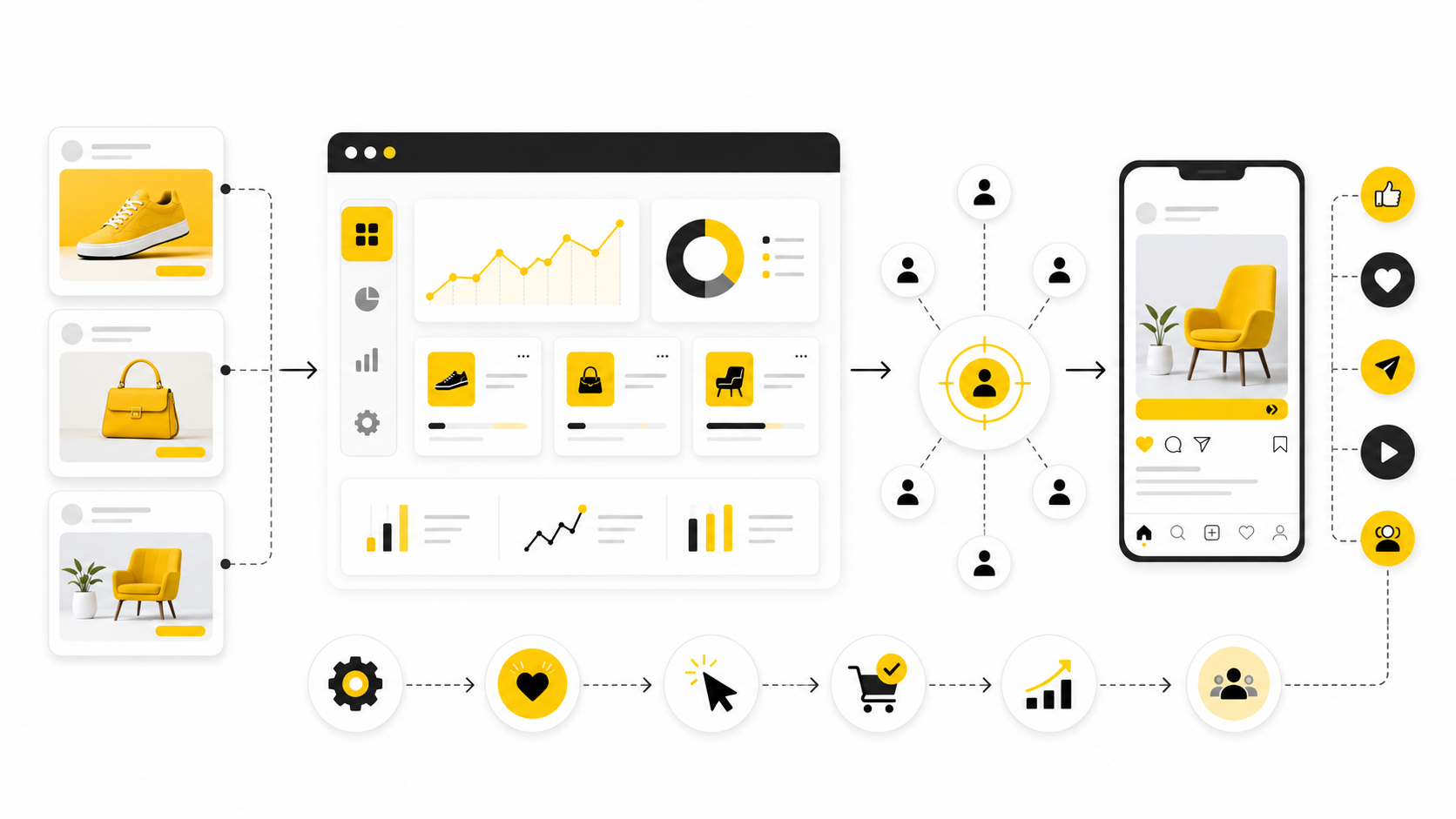
Advertising through social media is no longer just a way to “get visibility.” It is a full commercial system that connects audience research, creative testing, paid distribution, retargeting, conversion tracking, and post-click follow-up. When it works, it does not feel like random posting with a budget behind it. It feels like a controlled growth engine.
The reason this matters is simple: people now discover brands, compare offers, watch proof, ask questions, and make buying decisions inside or around social platforms. Global social media user identities reached 5.79 billion in April 2026, while U.S. digital advertising revenue reached nearly $300 billion in 2025. That does not mean every business should throw money at ads. It means the brands that understand the system have a serious advantage over brands that only boost posts and hope.
this guide breaks advertising through social media into six practical parts. The goal is not to make the topic sound complicated. The goal is to give you a working structure you can actually use when planning campaigns, choosing platforms, writing ads, building funnels, and measuring what happens after someone clicks.
Why Advertising Through Social Media Matters Now
Advertising through social media matters because attention, trust, and buying intent are no longer separated into clean stages. A person might discover a product through a short video, check comments for social proof, visit the website, leave without buying, see a retargeting ad, message the brand, and purchase two days later. That journey is messy, but it is also measurable when the campaign is built properly.
The biggest mistake businesses make is treating social ads as isolated promotions. They create one ad, send people to a weak page, and judge the whole channel after a few days. That is not a real test. A real campaign connects the ad, the audience, the offer, the landing page, the follow-up sequence, and the sales process into one system.
This is also why creative quality matters more than many advertisers expect. Platforms can distribute an ad, but they cannot make a boring offer feel urgent or a confusing message feel clear. The ad has to earn attention first, then guide that attention toward a believable next step.
Framework Overview
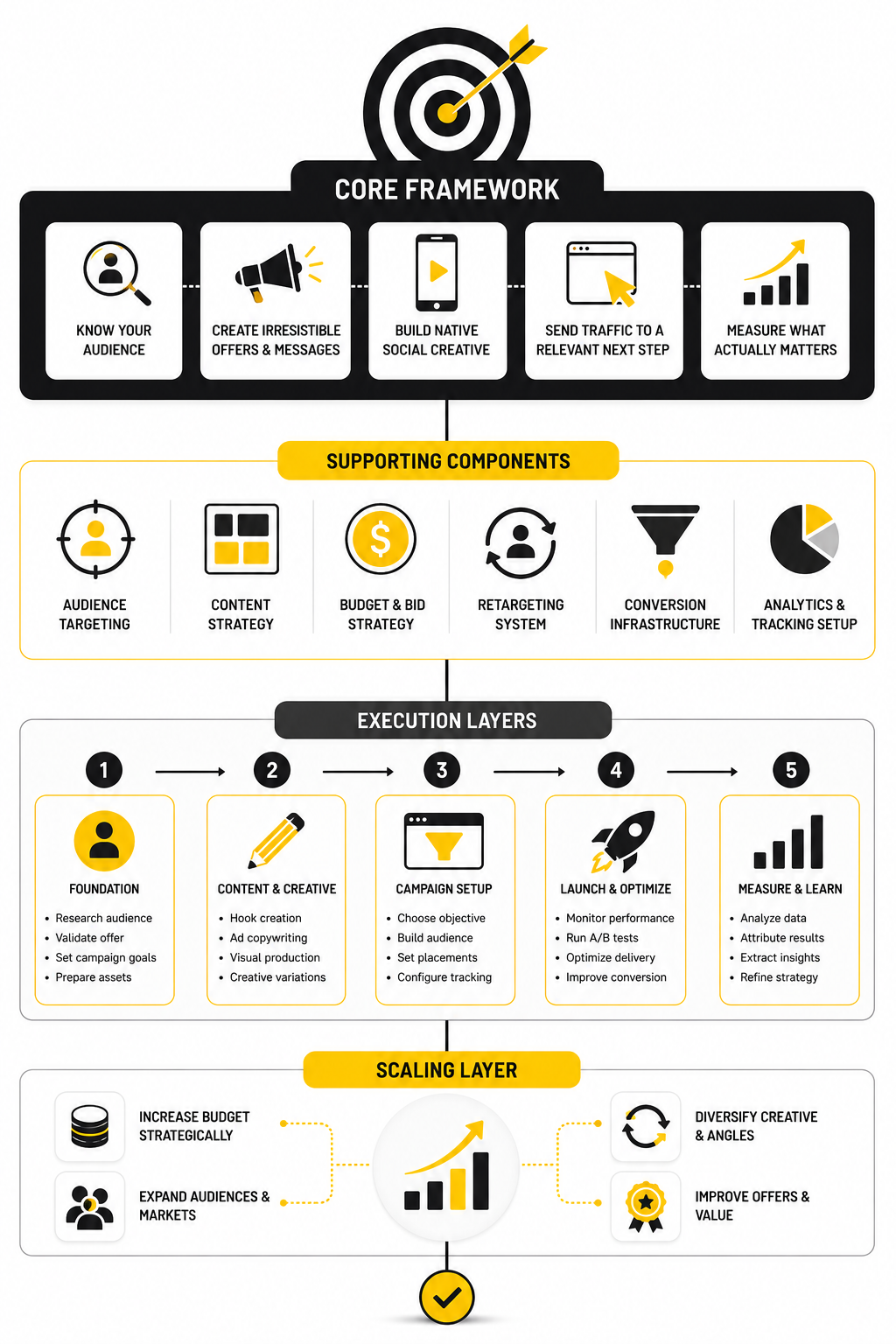
A strong social media advertising framework starts with the market, not the platform. Before choosing Meta, TikTok, LinkedIn, YouTube, Pinterest, Reddit, or X, you need to understand who you are trying to reach, what they already believe, what pain they are aware of, and what would make them stop scrolling. Platform choice matters, but message-market fit matters more.
The next layer is the offer path. This includes the promise in the ad, the action you want the user to take, and the page or conversation that follows the click. For ecommerce brands, that path may lead to a product page or a purpose-built landing page built with a tool like Replo. For service businesses, it may lead to a booking form, chat flow, webinar, or CRM pipeline using a platform like GoHighLevel.
The final layer is feedback. Every campaign should tell you something useful, even when it fails. You are looking for signals in thumb-stop rate, click-through rate, cost per lead, cost per purchase, conversion rate, lead quality, reply quality, and revenue. Without that feedback loop, advertising through social media becomes expensive guessing.
Core Components Of The System
The first core component is audience definition. This does not mean writing a vague persona like “small business owner aged 25 to 45.” It means understanding the buyer’s immediate problem, the trigger that makes the problem urgent, and the objection that stops them from acting. Good targeting helps, but strong positioning is what makes the right people pay attention.
The second component is creative testing. Social media platforms reward ads that generate engagement, retention, clicks, or conversions depending on the campaign objective. That means you need multiple angles, hooks, formats, and proof points. One ad rarely tells the whole truth about whether an offer can work.
The third component is conversion infrastructure. If someone clicks but the page is slow, unclear, generic, or disconnected from the ad, the campaign will bleed money. If someone submits a form but nobody follows up quickly, the business loses demand it already paid for. Tools like ManyChat, Brevo, and Buffer can support different parts of that system when they fit the campaign.
Professional Implementation
Professional implementation is less about launching ads and more about reducing waste. You need clean tracking, clear naming conventions, campaign hypotheses, creative testing rules, budget controls, and a decision process for when to pause, iterate, or scale. Without those basics, performance data becomes hard to trust.
The professional approach also separates leading indicators from final outcomes. Early metrics can show whether people notice and engage with the ad, but revenue metrics show whether the campaign deserves more budget. Both matter, but they answer different questions. Confusing them is one of the fastest ways to scale the wrong thing.
The rest of this guide will move from strategy into execution. First, we will look at how social media advertising actually works behind the scenes. Then we will build up the campaign components, platform decisions, implementation process, and measurement system that turn paid social from a gamble into a repeatable growth channel.
How Social Media Advertising Works
Advertising through social media works by matching a business goal with a platform’s delivery system. You choose the objective, define the audience signals, upload creative, set a budget, and tell the platform what result you want. The platform then uses its auction and prediction models to decide who is most likely to take that action at that moment.
That sounds simple, but the important part is hidden underneath. Social platforms are not just selling ad space. They are selling probability. Meta, for example, generated $196.2 billion in advertising revenue in 2025, which shows how deeply performance advertising is now tied to algorithmic delivery, creative testing, and automated optimization.
This is why a campaign cannot be judged only by whether the advertiser likes the ad. The platform cares about user behavior. If people watch, click, save, comment, message, or buy, the system receives stronger signals. If people ignore the ad, the platform usually makes distribution more expensive or weaker over time.
The Campaign Objective Sets The Direction
The campaign objective is the first major decision because it tells the platform what kind of outcome to optimize for. Meta’s current objective structure includes awareness, traffic, engagement, leads, app promotion, and sales, and that choice shapes who sees the ad and how delivery is optimized. If you choose traffic when you really need purchases, the platform may find people who click often but rarely buy.
This is where many advertisers accidentally train the algorithm in the wrong direction. A cheap click can look good in a dashboard while producing weak leads or no revenue. A higher-cost conversion can look expensive at first while actually producing better customers. The objective needs to match the business result, not the vanity metric that feels easiest to achieve.
For example, a local service business that wants booked appointments should usually think beyond traffic. The ad should push toward a form, call, message, or calendar booking, then the follow-up system should handle speed and qualification. A CRM and automation setup like GoHighLevel can make sense here because the real campaign does not end at the click.
The Auction Decides Who Sees The Ad
Most social media advertising platforms run some version of an ad auction. The advertiser enters a budget and bid strategy, but the winner is not always the brand willing to pay the most. Platforms also consider expected action rates, ad quality, relevance, user experience, and the likelihood that showing the ad will create value for both the advertiser and the user.
This is why better creative can lower costs. If two advertisers target similar audiences but one ad earns stronger engagement and conversion signals, the stronger ad can often win more efficient delivery. The platform has a reason to show ads that users respond to because poor ad experiences make the feed worse.
The auction also changes constantly. Competition rises during seasonal events, product launches, political cycles, and retail-heavy periods. That means the same campaign can perform differently in June than it does in November, even if the ad itself has not changed.
Targeting Is Now More Signal-Based Than Manual
Older social advertising advice focused heavily on manual interest targeting. That still has a place, but modern advertising through social media is increasingly driven by broad targeting, first-party data, pixel events, customer lists, creative signals, and algorithmic learning. The advertiser’s job has shifted from trying to manually control every audience detail to feeding the system better inputs.
That does not mean targeting is dead. It means targeting has become more strategic. You still need to know who the offer is for, what problem they care about, and which platform context fits the buying journey. But instead of building dozens of tiny audiences, many campaigns now perform better when the platform has enough conversion data and creative variety to find patterns.
This is especially important for ecommerce and lead generation. Product catalogs, conversion events, landing page behavior, and past customer data can help the system identify people who are more likely to buy or submit a qualified lead. If the data is messy, the campaign learns from messy signals.
Creative Is The Targeting
Creative has become one of the strongest targeting tools in paid social. The hook, format, language, visual style, offer, and proof naturally attract certain people and repel others. A direct response video about a painful business problem will pull a different audience than a polished brand awareness reel, even before the platform’s targeting settings are considered.
This is good news because it gives advertisers more control than they think. You can create ads for different awareness stages, objections, pain points, and buying triggers. One ad can speak to people who already know they need a solution, while another can educate people who only feel the problem but have not named it yet.
The problem is that many businesses test creative too narrowly. They change a button color or swap a headline, then call it testing. Real creative testing compares different angles, proof types, formats, and offers so you can learn what actually moves the market.
The Click Is Only The Middle Of The Journey
A social ad does not succeed because someone clicks. It succeeds when the full journey after the click supports the promise made in the ad. If the ad creates curiosity but the landing page feels generic, the campaign loses momentum. If the lead form collects interest but nobody follows up fast enough, paid demand turns cold.
This is where the funnel matters. A simple product offer may need a clean landing page, strong product proof, reviews, and a smooth checkout. A higher-ticket service may need a lead magnet, booking page, reminder sequence, sales pipeline, and human follow-up. Tools like ClickFunnels, Systeme.io, or Fillout can support different parts of that path when the campaign needs structured conversion steps.
The key is message match. The promise in the ad, the first headline on the page, and the next action should feel connected. When they do not, people feel friction even if they cannot explain why.
Retargeting Turns Interest Into Follow-Up
Retargeting exists because most people do not convert the first time they see an ad. They may be interested but distracted, skeptical, comparing options, waiting for payday, or simply not ready yet. Retargeting gives the business a second chance to answer objections, show proof, clarify the offer, or create urgency.
Good retargeting is not just repeating the same ad forever. It should move the conversation forward. Someone who watched a video might need a clearer offer. Someone who visited a pricing page might need trust signals. Someone who added a product to cart might need a reason to finish now.
This is also where messaging channels can become powerful. If a campaign drives comments, DMs, or quiz responses, a tool like ManyChat can help turn social attention into structured conversations. That matters because people often ask buying questions before they are willing to fill out a form or visit a checkout page.
Measurement Connects Spend To Decisions
Measurement is what separates advertising from guessing. A campaign needs enough tracking to show what happened before the click, after the click, and after the lead or purchase. Without that, you may know that people clicked, but you will not know whether those clicks produced real business value.
The best measurement setup usually combines platform data with website analytics, CRM data, purchase data, and sales feedback. Platform dashboards are useful, but they are not the whole truth. Attribution can be imperfect, privacy changes can limit visibility, and different tools may assign credit differently.
That does not make measurement useless. It means you need to look at patterns instead of obsessing over one number. If spend increases, qualified leads rise, sales conversations improve, and revenue follows, the campaign is probably doing useful work. If clicks rise but pipeline quality drops, the campaign is creating activity without enough commercial value.
Automation Helps, But It Does Not Replace Strategy
Social ad platforms are pushing harder into automation. Meta promotes AI-powered campaign tools for ad delivery, creative optimization, and sales campaigns, while TikTok’s 2026 trend material emphasizes changing discovery behavior and more intentional audience curiosity. Automation can absolutely help, but it works best when the strategy is clear before the machine gets involved.
The danger is handing control to automation before the offer, creative, tracking, and conversion path are ready. If the inputs are weak, automation can scale weak inputs faster. If the creative is off-brand or the tracking is poor, the campaign may optimize toward outcomes that look useful in-platform but disappoint in the real business.
Use automation as leverage, not as a replacement for thinking. Give the platform enough room to learn, but keep human control over positioning, customer insight, offer quality, brand standards, and final business decisions. That balance is where professional advertisers win.
Core Components Of A High-Performing Campaign
A high-performing campaign is not one magic ad. It is a chain of decisions that either support each other or quietly sabotage each other. When advertising through social media works well, the audience, message, creative, offer, landing experience, follow-up, and measurement system all point in the same direction.
This is why paid social can feel confusing from the outside. Two businesses can spend the same budget on the same platform and get completely different outcomes. One has a clear offer, sharp creative, clean tracking, and fast follow-up. The other has a decent-looking ad connected to a weak process.
The campaign components below are the foundation. They are not glamorous, but they are what make the difference between controlled testing and expensive guessing.
Start With One Clear Commercial Goal
Every campaign needs one primary goal before anything gets built. That goal might be purchases, booked calls, qualified leads, app installs, webinar registrations, trial starts, or message conversations. The more specific the goal, the easier it becomes to choose the right objective, creative angle, budget structure, and success metric.
The mistake is trying to make one campaign do everything. A campaign built for awareness will usually need different creative and measurement than a campaign built for direct sales. A campaign built for booked appointments will need different follow-up than a campaign built for low-ticket ecommerce purchases.
Your goal should also be close enough to revenue to matter. Reach, impressions, and clicks can be useful early signals, but they are not the business outcome. If the campaign is supposed to generate sales opportunities, judge it by the quality and cost of those opportunities, not just by how cheap the traffic looks.
Define The Buyer Problem Before The Audience Settings
Audience settings matter, but buyer understanding matters more. Before touching targeting controls, define the problem the buyer is trying to solve, the frustration they feel, the result they want, and the reason they have not acted yet. Those details shape the ad much more than a generic demographic range.
This is where many campaigns become weak. The advertiser builds an audience around surface-level traits, then writes a message that could apply to almost anyone. That usually creates soft engagement and low intent because the ad does not feel specific enough to stop the right person.
Good advertising through social media starts with tension. What is the buyer tired of dealing with? What outcome would make them feel relieved, proud, faster, safer, or more in control? When you know that, your creative starts sounding like it belongs in their world instead of sounding like another brand announcement.
Build The Offer Path Before Launching The Ad
The offer path is the route from first attention to next action. It includes the ad promise, the call to action, the landing page or form, the confirmation step, the follow-up, and the sales handoff. If one part is unclear, the whole campaign loses efficiency.
For ecommerce, the offer path may lead directly to a product page, bundle page, quiz, or landing page. A product-focused landing page builder like Replo can be useful when the campaign needs a page that matches the ad angle more tightly than a standard store template. The key is not the tool itself. The key is making the post-click experience feel like a natural continuation of the ad.
For service businesses, the offer path often needs more qualification. A lead form may need custom questions, a calendar step, reminder messages, and a pipeline that shows where each lead stands. A system like GoHighLevel fits this use case because social ads often create demand that needs to be followed up with quickly and consistently.
Turn The Campaign Into A Simple Execution Process
This is where the campaign becomes tangible. Instead of thinking about social ads as a vague marketing activity, treat them like a repeatable build process. Each step should produce something specific that the next step depends on.
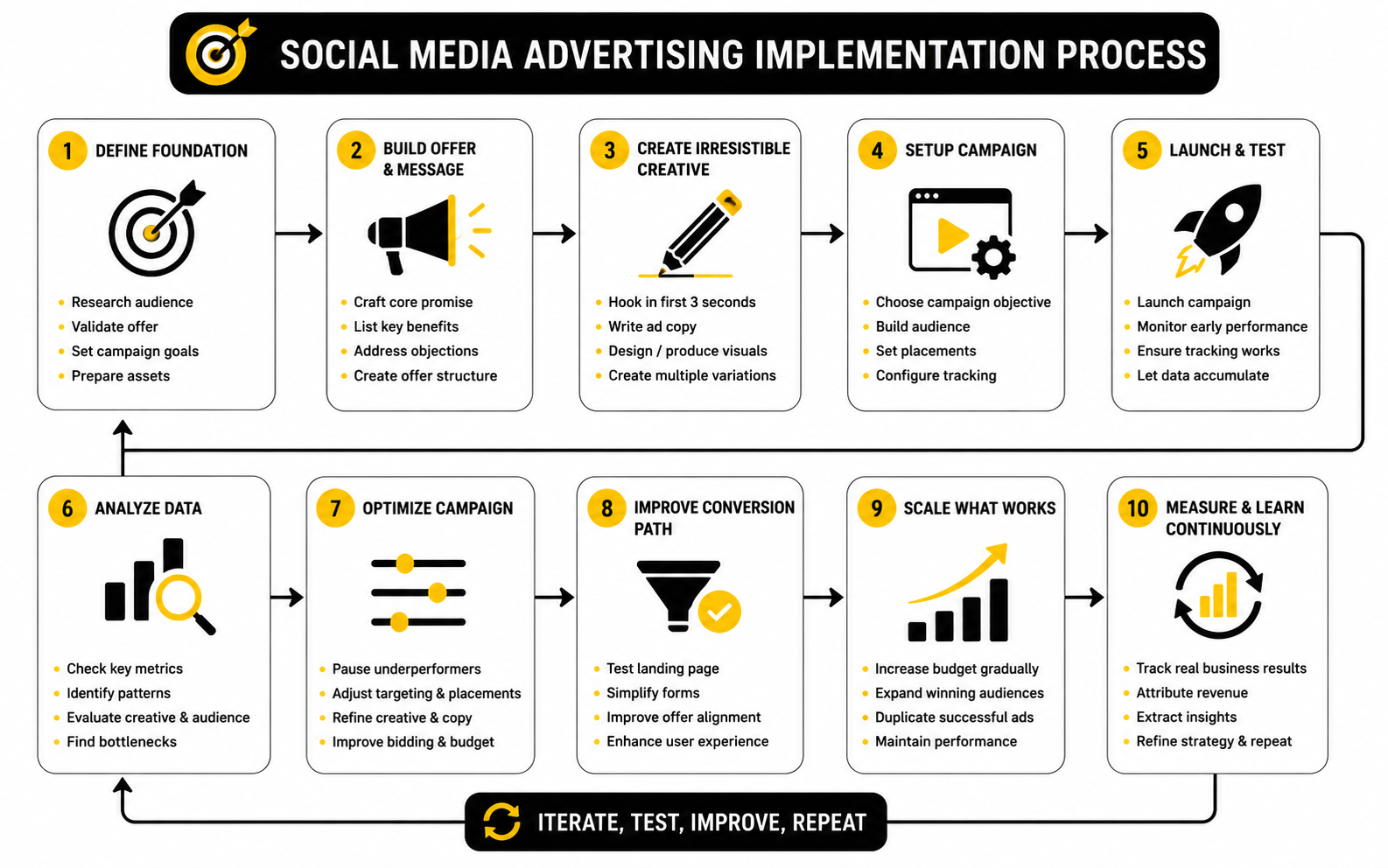
This process keeps you from launching random ads. It also makes performance easier to diagnose. If the ad gets attention but nobody clicks, the hook or offer may be weak. If people click but do not convert, the landing experience or message match may be the issue. If leads convert but do not buy, qualification or sales follow-up needs attention.
Create Multiple Angles Instead Of Minor Variations
Minor variations have their place, but they are rarely enough at the start. Changing one word in a headline does not teach you much if the underlying angle is wrong. Early testing should compare meaningfully different ideas.
A campaign might test an outcome angle, a pain angle, a proof angle, a comparison angle, and a speed angle. These angles speak to different reasons someone might care. One buyer may respond to saving time, another to avoiding mistakes, and another to seeing proof that people like them already solved the problem.
This matters because social platforms read user behavior fast. If one angle earns stronger attention and better downstream action, that tells you something about the market. Do not waste the learning phase on tiny edits that are too similar to produce useful insight.
Match Creative Format To Buyer Awareness
Not every buyer needs the same type of ad. Someone who already knows the problem and wants a solution may respond to a direct offer. Someone who is problem-aware but skeptical may need proof, education, or a demonstration before they are ready to click.
Short-form video can work well when the product or problem is easy to show visually. Static ads can work when the message is direct and the offer is simple. Carousel ads can help explain steps, compare options, or show multiple benefits. Message-based ads can work when the buyer naturally has questions before taking action.
The format should serve the decision journey. Do not choose video just because everyone talks about video. Do not choose static images just because they are easier to produce. Choose the format that helps the buyer understand why the offer matters now.
Build Follow-Up Before The Leads Arrive
Lead generation campaigns fail when the follow-up is treated as an afterthought. The ad creates the opportunity, but the business still has to convert that opportunity into a conversation, appointment, purchase, or customer. Slow follow-up can destroy campaign economics even when the ads are doing their job.
For message-driven campaigns, automation can help keep the conversation moving while the buyer is still engaged. A tool like ManyChat can support comment triggers, DM flows, qualification questions, and simple next steps when the campaign is built around social conversation. That is useful because some buyers are not ready to fill out a formal form, but they are ready to ask a question.
For email-based follow-up, the sequence should match the original promise. A lead who requested a guide, checklist, discount, demo, or consultation should receive messaging that continues that context. Platforms like Brevo or Moosend can support this when the campaign needs structured email communication after the click.
Use Tracking To Answer Better Questions
Tracking is not just there to prove that ads worked. It is there to help you ask better questions. Which angle attracted the right buyer? Which audience produced real opportunities? Which page converted interest into action? Which leads turned into revenue?
At a minimum, the campaign should track the key action that matters. For ecommerce, that may be product views, add-to-cart events, purchases, and purchase value. For lead generation, that may be form submissions, booked calls, show-up rate, qualified opportunities, and closed revenue.
The professional move is to connect platform data with business data. Platform metrics can show what happened inside the ad environment, but CRM and sales data show what happened after the lead entered the business. Without that connection, you may scale campaigns that look good in the dashboard but create low-quality customers.
Keep The Launch Lean But Complete
A good launch does not need to be bloated. You do not need twenty campaigns, fifty ad sets, and a massive creative library on day one. You need enough structure to learn, enough creative to compare, and enough tracking to make decisions.
A practical starting point is one clear offer, a small set of meaningfully different creative angles, one primary conversion path, and a defined review schedule. That gives the platform room to learn without making the account messy. It also gives you a cleaner read on what is actually working.
The launch should feel controlled. You know what you are testing, what result you want, what numbers you will review, and what decision you will make next. That is how advertising through social media becomes a process instead of a mood swing.
Statistics And Data
Data is useful only when it changes what you do next. In advertising through social media, numbers should help you diagnose the campaign, not decorate a report. A dashboard full of metrics can still be useless if nobody knows which number points to the next decision.
The biggest shift is that paid social data now has to be interpreted in context. Social media ad revenue reached $117.7 billion in 2025, but that growth does not mean every advertiser is getting cheaper results. It means more brands are competing for attention, more budget is flowing into automated delivery systems, and performance depends more heavily on creative quality, conversion infrastructure, and measurement discipline.
That is why benchmarks can be helpful, but dangerous. A benchmark can tell you whether your numbers are unusually high or low. It cannot tell you whether your campaign is profitable, whether your leads are qualified, or whether your offer is strong enough to scale. Use benchmarks as context, not as the final scoreboard.
The Metrics That Actually Matter
The most useful campaign metrics sit in a sequence. First, you measure whether people see and notice the ad. Then you measure whether they engage or click. Then you measure whether they convert. Finally, you measure whether those conversions create revenue, retention, or pipeline quality.
For most campaigns, that means watching a small set of numbers instead of obsessing over everything at once:
The trap is treating early metrics like final outcomes. A high CTR can be a good sign, but it can also mean the ad is attracting curiosity without buying intent. A low CPC can look efficient while filling your funnel with weak prospects. A higher CPA can still be profitable if those customers buy more, stay longer, or convert at a stronger rate later.
Benchmarks Are Starting Points, Not Targets
Benchmarks are most useful when they help you spot where the system is breaking. WordStream’s 2025 Facebook ads benchmark report, based on more than 1,000 campaigns, tracks average CPC, CTR, conversion rate, and cost per lead across traffic and lead objectives, which makes it useful for understanding broad market ranges rather than setting universal goals. Triple Whale’s 2026 benchmark analysis also notes that Meta ads became more expensive through 2025, with CPM rising 20.03% overall.
That matters because rising CPM changes how you manage the rest of the campaign. If reach becomes more expensive, you cannot rely on cheap distribution to cover weak creative. You need stronger hooks, better conversion rates, better retention, or a higher average order value to protect profitability.
But benchmarks should never replace your own economics. A $40 lead might be terrible for a low-margin offer and excellent for a service that closes at $3,000. A 2x ROAS might be unprofitable for a brand with thin margins and healthy for a business with strong repeat purchases. The right benchmark is always tied to your numbers.
Read Metrics In Clusters
One metric alone rarely gives you the truth. You need to read metrics in clusters because each number explains a different part of the campaign. This is where advertisers become dangerous in a good way: they stop reacting emotionally and start diagnosing.
If CPM is high but CTR is strong, the campaign may be reaching an expensive audience with relevant creative. The action might be to test broader targeting, new placements, or a different bid strategy while keeping the winning angle. If CPM is normal but CTR is weak, the issue is more likely creative or offer clarity. The action is not to panic about the platform. The action is to write better hooks and test stronger angles.
If CTR is strong but conversion rate is weak, the ad is creating interest that the landing experience is not converting. That points to message mismatch, page speed, unclear proof, weak offer framing, poor form design, or a checkout issue. If conversion rate is strong but sales quality is weak, the campaign may be attracting the wrong intent or asking too little during qualification.
Build An Analytics System That Matches The Funnel
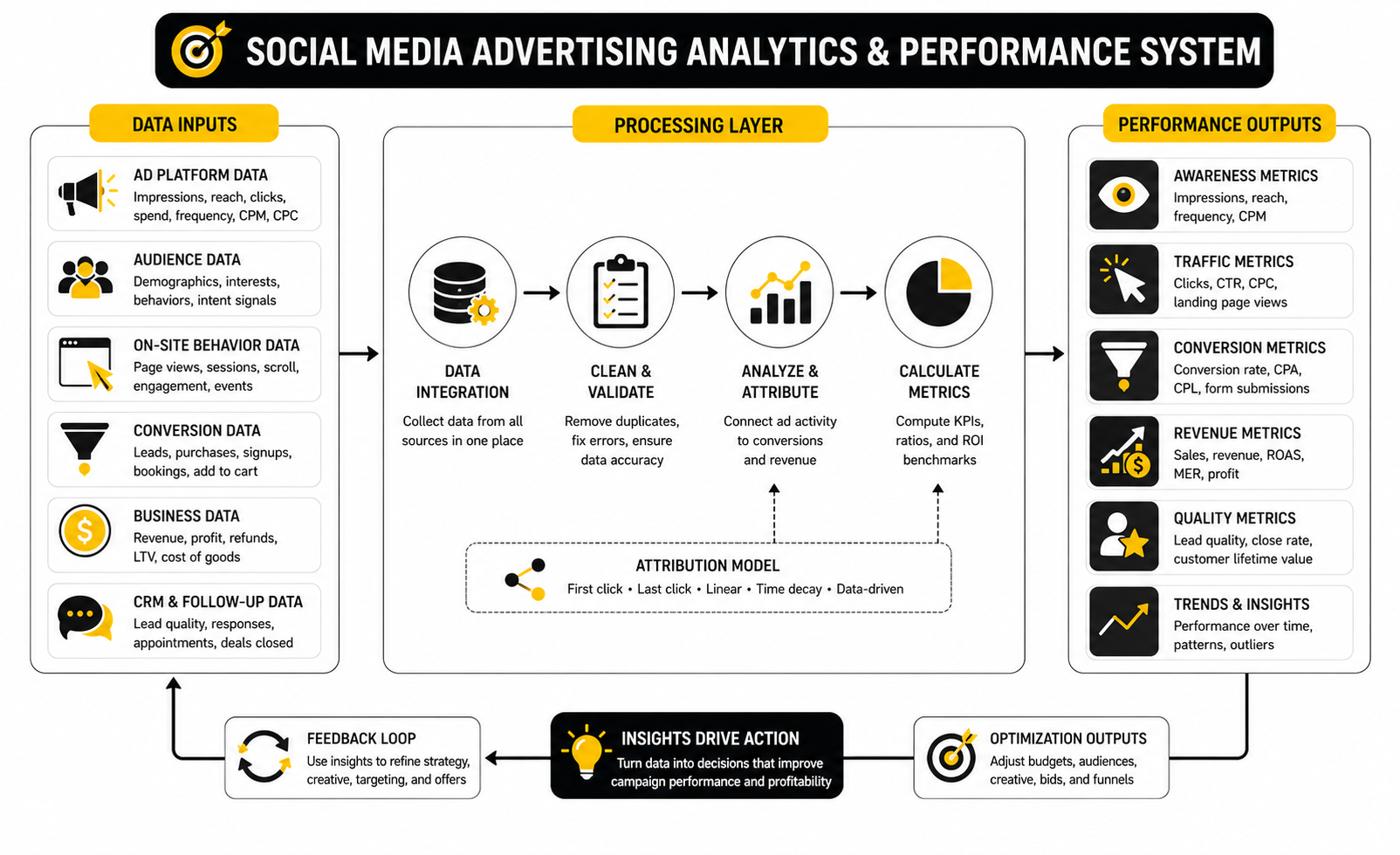
A practical analytics system should follow the buyer journey from first impression to final business outcome. The platform dashboard shows delivery and in-platform conversion signals. The website or landing page analytics show post-click behavior. The CRM shows lead status, appointments, pipeline value, and closed deals. The finance view shows whether revenue actually covers spend, tools, labor, fulfillment, and margin.
For service businesses, this means the ad platform is only one layer of truth. You need to know which leads booked, which showed up, which were qualified, which closed, and which became good customers. A CRM like GoHighLevel can help connect paid social leads to pipeline stages, follow-up actions, and sales outcomes when the campaign depends on human conversion after the click.
For ecommerce, the measurement system needs to connect ad spend with product-level performance, average order value, contribution margin, refunds, repeat purchase rate, and blended revenue. Platform ROAS is useful, but it should not be the only number in the room. A campaign can look weaker in-platform while still improving total sales, and it can look stronger in-platform while stealing credit from demand that would have converted anyway.
Attribution Is Useful, But Never Perfect
Attribution tries to answer a hard question: which touchpoint deserves credit for the conversion? The problem is that real buyers do not move in a clean straight line. They see ads, search the brand, read reviews, compare alternatives, click emails, return through direct traffic, and sometimes buy days or weeks later.
Privacy changes have also made measurement more complex. Recent research on privacy-preserving ad measurement highlights how modern systems increasingly need to balance conversion tracking with privacy protections, which means advertisers should expect modeled, partial, or platform-specific views rather than perfect visibility. That does not make attribution useless. It just means you should stop pretending one dashboard tells the whole story.
Use attribution as a directional tool. If every signal points the same way, trust the pattern. If Meta says one thing, analytics says another, and sales data says a third thing, investigate before scaling. The goal is not perfect certainty. The goal is enough confidence to make better budget decisions.
What Good Performance Signals Look Like
Good performance usually appears as alignment across the funnel. The ad earns attention, the click rate is healthy, the landing page converts, the lead or customer quality holds up, and revenue moves in the right direction. No single metric has to be perfect if the full system works.
For example, a campaign with an average CTR but excellent conversion rate may still be worth scaling because the people who click are highly qualified. A campaign with a very high CTR but low sales quality may need tighter messaging, stronger qualification, or a more specific offer. A campaign with expensive CPM but strong purchase value may work because the audience is competitive but commercially valuable.
The important thing is to define success before you review the data. Otherwise, you will move the goalposts every time the dashboard feels uncomfortable. Decide what must be true for the campaign to continue, what would justify more budget, and what would force a creative or funnel rebuild.
What Bad Data Usually Means
Bad data does not always mean the campaign is doomed. It usually means one part of the system is not doing its job. The faster you identify the weak link, the faster you can fix it.
Weak reach efficiency can mean the market is expensive, the audience is too narrow, the placement mix is limited, or the ad quality is poor. Weak engagement can mean the creative does not create enough tension or curiosity. Weak click-through can mean the offer is unclear. Weak conversion can mean the page fails to continue the promise. Weak sales quality can mean the campaign attracts the wrong people.
This is why you should not change everything at once. If you change audience, creative, landing page, budget, and follow-up at the same time, you may improve performance but learn nothing. Change the part most likely causing the problem, then watch what happens next.
Reporting Should Lead To Decisions
A good report does not just summarize what happened. It tells you what to do next. That is the difference between analytics and admin work.
A practical paid social report should answer five questions:
This keeps advertising through social media grounded in action. You are not reporting for the sake of reporting. You are using data to decide whether to improve the creative, rebuild the offer path, fix the tracking, strengthen follow-up, or increase budget.
The Best Number Is The One That Protects Profit
The final metric should always connect back to economics. For ecommerce, that may be contribution margin, blended MER, new customer acquisition cost, payback period, or customer lifetime value. For service businesses, it may be qualified cost per booked call, show-up rate, close rate, cost per acquired client, and gross profit per client.
This is where many advertisers get too platform-focused. They ask whether the ad account looks good, but the better question is whether the business is healthier because of the ad account. More clicks do not matter if they create no customers. More leads do not matter if sales hates them. More purchases do not matter if margin disappears.
The cleanest approach is simple. Know your break-even point. Know your target point. Know which early signals predict profitable customers. Then use every campaign report to move closer to that target.
Professional Implementation And Optimization
Professional implementation starts when the campaign is no longer treated as a one-time launch. At this stage, advertising through social media becomes a system of controlled tradeoffs: speed versus certainty, automation versus control, scale versus efficiency, and short-term performance versus long-term brand trust. The goal is not to touch every setting every day. The goal is to know which levers matter and when to use them.
This is where advanced advertisers separate themselves from casual operators. They do not panic after one bad day, and they do not scale aggressively after one lucky spike. They look for patterns, protect the economics, and improve the inputs that make the platform more likely to find profitable customers.
Scaling Requires More Than Raising The Budget
Scaling is not just increasing spend. If the campaign only works at a small budget, the system may be too fragile to scale. Bigger budgets usually force the platform to reach more people, which can expose weaker creative, weaker landing pages, weaker follow-up, or a smaller true market than the early results suggested.
A safer scaling process starts with proof. The campaign should show repeated performance across several days, enough conversion volume to trust the signal, and acceptable quality after the lead or purchase. If a campaign generates cheap leads but sales rejects most of them, scaling only creates more waste.
There are two basic scaling paths. Vertical scaling increases budget inside a working campaign. Horizontal scaling expands winning angles into new creatives, audiences, placements, formats, offers, or platforms. Most brands need both, but horizontal scaling is often more stable because it creates more ways for the market to respond.
Creative Fatigue Is A Real Growth Constraint
Creative fatigue happens when an ad loses its ability to earn attention from the same market. Frequency rises, engagement softens, click-through drops, costs climb, and the same message starts feeling stale. This is not always a platform problem. Often, it is a creative pipeline problem.
The solution is not endless random content. The solution is planned creative refreshes based on proven angles. If a pain-point ad works, create new versions with different openings, proof points, visuals, and objections. If a demonstration works, test different use cases, different first three seconds, and different calls to action.
TikTok’s 2026 trend forecast points toward more grounded, behind-the-scenes, human-feeling brand content, which matters because polished sameness is easier to ignore in crowded feeds. The brands that keep winning creative attention usually have a process for finding fresh expressions of the same core promise, not a habit of starting from zero every week.
Automation Works Best With Strong Inputs
Modern ad platforms are moving deeper into automation. Meta’s 2025 results showed average price per ad rising year over year while its advertising business continued expanding, which reinforces how much competition and algorithmic delivery now shape paid social economics. At the same time, Meta and other platforms continue pushing AI-assisted creative, targeting, and budget allocation.
Automation can help because it processes more signals than a human media buyer can manually manage. It can test combinations, shift delivery, and find pockets of conversion behavior quickly. But automation cannot fix a weak offer, unclear positioning, bad tracking, or a landing page that does not match the ad.
That is the key point. Do not use automation to avoid strategy. Use it to amplify strategy. The better your creative, conversion events, customer data, and offer path are, the more useful the platform’s automation becomes.
Budget Allocation Should Follow Confidence
Budget should move toward confidence, not excitement. A new campaign with unproven creative should be funded enough to learn, but not so much that every bad assumption becomes expensive. A proven campaign can earn more budget when it shows stable conversion quality and clear economics.
A practical budget model separates testing spend from scaling spend. Testing spend is there to discover winning angles, audiences, hooks, and offers. Scaling spend is there to push what already has evidence behind it. Mixing those two budgets creates messy decision-making because every test is judged too harshly and every winner is protected too emotionally.
For businesses managing several campaigns, this also means the budget should not be spread evenly just to feel balanced. Some campaigns deserve more because they are closer to revenue. Some deserve less because they are learning campaigns. Some should be paused because they are consuming budget without creating useful insight.
Platform Choice Creates Strategic Tradeoffs
No platform is universally best. Meta is often strong for broad consumer reach, retargeting, ecommerce, local services, and algorithmic conversion campaigns. TikTok can be powerful for discovery, entertainment-driven creative, and products that benefit from demonstration or cultural relevance. LinkedIn can be expensive, but useful when the buyer is professional, high-value, and easier to define by role or company context.
YouTube often plays a different role because people may be more willing to watch longer explanations, tutorials, reviews, and founder-led content. That can make it useful when the offer needs more education or trust before conversion. Reddit, Pinterest, Snapchat, and X can also make sense in specific markets, but they should be chosen because the audience and behavior fit the offer, not because the platform is trendy.
The wrong platform choice usually creates friction. You may get impressions, but the context does not support the decision you want the buyer to make. Strong advertising through social media starts by matching the platform environment to the buyer’s awareness level, attention style, and purchase path.
Compliance And Trust Are Part Of Performance
Trust is not a soft metric when money is involved. Scam ads, misleading claims, fake urgency, exaggerated earnings promises, and unclear disclosures can damage the market and the brand. Recent reporting around scam advertising and platform accountability shows why users, regulators, and advertisers are paying closer attention to ad quality and consumer protection.
This matters even for legitimate businesses. If your ad sounds too good to be true, people bring skepticism into the click. If the landing page hides key details, people hesitate. If the follow-up feels aggressive or disconnected from what was promised, the campaign may generate short-term activity while damaging long-term trust.
Compliance should be built into the creative process, not added after the ad is rejected. Avoid claims you cannot support. Be clear about pricing, limitations, eligibility, and what the user is actually getting. A slightly less aggressive ad that creates qualified trust is usually more valuable than a hype-heavy ad that attracts the wrong expectations.
First-Party Data Is Becoming More Important
As privacy rules, browser changes, and platform restrictions keep evolving, first-party data becomes a stronger asset. Email lists, customer lists, purchase history, CRM stages, quiz answers, booking data, and product behavior can all help improve targeting, retargeting, exclusion lists, and measurement. The business that owns better data has more control.
This does not mean collecting data carelessly. It means asking for the right information at the right moment and using it responsibly. A lead form should collect enough information to qualify the person without creating unnecessary friction. A quiz should help the buyer get a better recommendation, not just harvest details.
For many businesses, the gap is operational. They run ads, but their customer data lives in disconnected tools. Connecting forms, email, CRM, calendar, sales notes, and revenue tracking through systems like GoHighLevel, Brevo, or Copper can make the campaign easier to optimize beyond the platform dashboard.
Landing Pages Need Their Own Testing System
The ad often gets blamed when the landing page is the real bottleneck. A campaign may have strong creative and qualified traffic, but the page fails to convert because the headline is vague, the proof is weak, the page is slow, the CTA is buried, or the offer feels different from what the ad promised. That is not an ad problem. That is a conversion problem.
Landing page testing should focus on the parts that change buyer confidence. Test the headline, offer framing, proof placement, page structure, objections, form length, pricing presentation, and CTA clarity. Do not waste early testing energy on tiny design changes unless there is a real reason to believe they affect the decision.
For ecommerce, campaign-specific pages can be especially useful when the ad angle is more specific than the standard product page. A builder like Replo can help create pages that align more closely with paid social angles. For info products, services, or lead magnets, tools like ClickFunnels or Systeme.io can support structured funnel paths when the offer needs more than a simple website page.
Lead Quality Must Be Managed Intentionally
Lead generation can look amazing until you inspect the leads. Low-cost leads are not automatically good leads. Sometimes they come from people who are curious, unqualified, outside the service area, unwilling to pay, or not serious enough to take the next step.
This is why qualification has to be part of the campaign design. The ad should attract the right intent, the form should ask useful questions, the thank-you step should set expectations, and the follow-up should push toward a meaningful action. If a booked call is the real goal, optimize toward booked and qualified calls, not just raw form submissions.
Tools like Fillout can help when the form needs better logic, routing, or qualification. A scheduling tool like Cal.com can make sense when the next step is a booking. The point is to reduce friction for good-fit prospects while filtering out people who were never likely to buy.
Multi-Platform Scaling Needs Message Discipline
Expanding to more platforms can increase reach, but it can also create inconsistency. A brand may run one promise on Meta, a different tone on TikTok, a separate offer on LinkedIn, and a generic landing page that matches none of them. That creates confusion and weakens learning.
The better approach is to keep the core strategy consistent while adapting the creative format to each platform. The promise should stay recognizable. The proof should stay credible. The CTA should match the buyer journey. What changes is the execution: pacing, format, hook style, visual language, and depth of explanation.
This is especially important when teams are involved. A media buyer, copywriter, designer, video editor, founder, and salesperson may all touch different parts of the campaign. Without shared messaging rules, each person makes reasonable choices that add up to a fragmented customer experience.
The Expert Move Is Knowing What Not To Scale
Not every winning ad deserves more budget. Some ads win because they attract easy but low-value conversions. Some offers convert well but create fulfillment problems. Some lead magnets generate volume but no buying intent. Some campaigns perform only because the audience is small and temporarily underpriced.
This is why scaling decisions should include operational reality. Can the team handle more leads? Can fulfillment maintain quality? Can sales follow up fast enough? Can customer support absorb the extra volume? If not, scaling can turn a good campaign into a business problem.
The smartest advertisers protect the business, not just the ad account. They scale campaigns that create profitable customers, manageable demand, and stronger market position. They cut campaigns that only make dashboards look good. That discipline is boring until it saves you a lot of money.
Measurement, Scaling, Mistakes, And FAQ
By this point, the system should be clear. Advertising through social media is not just ad creative, not just targeting, and not just reporting. It is the connection between message, media, conversion, follow-up, data, and business economics.
The strongest campaigns usually have a simple pattern. They know who they are speaking to, they make one clear promise, they use creative to qualify attention, they send people into a relevant next step, and they measure the outcome beyond the platform dashboard. That sounds basic, but it is exactly where most campaigns break.
The final step is thinking about the whole ecosystem. The campaign is not finished when the ad goes live. It is finished when the business can see what happened, learn from it, improve the weak link, and repeat the process with more confidence.
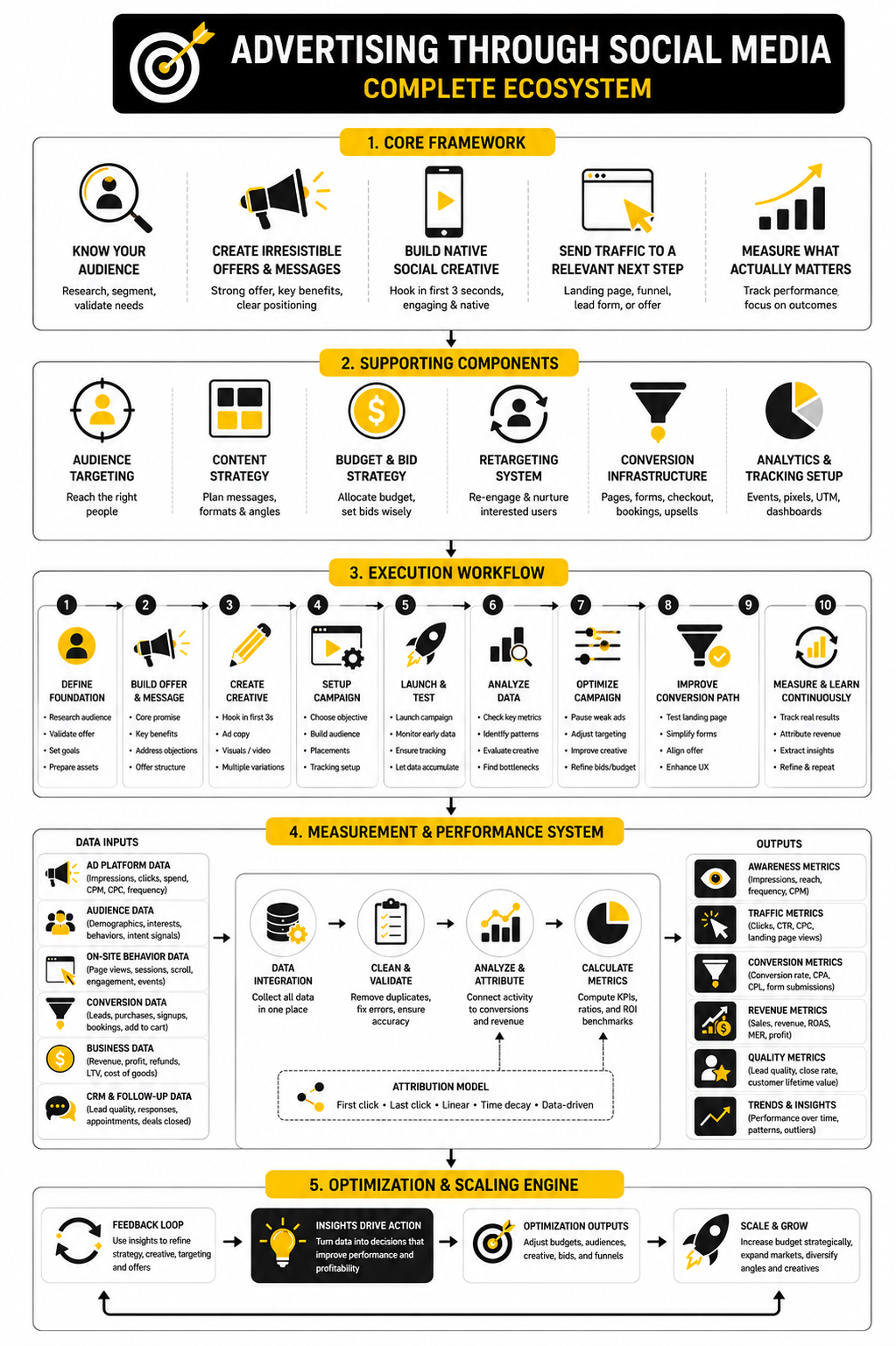
The Final System To Build Around
The complete paid social system has five layers. The first layer is market insight, because weak buyer understanding makes every later decision harder. The second layer is creative, because attention has to be earned before it can be converted. The third layer is conversion, because clicks are not revenue. The fourth layer is follow-up, because many buyers need more than one touchpoint. The fifth layer is measurement, because the business needs to know what to scale and what to cut.
When these layers work together, advertising through social media becomes easier to manage. You are not reacting to every number emotionally. You are asking which layer needs attention. That gives you a cleaner way to improve campaigns without rebuilding everything every time performance moves.
This is also why tools should support the system, not replace it. A funnel builder, CRM, email platform, chatbot, analytics setup, or scheduler can make execution smoother. But the strategy still has to come from a clear understanding of the buyer, the offer, and the business model.
The Biggest Mistakes To Avoid
The first major mistake is launching before the offer is sharp. A weak offer makes targeting harder, creative less persuasive, and conversion more expensive. If the market does not understand why the offer matters now, the platform cannot magically create urgency.
The second mistake is optimizing for the wrong action. Traffic campaigns can create clicks without buyers. Lead campaigns can create form fills without qualified prospects. Sales campaigns can generate revenue that still fails to protect margin if the numbers are not reviewed properly.
The third mistake is changing too many things at once. If you edit the audience, budget, creative, landing page, and offer in the same window, you lose the ability to learn. Strong advertisers isolate variables where possible, then make decisions based on patterns instead of mood.
When To Pause, Improve, Or Scale
Pause a campaign when the data shows a clear lack of useful signal. That might mean the creative is not earning attention, the offer is not producing qualified action, or the economics are too far from break-even with no obvious path to improvement. Pausing is not failure. It is how you protect budget for better tests.
Improve a campaign when one part of the journey is clearly underperforming while another part shows promise. If the ad earns clicks but the page does not convert, improve the page. If the lead cost is fine but sales quality is weak, improve qualification. If the page converts but CPM keeps rising, refresh the creative or test new angles.
Scale only when the campaign has earned it. You want repeated performance, clean enough tracking, acceptable lead or customer quality, and confidence that the business can handle more demand. Scaling too early feels exciting, but it often turns a useful test into an expensive lesson.
What Is Advertising Through Social Media?
Advertising through social media is the process of using paid placements on platforms like Facebook, Instagram, TikTok, LinkedIn, YouTube, Pinterest, Reddit, Snapchat, and X to reach specific audiences and drive business outcomes. Those outcomes can include awareness, traffic, leads, purchases, app installs, booked calls, messages, or retargeting actions. The best campaigns connect the ad to a clear offer, a relevant conversion path, and a measurement system that shows whether the spend created real value.
Why Is Advertising Through Social Media Important?
It is important because social platforms are where people discover products, compare brands, watch proof, ask questions, and return later when they are ready to buy. Global social media user identities reached 5.79 billion in April 2026, which makes social platforms a major layer of modern attention. The opportunity is not just reach. The opportunity is reaching the right person with the right message at the right stage of intent.
Which Social Media Platform Is Best For Advertising?
There is no single best platform for every business. Meta is often strong for ecommerce, local services, retargeting, and broad consumer campaigns. TikTok can work well for discovery-led products and creative that feels native to short-form video. LinkedIn can make sense for B2B offers with higher customer value, while YouTube can support education-heavy offers that need more explanation.
How Much Should A Business Spend On Social Media Ads?
A business should spend enough to collect useful data without risking money it cannot afford to lose. The right starting budget depends on the offer price, sales cycle, conversion rate, platform, market competition, and how much data is needed to make decisions. A small local campaign may start with a modest daily budget, while an ecommerce brand with proven margins may need more spend to test creative and exit the learning phase.
What Metrics Matter Most In Paid Social?
The most important metrics depend on the campaign goal, but the core sequence is attention, click, conversion, and business value. CPM, hook rate, CTR, CPC, conversion rate, CPA, CPL, ROAS, MER, close rate, and customer lifetime value all answer different questions. The mistake is treating one metric as the whole truth. A campaign should be judged by whether it creates profitable customers or valuable opportunities, not just cheap clicks.
What Is A Good ROAS For Social Media Advertising?
A good ROAS depends on margin, repeat purchase behavior, fulfillment cost, refunds, and customer lifetime value. A 2x ROAS may be weak for a low-margin product and acceptable for a business with strong repeat purchases. A higher ROAS can still be misleading if it comes from existing demand or excludes important costs. The better question is whether the campaign contributes profitable revenue after all real costs are considered.
How Long Should I Run A Campaign Before Judging It?
A campaign should run long enough to collect meaningful data, not just enough time to satisfy impatience. For low-ticket purchases, useful signals may appear faster because conversions happen more frequently. For high-ticket services or longer sales cycles, you may need to wait for booked calls, show-up rates, qualified opportunities, and closed deals before judging performance. Early metrics can guide improvements, but final decisions should be tied to the real business outcome.
Why Do Social Media Ads Stop Working?
Social ads often stop working because creative fatigue sets in, competition rises, the audience becomes saturated, the offer loses urgency, or the campaign gets scaled beyond the strength of its original signal. Sometimes the issue is not the ad at all. The landing page, checkout, follow-up, pricing, or sales process may be the real bottleneck. That is why the full funnel needs to be reviewed before blaming the platform.
Should I Use A Landing Page Or Send Traffic To My Website?
Use a landing page when the campaign needs a focused conversion path. A general website can work when it is already clear, fast, and aligned with the ad promise, but many websites have too many distractions for paid traffic. Campaign-specific pages can improve message match because they continue the exact angle used in the ad. For ecommerce campaigns, a tool like Replo can help create more focused product and landing experiences.
Do I Need Email Or CRM Follow-Up For Social Ads?
Yes, if the purchase decision is not instant. Many people click, submit a form, ask a question, or book a call before they are fully ready to buy. Email, SMS, CRM pipelines, reminders, and message automation help turn paid attention into actual revenue. A platform like GoHighLevel can be useful when leads need tracking, follow-up, appointment reminders, and sales pipeline visibility.
Are Chatbots Useful For Social Media Advertising?
Chatbots can be useful when the campaign naturally creates questions, comments, DMs, or interactive lead qualification. They work especially well when the buyer wants a quick next step without filling out a long form. The key is to keep the flow helpful, clear, and connected to the offer. For comment-to-DM or social conversation campaigns, ManyChat can support that workflow.
What Is The Difference Between Boosting A Post And Running A Real Campaign?
Boosting a post is usually a simplified way to increase reach or engagement. A real campaign gives you more control over objectives, audiences, placements, creative testing, conversion tracking, budget structure, and optimization. Boosting can be useful for simple visibility, but it is rarely enough for serious lead generation or sales. If revenue matters, build the campaign properly.
How Many Ads Should I Test At Once?
Test enough ads to learn something, but not so many that the budget gets spread too thin. A practical starting point is three to five meaningfully different creative angles, not tiny variations of the same idea. Each angle should test a real hypothesis about what the buyer cares about. Once a winner appears, create new variations around that angle instead of constantly starting from scratch.
Is AI Changing Advertising Through Social Media?
Yes, AI is changing creative production, targeting, bidding, reporting, and campaign automation. Meta reported $196.18 billion in 2025 advertising revenue, and the major platforms are continuing to invest heavily in AI-assisted ad systems. But AI does not remove the need for strategy. It makes strong inputs more valuable and weak inputs more expensive to scale.
What Is The Best Way To Start If I Am New?
Start with one offer, one audience problem, one conversion goal, and a small set of strong creative angles. Build the post-click path before launching, then track the action that matters most to the business. Do not try to master every platform at once. Get one simple campaign working, learn from the data, and improve the system step by step.
Build a stronger local presence with BAAM AI
Turn your website, Google profile, social channels, and AI visibility into one growth engine
Most businesses do not need more random marketing activity. They need a consistent presence system that helps the right people find them, trust them, and take action. BAAM AI brings strategy, local SEO, website updates, Google Maps visibility, social content, AI-search readiness, media production, and reporting into one practical monthly engine.
If you want your marketing to keep working after the campaign ends, start with a free BAAM AI presence audit. See how your business shows up today and where the fastest visibility wins are at BAAM AI.