
BAAM AI Blog
Advertising Social Media Marketing: A Practical Framework For Growth
Advertising social media marketing is the practice of using paid social campaigns, organic content, audience targeting, creative testing, and conversion systems together to attract attention, build trust, and turn...
Advertising social media marketing is the practice of using paid social campaigns, organic content, audience targeting, creative testing, and conversion systems together to attract attention, build trust, and turn that attention into measurable business results.
That definition matters because social media is no longer just a place to post updates. With 5.79 billion social media user identities worldwide, it has become one of the largest demand-generation environments businesses can use. But reach alone does not create revenue. The real advantage comes from building a system where content, ads, offers, landing pages, follow-up, and reporting all work together.
this guide breaks advertising social media marketing into six practical parts so you can understand the strategy, build the right foundation, and avoid treating social platforms like random posting machines.
Why Advertising Social Media Marketing Matters
Social media marketing matters because attention has shifted, but buyer behavior has become harder to influence. People scroll fast, compare options quickly, and ignore anything that feels generic. That means businesses need more than a clever caption or a boosted post.
Paid social gives you speed, targeting, and measurable testing. Organic social gives you trust, familiarity, and proof that your brand is alive. When both work together, advertising social media marketing becomes a growth system instead of a content calendar.
The pressure is also financial. Gartner reported that digital channels now account for 61.1% of total marketing spend, which means brands are already putting serious budget into online acquisition. The question is not whether social media deserves attention. The question is whether your system is strong enough to turn that attention into pipeline, sales, retention, and brand equity.
The Framework Behind Social Media Advertising
A strong framework starts with one simple idea: social media is not one channel. It is a chain of moments. Someone sees your content, notices your promise, checks your profile, clicks your offer, lands on a page, receives follow-up, and eventually decides whether to buy.
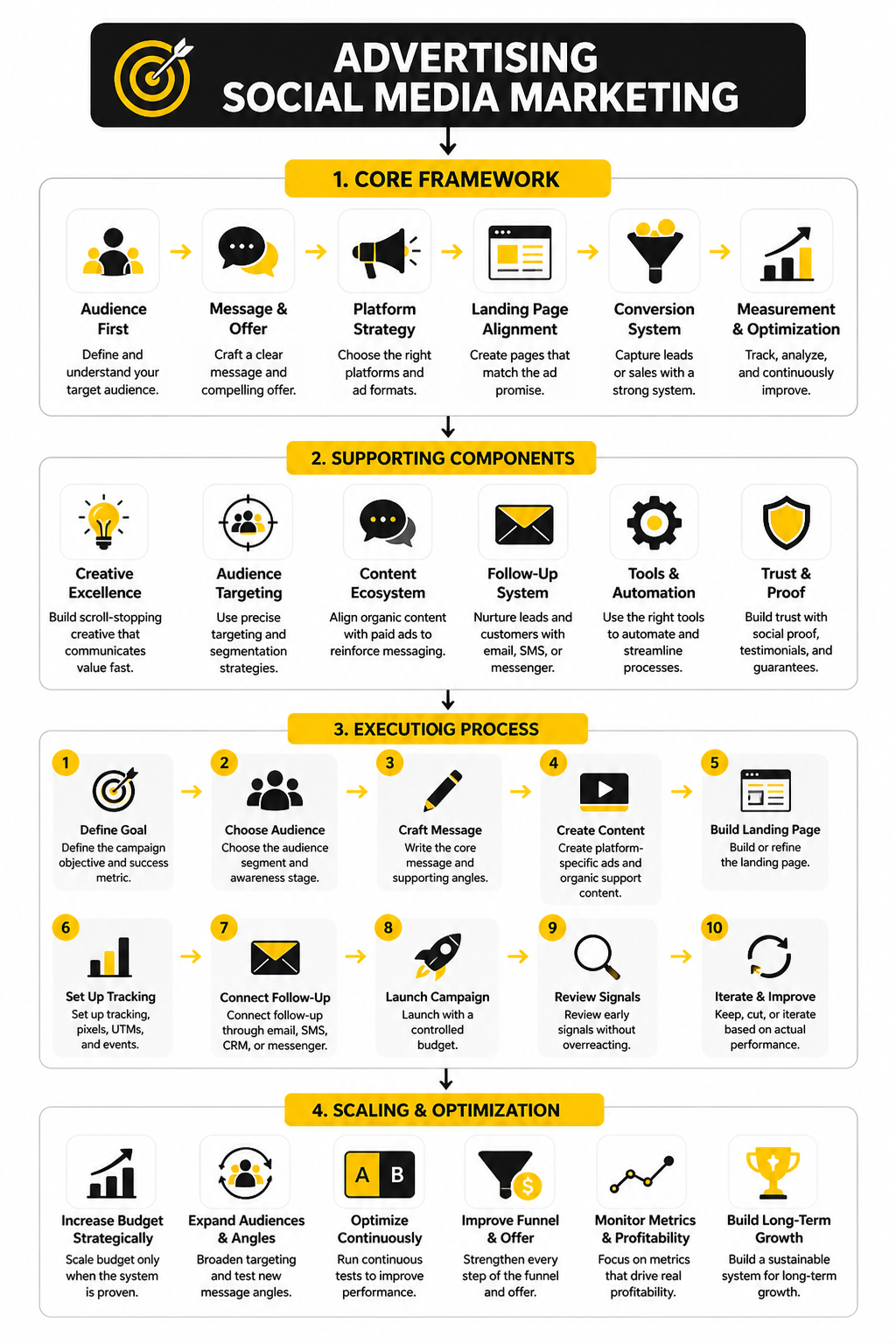
That journey needs structure. You need clear audience segments, strong creative angles, relevant offers, conversion-focused landing pages, and a follow-up process that does not disappear after the first click. Tools such as ManyChat can support message-based follow-up when social conversations are part of the buyer journey, while funnel and CRM platforms can help connect ads to actual sales activity.
The framework is not complicated, but it is unforgiving. Weak creative makes targeting look broken. Weak offers make good traffic look bad. Weak follow-up wastes paid clicks. That is why professional advertising social media marketing treats every stage as connected, not as separate tasks owned by separate people.
Core Components Of A Strong Social Media Marketing System
The first core component is positioning. Your audience needs to understand who the offer is for, what problem it solves, and why it is worth attention now. Without that clarity, even a large ad budget can only amplify confusion.
The second component is creative testing. Social platforms reward messages that earn engagement, but engagement alone is not the goal. The better question is which hooks, formats, proof points, and offers move people closer to action.
The third component is conversion infrastructure. A campaign should not send interested people into a vague homepage and hope for the best. It needs focused landing pages, clear calls to action, tracking, retargeting, and follow-up. For ecommerce and landing-page-heavy campaigns, tools like Replo can fit naturally into this part of the system.
Professional Implementation And Campaign Planning
Professional implementation begins before anything goes live. You define the offer, the audience, the conversion goal, the budget, the creative testing plan, and the success metric. This prevents the common mistake of launching campaigns and only then trying to decide what “good performance” means.
The best teams also separate learning goals from scaling goals. Early campaigns should answer questions: which audience responds, which message gets attention, which offer creates intent, and which landing page converts. Scaling comes after those answers are clear.
This is where advertising social media marketing becomes practical rather than theoretical. The goal is not to be everywhere. The goal is to build a repeatable system that turns the right attention into measurable outcomes.
The Framework Behind Social Media Advertising
The next step is to turn the idea into a working framework. Advertising social media marketing becomes much easier when you stop thinking in terms of isolated posts and start thinking in terms of movement. Every campaign should move a specific audience from problem awareness to trust, from trust to action, and from action to follow-up.
That movement usually has four layers: audience, message, offer, and conversion path. Audience defines who you are trying to reach. Message explains why they should care. Offer gives them a reason to act now. Conversion path makes the next step obvious.
Most weak campaigns fail because one of those layers is missing. The audience may be too broad, the message may sound like everyone else, the offer may feel vague, or the landing page may create friction. When the framework is tight, each part supports the next one.
Audience Clarity Comes First
Audience clarity is not just demographics. Age, location, and interests can help, but they do not explain buying intent on their own. A better audience definition includes the problem people are trying to solve, the stage of awareness they are in, and what they already believe about the solution.
For example, someone who knows they need a CRM behaves differently from someone who only knows their follow-up process is messy. One person may respond to feature comparisons. The other needs education, pain recognition, and a simpler first step.
This is where many brands waste money. They target “business owners” or “busy moms” or “fitness enthusiasts” and expect the platform to do all the strategic work. Platforms can find patterns, but they cannot fix unclear thinking.
Message Fit Makes The Campaign Work
Message fit means the creative speaks to the audience’s real situation. It should feel specific enough that the right person recognizes themselves quickly. That does not mean being clever for the sake of it. It means being relevant.
Strong social media advertising usually starts with a clear hook. The hook earns attention, but the body of the message has to build belief. That belief can come from demonstration, proof, contrast, education, or a sharp explanation of what changes when the person takes action.
In advertising social media marketing, the message must also match the platform. A LinkedIn ad can handle a more direct business case. A TikTok or Instagram Reel often needs faster visual context. A Facebook retargeting ad may work best when it addresses objections from people who already visited the offer page.
The Offer Must Be Easy To Understand
The offer is where attention becomes intent. A strong offer does not force people to decode what they are getting. It makes the value clear, removes unnecessary friction, and gives the audience a next step that matches their level of readiness.
For cold audiences, that next step may be a free guide, quiz, webinar, consultation, product sample, or low-risk entry offer. For warmer audiences, it may be a direct purchase, booking, trial, or demo request. The mistake is asking too much too early or offering something so soft that it never creates buying momentum.
If you are building a funnel around paid social traffic, tools like ClickFunnels or Systeme.io can make sense when you need landing pages, opt-ins, and simple sales flows without stitching together too many separate systems.
Conversion Path Turns Clicks Into Outcomes
A click is not a result. It is only a signal that someone was interested enough to leave the feed. What happens after that click determines whether your campaign becomes profitable or just produces nice-looking dashboard numbers.
The conversion path should feel like a natural continuation of the ad. If the ad promises a checklist, the page should deliver that checklist clearly. If the ad promotes a product benefit, the landing page should reinforce that benefit with proof, details, and a simple action.
This is also where follow-up matters. Many buyers do not convert on the first visit, especially when the purchase requires trust, budget, or internal discussion. Email, SMS, retargeting, and message automation can keep the conversation alive without relying on one ad impression to do all the work.
Measurement Keeps The Framework Honest
Measurement is what stops the framework from becoming theory. You need to know which creative earns attention, which audience creates qualified traffic, which offer produces intent, and which follow-up turns that intent into revenue. Without measurement, every campaign review becomes opinion.
The practical approach is to track both platform metrics and business metrics. Reach, click-through rate, cost per click, and engagement help diagnose the front end of the campaign. Leads, bookings, sales, customer acquisition cost, and lifetime value tell you whether the campaign is actually working.
This is where a CRM and pipeline system can be useful, especially for service businesses, agencies, coaches, consultants, and local businesses. A platform like GoHighLevel can fit when you need ads, forms, appointments, conversations, pipeline tracking, and follow-up to connect in one place.
Core Components Of A Strong Social Media Marketing System
A strong system is built before the campaign goes live. That matters because social platforms are faster than most internal marketing teams. If your audience, creative, landing page, tracking, and follow-up are not ready, the platform will still spend the budget.
Advertising social media marketing works best when each component has a clear job. The ad earns attention. The page builds confidence. The form or checkout captures intent. The follow-up turns that intent into action. When those pieces are aligned, performance becomes easier to diagnose and improve.
Start With The Campaign Goal
The campaign goal decides almost everything that follows. A brand awareness campaign needs different creative, targeting, and measurement than a lead generation campaign. A direct sales campaign needs even more discipline because every weak step can damage return on ad spend.
This is why the goal should be specific before you write a single ad. “Get more customers” is not a campaign goal. “Generate qualified consultation bookings under a target cost per booking” is much clearer. “Sell a front-end product profitably while building a retargeting pool” is also clearer.
The goal also keeps the team honest. If the goal is leads, do not celebrate cheap engagement as if it proves success. If the goal is sales, do not let a high click-through rate distract you from weak checkout conversion.
Build The Execution Flow Before Launch
The execution flow is the practical path a person follows after seeing your content or ad. It should be mapped before the first campaign goes live, not patched together after the first week of messy data. This is where the strategy becomes tangible.
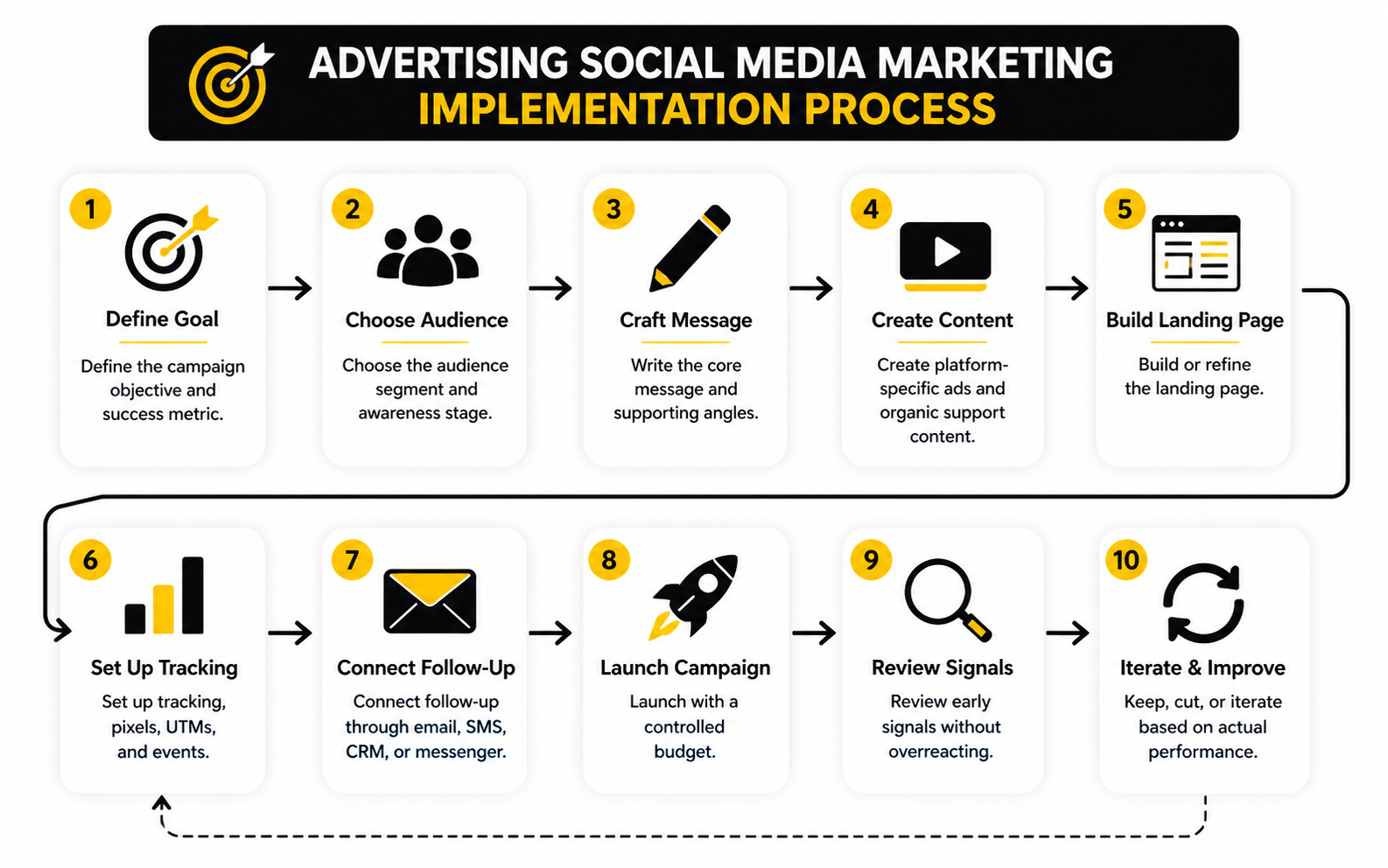
A simple execution process looks like this:
This process prevents random action. It also makes collaboration easier because everyone can see where their work fits. The media buyer is not guessing what the landing page promises. The copywriter is not writing blind. The sales team knows what kind of lead or buyer is coming in.
Create Platform-Specific Creative
Creative should be built for the platform, not simply resized for it. TikTok’s own guidance recommends vertical, high-resolution assets and content that feels native to the feed, while Meta’s creative testing guidance supports comparing multiple creative variants to learn what actually performs. That is the practical reality now: the same message may need different packaging across platforms.
This does not mean you need a completely new strategy for every channel. The core offer can stay the same. The hook, format, pacing, proof, and call to action should adapt to the way people behave on that platform.
For example, a short-form video may open with a fast problem statement. A carousel may break down the argument step by step. A retargeting ad may focus on objections, proof, or urgency. The message stays consistent, but the delivery changes.
Connect Content And Paid Ads
Organic content and paid ads should not compete with each other. They should feed each other. Organic content helps you test language, objections, questions, and angles before you put serious budget behind them.
Paid ads then amplify what already shows signs of interest. If a post gets strong saves, comments, profile visits, or replies, it may reveal a message worth turning into an ad angle. If a paid ad produces qualified leads, that same angle can become organic content, email copy, webinar positioning, or sales enablement.
This is where advertising social media marketing becomes more efficient. You are no longer inventing from scratch every week. You are building a feedback loop between what people respond to publicly and what they act on commercially.
Set Up Follow-Up Before Traffic Arrives
Follow-up is not a bonus. It is part of the campaign. Many people will click, browse, hesitate, get distracted, compare options, or wait until later. Without follow-up, you are paying to create interest and then letting that interest fade.
For lead-based campaigns, follow-up can include email, SMS, calendar reminders, sales notifications, and pipeline stages. For conversational funnels, ManyChat can fit when comments, DMs, or messenger flows are part of the social journey. For broader CRM and automation needs, GoHighLevel can help connect forms, appointments, conversations, and sales follow-up.
The key is to make follow-up match the promise. If someone requested a guide, deliver it quickly and continue with useful context. If someone booked a call, confirm the appointment and reduce no-shows. If someone abandoned a checkout, remind them with clarity rather than desperation.
Prepare The Measurement Stack
Measurement needs to be ready before launch because retroactive tracking is messy. You need platform pixels, conversion events, UTMs, analytics, CRM fields, and reporting views set up early. Otherwise, the first round of decisions will be based on incomplete information.
This matters even more as ad costs shift. Recent benchmark coverage has shown Meta CPMs rising by more than 20% overall in 2025, while LinkedIn’s 2025 benchmark data showed CPM increases of more than 20% across most industries. Higher costs make sloppy measurement expensive.
Your measurement stack does not have to be complicated. It just has to answer the right questions. Which audience is producing qualified action? Which creative is creating intent, not just clicks? Which landing page is converting? Which follow-up sequence is helping revenue happen?
Statistics And Data
The numbers only matter when they help you make a better decision. In advertising social media marketing, data should tell you where attention is getting cheaper or more expensive, where people are showing intent, and where the funnel is leaking. Random stats are useless unless they change what you do next.
Global social media ad spend reached nearly a quarter of a trillion dollars in 2024, which tells you one thing clearly: competition is not going away. More brands are buying attention, more platforms are selling it, and more creative is fighting for the same scroll. That means performance is no longer about simply “running ads.” It is about interpreting signals faster than your competitors.
Benchmarks Are Starting Points, Not Targets
Benchmarks are useful because they give you context. If your cost per click is dramatically higher than your market average, you may have a creative, targeting, or offer problem. If your click-through rate is strong but your conversion rate is weak, the issue is probably not the ad itself.
But benchmarks can also mislead you. A cheap click from an unqualified audience is not a win. A high CPM on LinkedIn may still make sense if the leads are valuable and the sales cycle supports it. A low cost per lead may be terrible if the sales team cannot close those leads.
Use benchmarks as diagnostic tools, not as ego metrics. The real question is always: does this number help the business acquire customers at an acceptable cost?
The Metrics That Actually Matter
A clean analytics system separates attention metrics, intent metrics, conversion metrics, and revenue metrics. This is important because each layer answers a different question. If you mix them together, you will make messy decisions.
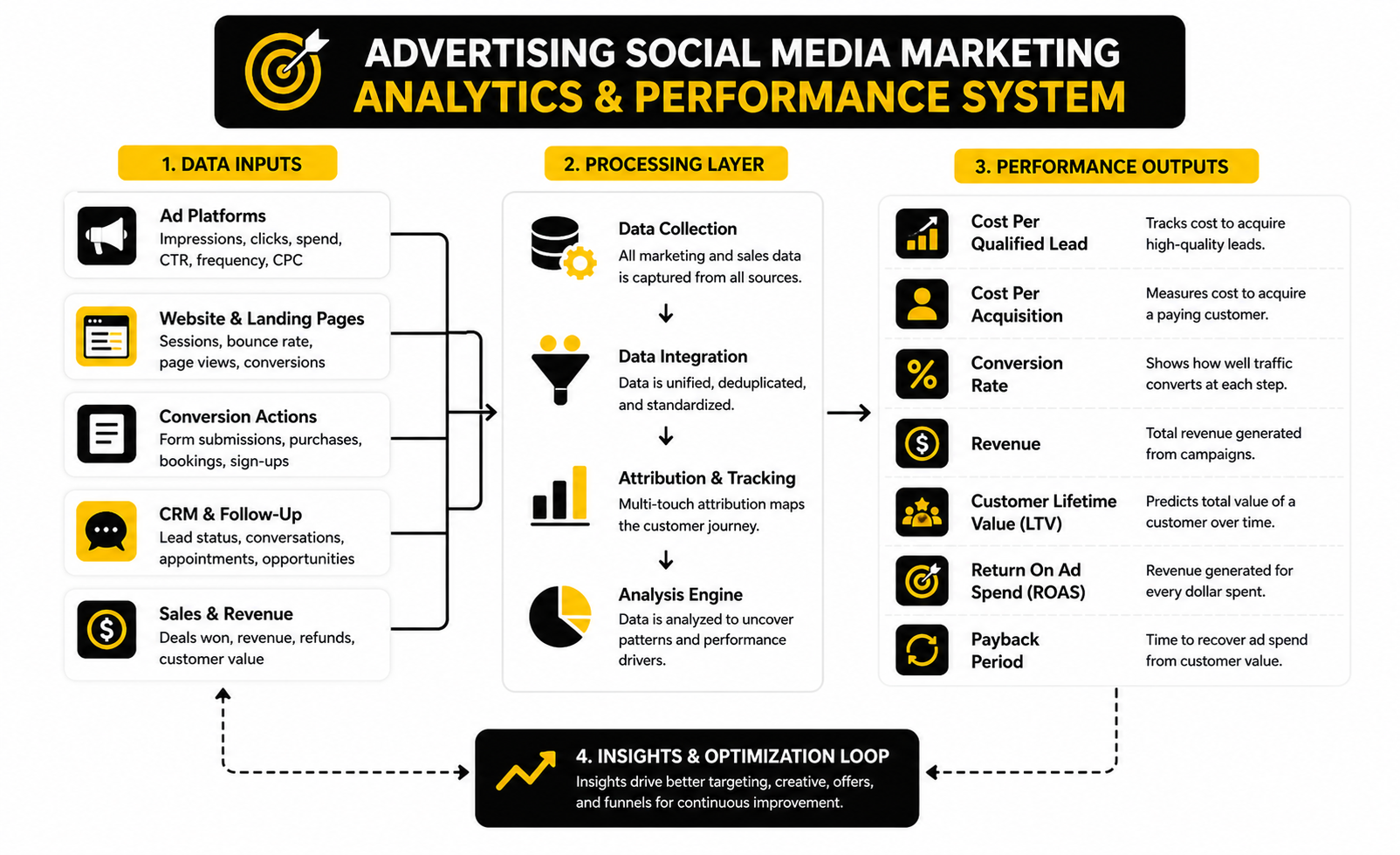
Attention metrics show whether people are noticing the campaign. These include reach, impressions, CPM, thumb-stop rate, video views, engagement rate, and click-through rate. They help you evaluate creative strength and platform fit.
Intent metrics show whether the attention is meaningful. These include landing page views, form starts, quiz completions, add-to-cart actions, booked calls, replies, and saved posts. They tell you whether people are moving beyond passive interest.
Conversion and revenue metrics show whether the system is producing business outcomes. These include cost per lead, cost per acquisition, conversion rate, average order value, pipeline value, return on ad spend, marketing efficiency ratio, and customer lifetime value. These are the numbers that decide whether you scale, fix, or stop.
What Rising Costs Really Mean
Rising ad costs do not automatically mean social media advertising is broken. They mean the margin for lazy execution is smaller. Meta ad performance data showed CPM rising 20.03% overall in 2025, which makes creative quality, offer strength, and owned follow-up more important.
When CPM rises, weak ads get punished faster. A campaign with average creative and no follow-up may become unprofitable even if it worked a year ago. The solution is not always to cut budget. Often, the solution is to improve the system around the budget.
That may mean testing sharper hooks, improving landing page speed, tightening audience exclusions, building better retargeting sequences, or moving more value into email and SMS follow-up. Tools like Brevo or Moosend can support this when email nurturing is part of the social conversion path.
Read Platform Metrics In Context
Each platform has a different role, so the data should be judged differently. Meta can be strong for broad reach, retargeting, ecommerce, and lead generation. LinkedIn can be expensive but useful for B2B when deal size and targeting quality justify the cost. TikTok may create faster discovery, but creative fatigue can arrive quickly if the content does not feel native.
This is why you should not compare every platform by cost per click alone. A cheaper click may bring lower intent. A more expensive click may bring a buyer with a much higher lifetime value. The better comparison is cost per qualified opportunity, cost per customer, and payback period.
For content-heavy teams, scheduling and performance review tools like Buffer can help keep organic publishing organized while paid campaigns run. That matters because organic data often reveals which topics, objections, and angles deserve paid testing.
Diagnose The Funnel Before Changing The Budget
When results drop, most people touch the budget first. That is usually too early. You need to diagnose where the breakdown is happening before you increase, decrease, or move spend.
If impressions are expensive and reach is limited, the issue may be audience size, auction pressure, or platform choice. If impressions are fine but clicks are weak, the issue is likely creative or message-market fit. If clicks are strong but conversions are weak, the landing page, offer, proof, or form may be the problem.
If leads are coming in but revenue is not, the issue may be qualification, speed-to-lead, sales process, or follow-up. This is where a CRM matters because platform dashboards rarely show the full journey from first click to closed deal. A connected system such as GoHighLevel can be useful when you need to see conversations, appointments, pipeline stages, and campaign outcomes in one place.
Use Data To Decide What Happens Next
Good reporting should create action. If a report does not help you decide what to keep, cut, test, or scale, it is just decoration. The best advertising social media marketing dashboards are simple enough to use every week and detailed enough to catch problems before they become expensive.
A practical weekly review should answer five questions:
That final question is the most important. Data is not there to make you feel smart. It is there to show you the next best move.
Optimization, Measurement, And Scaling
Scaling is where weak systems break. A campaign can look promising at a small budget, then fall apart when spend increases because the audience saturates, creative fatigue kicks in, or the follow-up process cannot handle more volume. That is why scaling advertising social media marketing is less about “spend more” and more about knowing what is actually ready to absorb more attention.
The safest way to scale is to increase pressure only after the campaign has proven repeatable performance. One good day is not proof. One strong ad is not a system. You want consistent signals across creative, audience quality, conversion rate, lead quality, sales feedback, and payback period.
Scale The Constraint, Not Just The Budget
Every campaign has a constraint. Sometimes the constraint is creative because the audience stops responding after seeing the same angle too often. Sometimes the constraint is the landing page because the ad gets clicks but the page does not turn those clicks into action. Sometimes the constraint is sales capacity because leads arrive faster than the team can follow up.
Scaling should focus on the constraint first. If creative is the bottleneck, more budget only burns through the audience faster. If follow-up is the bottleneck, more leads only create more missed opportunities. If the offer is the bottleneck, better targeting will not save it.
This is why serious teams review the whole system before increasing spend. They look at ad fatigue, conversion paths, sales notes, customer quality, refunds, retention, and payback. Scaling only works when the business can handle the extra volume without damaging profitability or customer experience.
Watch For Creative Fatigue Early
Creative fatigue is one of the most common scaling risks. It usually shows up as declining click-through rate, rising frequency, weaker engagement, higher costs, and fewer qualified actions. The dangerous part is that it can happen gradually, so teams often notice it only after performance has already dropped.
The fix is not to panic and replace everything. Start by separating the winning message from the tired execution. If the angle still works, you may only need new hooks, formats, visuals, proof points, or opening lines. If the angle itself has stopped working, you need to test a different promise or audience insight.
A practical creative system keeps new variations moving before the old ones collapse. That can include new short-form videos, founder-led clips, customer objections, comparison angles, product demonstrations, and educational posts. For planning and publishing across channels, Buffer can help keep the content rhythm consistent without turning the process into chaos.
Balance Automation With Human Judgment
Automation is useful, but it is not a replacement for strategy. Platform algorithms can optimize delivery, but they still need strong inputs. If the offer is unclear, the creative is generic, or the landing page is weak, automation will simply find the best version of a bad setup.
The same is true for AI tools. They can speed up research, briefs, scripts, reporting, customer support, and content production. But AI should not flatten your voice or make your brand sound like everyone else. The brands that win with AI will use it to move faster while keeping human judgment in the parts that matter most.
This balance is especially important in customer conversations. A chatbot can answer common questions and route people faster, but it should not create friction when someone is ready to buy or needs a real response. Tools like Chatbase can be useful for structured support and lead handling, but the experience still needs to feel helpful, not robotic.
Build For Privacy And First-Party Data
Privacy changes are not a side issue anymore. They affect targeting, attribution, retargeting, personalization, and reporting. The practical response is to build more direct relationships with your audience instead of relying only on third-party tracking.
First-party data matters because it comes from people who interacted with your brand directly. That can include email subscribers, customers, quiz responses, booking forms, purchase history, website behavior, and CRM activity. The better your owned data, the less fragile your advertising becomes.
This does not mean collecting data aggressively. It means collecting the right data with a clear value exchange. If someone fills out a form, books a call, joins a list, or answers a quiz, they should understand what they are getting and why it is useful. That trust is part of the marketing system.
Know When To Broaden And When To Narrow
One advanced tradeoff is audience control. Narrow targeting can help early campaigns stay focused, especially when the offer is specific or the budget is small. But overly narrow targeting can limit learning, increase costs, and prevent the platform from finding better pockets of demand.
Broad targeting can work when the creative and offer are strong enough to qualify the audience. In that case, the ad itself does part of the targeting because the right people pay attention and the wrong people ignore it. This is powerful, but it requires sharper messaging.
The decision depends on the campaign stage. Early testing may need tighter audience definitions so you can learn clearly. Scaling may need broader audiences so the campaign has room to breathe. Retargeting should stay more specific because those people have already shown intent.
Protect Margin While You Scale
Revenue growth is not the same as profitable growth. A campaign can produce more sales while quietly weakening the business if acquisition costs rise faster than customer value. This is especially risky when teams judge performance only by platform-reported return on ad spend.
Protecting margin means looking at contribution profit, refund rates, fulfillment costs, sales team capacity, churn, and lifetime value. If a channel brings customers who buy once and never return, the campaign may need a different offer or follow-up strategy. If a channel brings fewer customers but better retention, it may deserve more budget than the dashboard suggests.
This is where advertising social media marketing becomes a business decision, not just a media buying decision. The best question is not “Which ad got the cheapest result?” The better question is “Which campaign brings the kind of customer we actually want more of?”
Create A Scaling Rhythm
Scaling should have a rhythm. You test, read the data, identify the constraint, improve one major variable, and then test again. That rhythm keeps the team from changing too many things at once and losing track of what actually caused the result.
A simple scaling rhythm can look like this:
This is not flashy, but it works. Consistency beats random bursts of effort. When the process is clear, your team can scale with more confidence and fewer expensive surprises.
Common Mistakes, Tools, And FAQs
By this point, the system should be clear. Advertising social media marketing is not one tactic. It is the connection between strategy, creative, traffic, conversion, follow-up, measurement, and scaling.
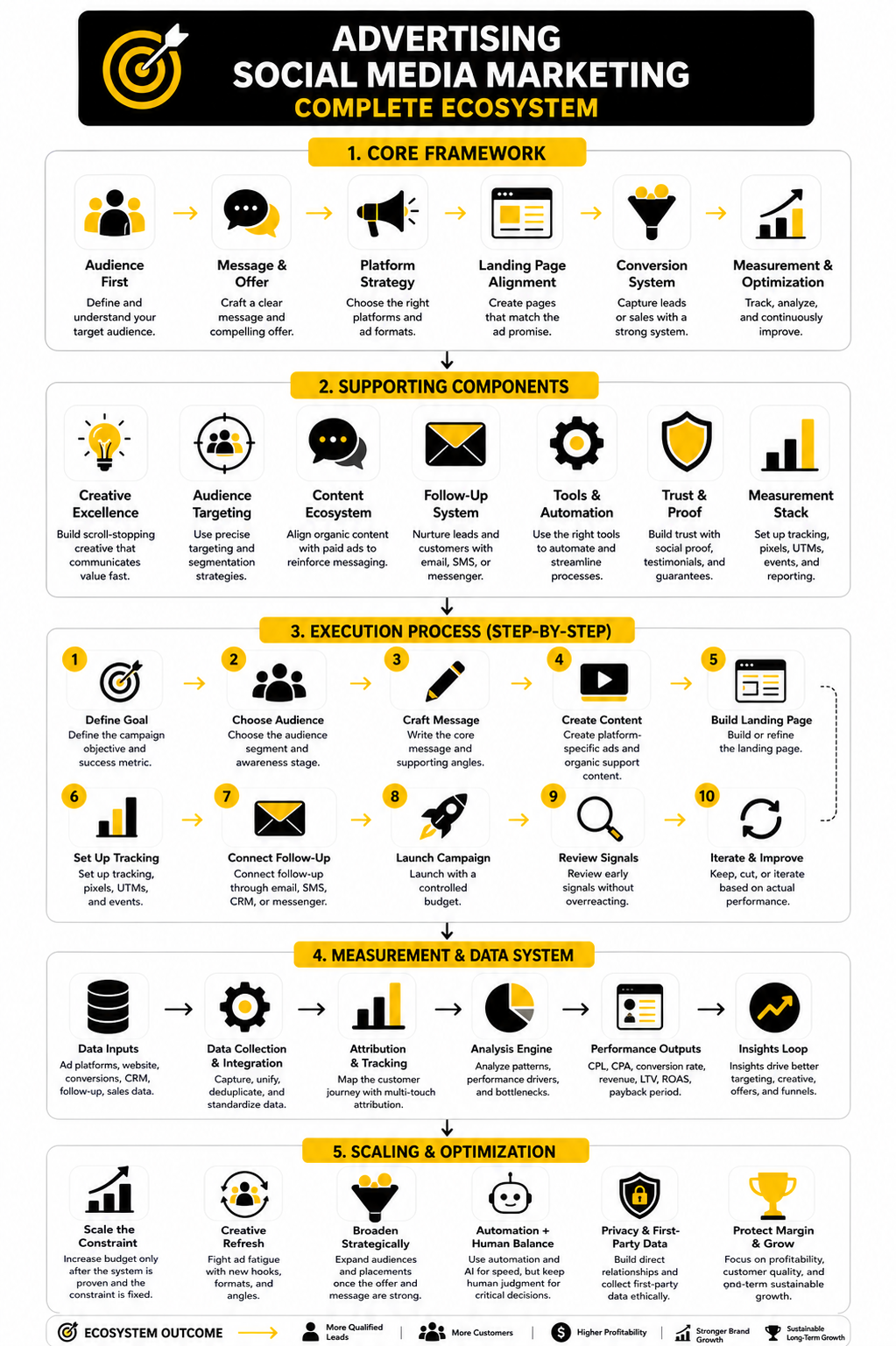
The final challenge is discipline. Most campaigns do not fail because the team lacks access to platforms or tools. They fail because the system becomes messy, the message becomes generic, or the team reacts emotionally to short-term data instead of improving the biggest constraint.
Common Mistakes To Avoid
The first mistake is launching without a clear offer. If the audience cannot quickly understand what they get, why it matters, and what to do next, the campaign will struggle. A good offer does not need hype, but it does need clarity.
The second mistake is judging ads too early. Early data can show direction, but it does not always prove the final outcome. Let the campaign collect enough signal before making major decisions, especially when the buying journey takes more than one touch.
The third mistake is separating marketing from sales. If paid social creates leads but the sales team responds slowly, ignores context, or treats every lead the same, performance will suffer. The campaign does not end when the form is submitted.
The fourth mistake is chasing tools instead of fixing the message. Software can help you execute faster, but it cannot make a weak promise compelling. Before adding another platform, make sure the audience, offer, creative, and follow-up are already sound.
Choosing The Right Tools
Tools should support the system, not replace it. If you need social scheduling and content organization, Buffer can help keep publishing consistent. If you need messenger automation, ManyChat can support comment-to-message flows and conversational follow-up.
If you need funnels and landing pages, ClickFunnels, Systeme.io, or Replo may fit depending on your business model. If you need CRM, pipelines, bookings, and automation in one place, GoHighLevel can be useful for service businesses and agencies.
The right stack depends on your bottleneck. Do not buy funnel software when your problem is weak creative. Do not buy an automation platform when your problem is unclear positioning. Match the tool to the constraint.
What is advertising social media marketing?
Advertising social media marketing is the use of paid social ads, organic social content, targeting, creative testing, landing pages, and follow-up systems to attract and convert customers. It connects attention with measurable business outcomes. The goal is not just visibility, but profitable movement through the buyer journey.
How is social media advertising different from social media marketing?
Social media advertising usually refers to paid campaigns on platforms like Meta, TikTok, LinkedIn, YouTube, Pinterest, or Snapchat. Social media marketing is broader because it includes organic content, brand positioning, community, analytics, and customer engagement. Advertising social media marketing combines both so paid and organic efforts support each other.
Which platform is best for social media advertising?
There is no universal best platform. Meta can work well for broad consumer targeting, ecommerce, retargeting, and lead generation. LinkedIn can work for B2B when deal size supports higher costs. TikTok and Instagram can work when the brand has strong short-form creative and a clear offer.
How much should a business spend on social media ads?
Budget depends on the offer, audience size, conversion goal, sales cycle, and acceptable acquisition cost. A small test budget should be large enough to gather useful data, not just a few random clicks. The more carefully move is to start controlled, prove the funnel, then scale based on profitable performance.
What metrics matter most in advertising social media marketing?
The most important metrics are the ones tied to business outcomes. Cost per qualified lead, cost per acquisition, conversion rate, revenue, lifetime value, and payback period matter more than likes or impressions. Attention metrics still help, but they should be used to diagnose performance, not define success alone.
How long does it take social media ads to work?
Some campaigns can show early signals within days, but reliable performance usually takes more testing. Creative, audience, offer, landing page, and follow-up all need enough data to evaluate properly. The more complex the buying decision, the longer the path from first click to revenue.
Why do social media ads stop working?
Ads often stop working because of creative fatigue, audience saturation, rising costs, weak offers, poor landing page performance, or slow follow-up. Sometimes the platform is not the real problem. The campaign may simply need new angles, better proof, sharper positioning, or stronger conversion infrastructure.
Should organic content and paid ads use the same strategy?
They should share the same positioning, but not always the same format. Organic content is useful for testing topics, building trust, and learning what the audience responds to. Paid ads can then amplify the strongest angles with more structured conversion goals.
Do small businesses need a full funnel?
Yes, but “full funnel” does not need to mean complicated. A simple funnel can be one strong ad, one focused landing page, one form or checkout, and one follow-up sequence. The key is making sure every step has a purpose.
What is the biggest mistake beginners make?
The biggest beginner mistake is boosting random posts and calling it strategy. Boosting can increase reach, but it does not automatically create a conversion system. A real campaign needs a clear goal, audience, message, offer, tracking, and follow-up.
Is AI useful for social media marketing?
AI can be useful for research, ideation, scripts, reporting, customer support, and workflow speed. But it should not replace strategic judgment or brand voice. The strongest teams use AI to move faster while keeping human insight in the parts that shape trust and buying decisions.
When should a campaign be scaled?
A campaign should be scaled when it has consistent performance, clear tracking, enough creative variation, and a conversion path that can handle more volume. Do not scale because one ad had a good day. Scale when the system is stable enough to absorb more spend without breaking profitability.
Build a stronger local presence with BAAM AI
Turn your website, Google profile, social channels, and AI visibility into one growth engine
Most businesses do not need more random marketing activity. They need a consistent presence system that helps the right people find them, trust them, and take action. BAAM AI brings strategy, local SEO, website updates, Google Maps visibility, social content, AI-search readiness, media production, and reporting into one practical monthly engine.
If you want your marketing to keep working after the campaign ends, start with a free BAAM AI presence audit. See how your business shows up today and where the fastest visibility wins are at BAAM AI.