
BAAM AI Blog
Advanced Strategy, Risks, And Scaling
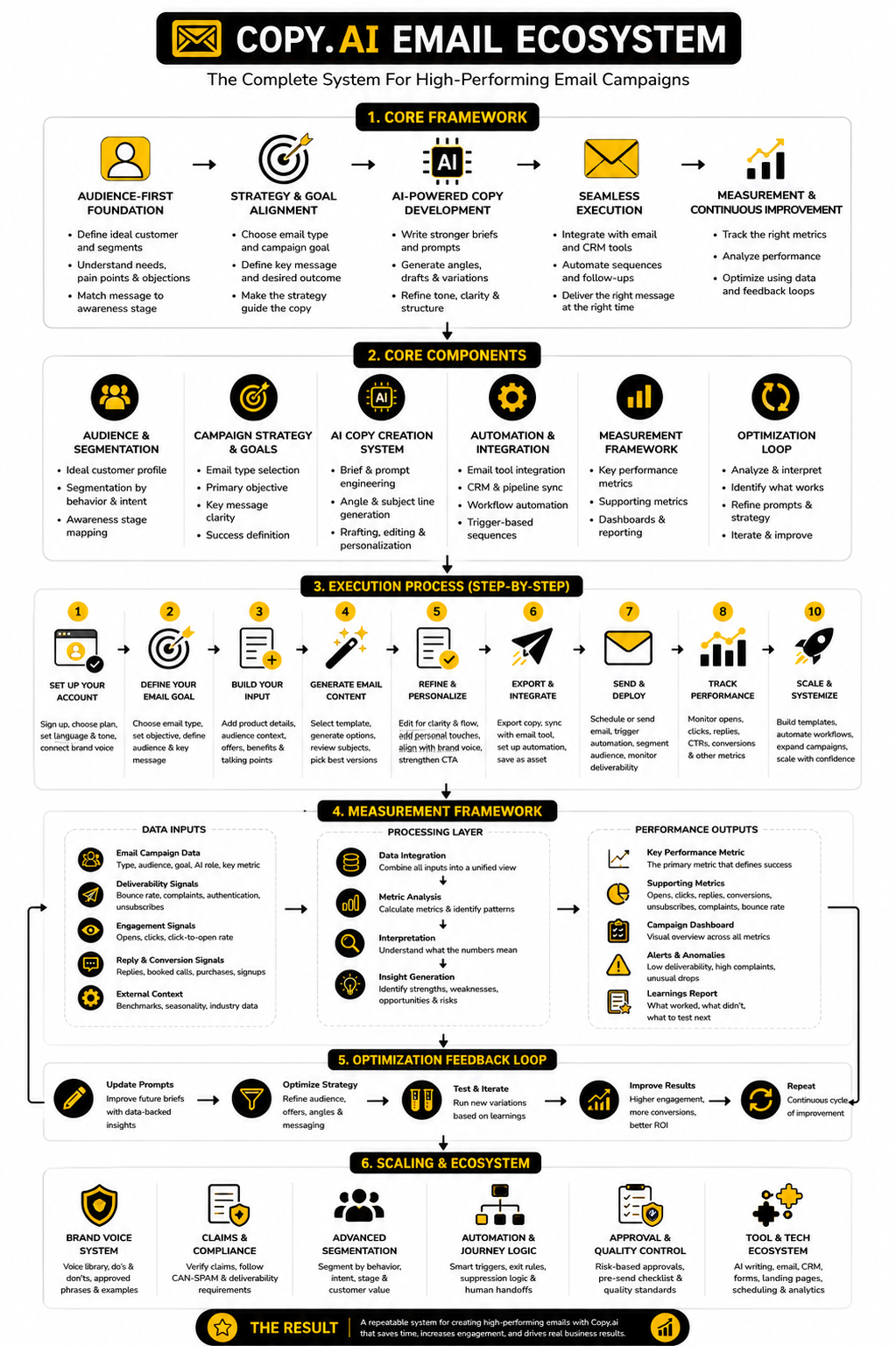
Once the basics are working, the next challenge is scale. A single copy ai email workflow can help one marketer draft faster, but a scaled workflow has to protect quality across people, campaigns, segments, tools...
Affiliate disclosure: this article may include compensated links. Recommendations should still be evaluated against your use case, budget, and current provider terms.
Should you choose Copy.ai?
Copy.ai is worth considering when the use case, budget, and implementation effort match what you actually need to do next.
teams that want a practical tool decision without reading another generic feature list
Check Copy.aiOnce the basics are working, the next challenge is scale. A single copy ai email workflow can help one marketer draft faster, but a scaled workflow has to protect quality across people, campaigns, segments, tools, and approvals. That is where the real tradeoffs appear.
The biggest risk is not that AI writes badly. The bigger risk is that AI writes confidently in a way that slowly flattens your brand, weakens your claims, and makes every campaign feel the same. At low volume, you can catch that manually; at higher volume, you need stronger systems.
Scaling AI-assisted email copy is not about producing more messages just because you can. It is about producing more relevant messages with tighter controls. If the system makes it easier to send generic email at higher volume, you have not improved the marketing machine; you have made the noise louder.
Protect Brand Voice Before You Scale
Brand voice is not a list of adjectives. “Friendly, helpful, professional” is too vague to guide an AI tool. A useful voice system explains what the brand sounds like, what it never says, how it handles urgency, how it presents proof, and how direct the copy should be.
The practical move is to build a small voice library. Include approved subject lines, strong openings, high-performing CTAs, phrases the brand uses often, and phrases the brand avoids. Then use that library as input whenever AI drafts or edits email copy.
This matters because AI tends to average things out. Without specific examples, it often moves toward safe, generic language that feels like every other marketing email. A good voice system keeps the output recognizable while still giving the team room to test angles and formats.
Control The Claims AI Is Allowed To Make
AI can make copy sound more persuasive by making claims more specific, but specificity is dangerous if the claim is not true. This is where marketing teams need discipline. Every claim in an AI-assisted email should be either directly supported, clearly framed as an opinion, or removed.
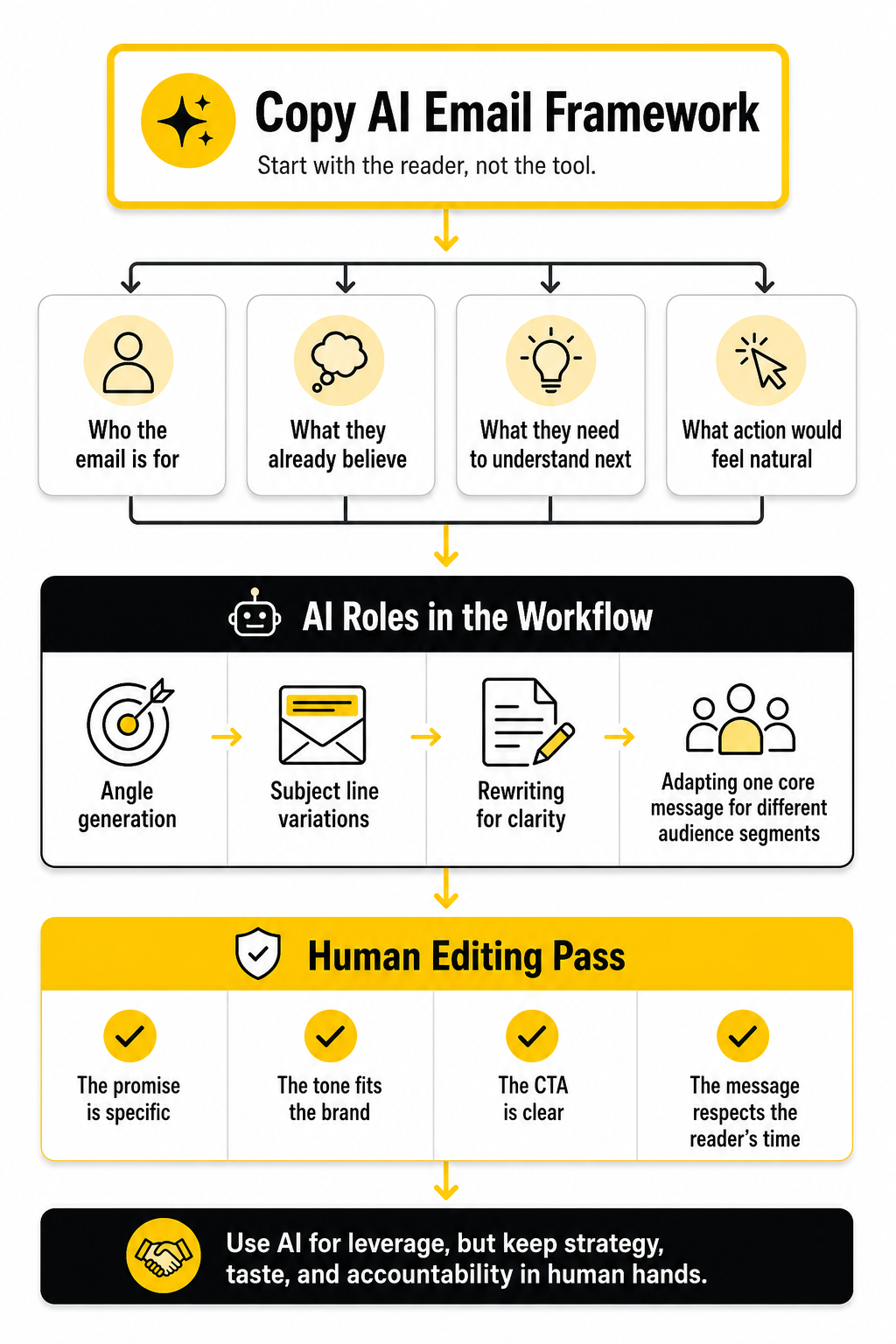
Use a simple rule: if the email promises a result, names a number, compares performance, or implies urgency, someone must be able to verify it. If the proof does not exist, the line should not go out. This is not about being cautious for the sake of it; it is about protecting trust.
This is also where compliance and deliverability overlap. The FTC’s CAN-SPAM guidance requires commercial email to avoid false or misleading header information and deceptive subject lines. AI can help write faster, but it cannot carry the legal or reputational responsibility for what you send.
Segment Without Overcomplicating The System
Segmentation is powerful, but it can turn into a mess if every tiny audience gets its own version of every email. More segments mean more copy, more approvals, more testing complexity, and more chances for broken logic. The goal is useful segmentation, not infinite personalization.
Start with segments that clearly change the message. New subscribers, active leads, past customers, abandoned cart users, trial users, and inactive contacts usually deserve different copy because their context is different. But splitting audiences by details that do not change the buying conversation can create work without improving results.
AI helps when it adapts one core message for meaningful segments. It hurts when it creates dozens of shallow variations that nobody can properly review or measure. Keep the segmentation tied to real differences in intent, awareness, behavior, or customer value.
Balance Automation With Human Timing
Automation is useful because it sends the right message without waiting for a person to remember. But automation becomes annoying when it ignores context. A customer who already purchased should not keep receiving aggressive sales reminders, and a lead who just replied should not immediately get another generic follow-up.
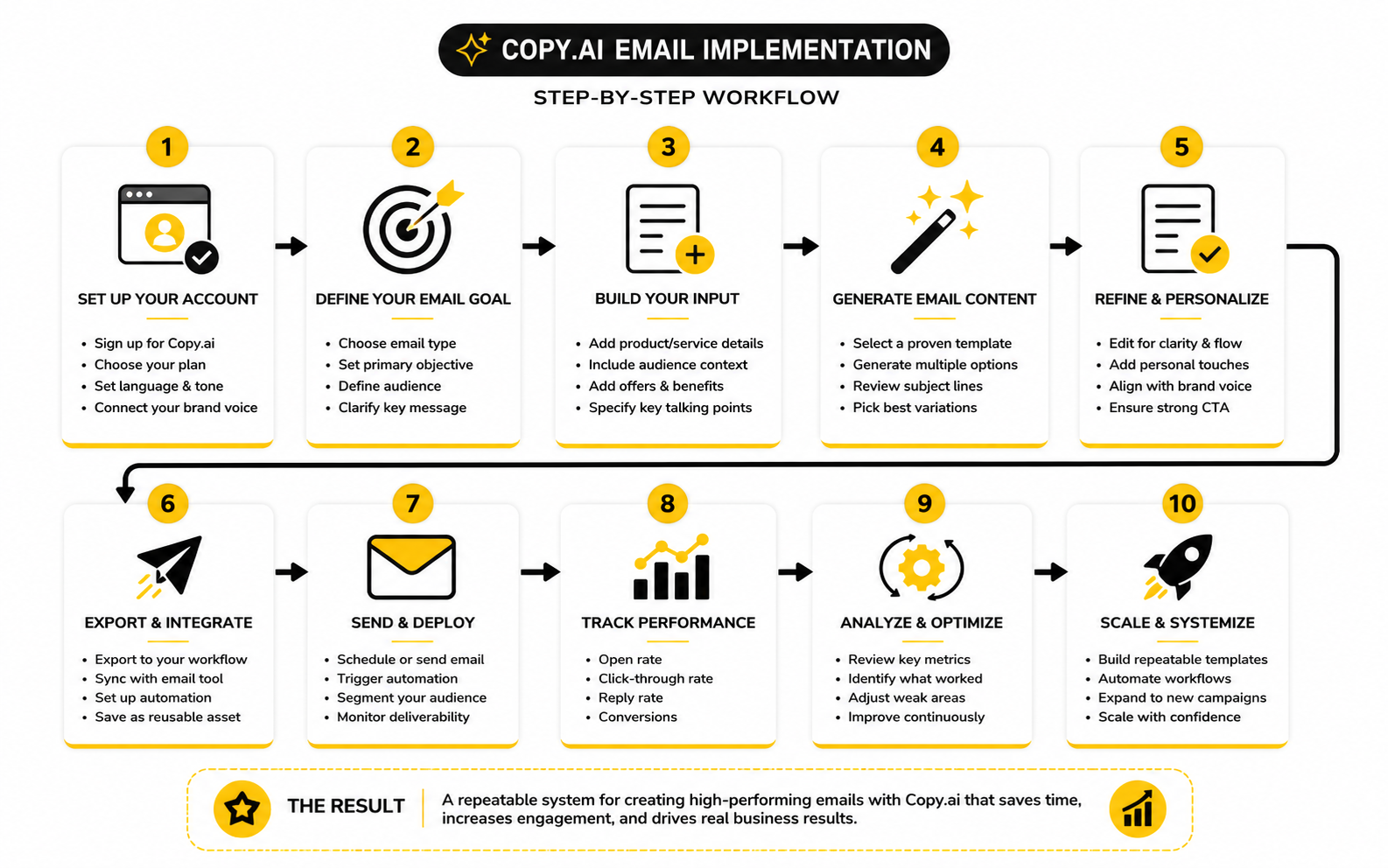
This is why advanced email systems need suppression logic, exit rules, and human handoff points. The copy can be excellent, but the experience still fails if the sequence keeps pushing after the reader has moved to a different stage. Good automation feels responsive; bad automation feels blind.
AI can help draft the emails inside the sequence, but the customer journey logic has to come first. For teams that want CRM, automation, pipeline tracking, and AI features in one operating system, GoHighLevel can be a practical fit. The important thing is not the tool by itself; it is whether the tool helps you send fewer irrelevant messages and more timely ones.
Keep Deliverability In The Strategy Conversation
Deliverability is not only a technical issue for the person managing DNS records. It should influence copy, segmentation, frequency, list hygiene, and campaign planning. If the inbox providers see weak engagement and rising complaints, your future emails may have a harder time reaching people.
This becomes more important as teams use AI to produce more copy. Validity’s 2025 deliverability benchmark found that one in six legitimate marketing emails fails to reach the inbox. That should make every marketer more careful about volume, relevance, and list quality.
The action is straightforward. Do not use AI as an excuse to send more often to people who are not engaging. Use it to improve the relevance of what you send, clean up unclear copy, and create better reactivation or sunset sequences for inactive contacts.
Build Approval Rules For Different Risk Levels
Not every email needs the same approval process. A low-risk newsletter intro can move quickly. A promotional campaign with revenue claims, compliance-sensitive wording, or aggressive urgency needs more review.
Create risk tiers for your copy ai email workflow. Low-risk emails can be reviewed by the campaign owner. Medium-risk emails may need a marketing lead. High-risk emails should involve legal, compliance, product, or leadership depending on the claim and industry.
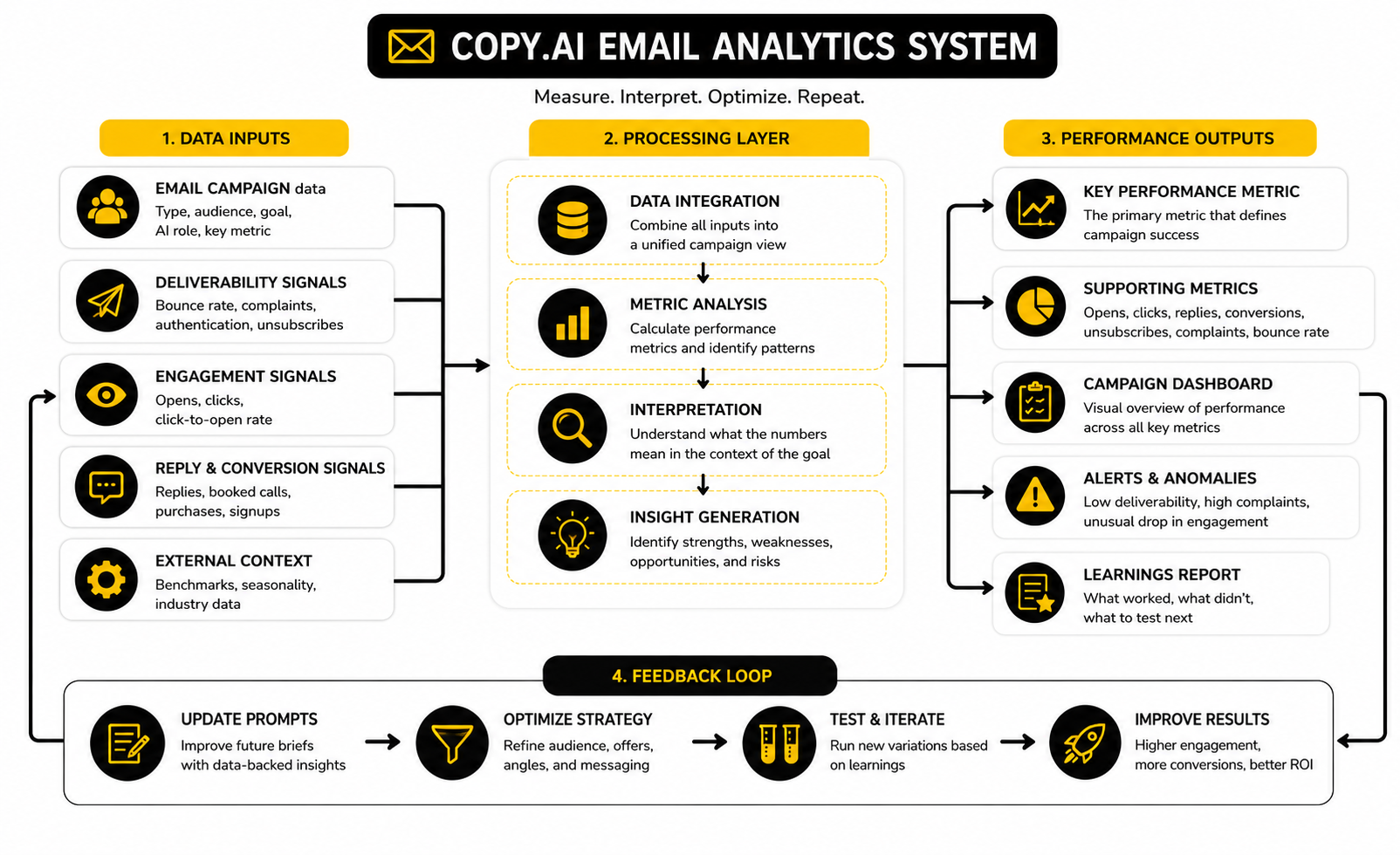
This keeps the workflow fast without making it reckless. The worst system is one where every email needs five approvals, because the team will either slow down or bypass the process. The best system applies the right level of control to the right level of risk.
Use AI For Quality Control, Not Just Drafting
AI is often treated as a writing tool, but it can be just as useful as a review tool. Before sending, ask it to check whether the email has one clear goal, whether the CTA matches the body, whether the tone fits the audience, and whether any claims sound unsupported. This gives you another layer of quality control before the human final pass.
You can also use AI to compare versions. Give it two drafts and ask what changed in the reader’s perceived promise, urgency, objection handling, and clarity. This helps you avoid choosing the version that sounds nicer but sells the idea less clearly.
The key is to keep the review prompt specific. Do not ask, “Is this good?” Ask what matters: clarity, credibility, relevance, friction, proof, tone, and next-step alignment. Specific questions produce useful criticism.
Know When Not To Use AI
There are moments when AI should not lead the writing. Sensitive customer apologies, major brand statements, legal notices, crisis communication, and deeply personal founder emails usually need a heavier human hand. AI can help organize thoughts, but the message should come from real judgment and real accountability.
That does not mean AI has no role. It can help simplify a draft, find unclear phrasing, or test whether the message could be misread. But it should not be the emotional center of the email.
This is the mature way to use AI. Use it aggressively where speed, structure, and variation help. Pull it back where trust, nuance, and responsibility matter more than output volume.
Create A Prompt Library That Improves Over Time
A prompt library turns individual wins into reusable assets. When a prompt produces a strong email, save it with notes about the audience, campaign type, result, and edits made after drafting. Over time, this becomes a practical internal playbook.
Do not save prompts blindly. Save the ones that produce useful output and update them when performance data shows a better approach. A prompt that worked for a webinar reminder may not work for a reactivation campaign, so label everything clearly.
This is where advanced teams separate themselves. They do not just use AI; they train their process around what actually works for their audience. The library becomes sharper because it is built from real campaigns, not theory.
Make The System Easy Enough To Actually Use
A sophisticated workflow is worthless if the team avoids it. The best copy ai email system is clear, repeatable, and fast enough to survive busy weeks. It should help people write better without forcing them into a complicated ritual every time they need an email.
Keep the default workflow simple, then add advanced steps only when the campaign deserves them. A basic newsletter may need a brief, draft, edit, and send. A launch sequence may need strategy prompts, segmentation variants, compliance review, landing page checks, and post-send analysis.
That balance matters. AI should reduce operational drag, not create a new layer of busywork. If the process helps the team move faster while making better decisions, it is working.
Build a stronger local presence with BAAM AI
Turn your website, Google profile, social channels, and AI visibility into one growth engine
Most businesses do not need more random marketing activity. They need a consistent presence system that helps the right people find them, trust them, and take action. BAAM AI brings strategy, local SEO, website updates, Google Maps visibility, social content, AI-search readiness, media production, and reporting into one practical monthly engine.
If you want your marketing to keep working after the campaign ends, start with a free BAAM AI presence audit. See how your business shows up today and where the fastest visibility wins are at BAAM AI.