
BAAM AI Blog
360 Marketing Agency: The Complete Framework For Building One Connected Growth System
A 360 marketing agency helps a business stop treating marketing like a pile of disconnected tasks. Instead of running ads in one corner, content in another, email somewhere else, and reporting after the fact, a 360...
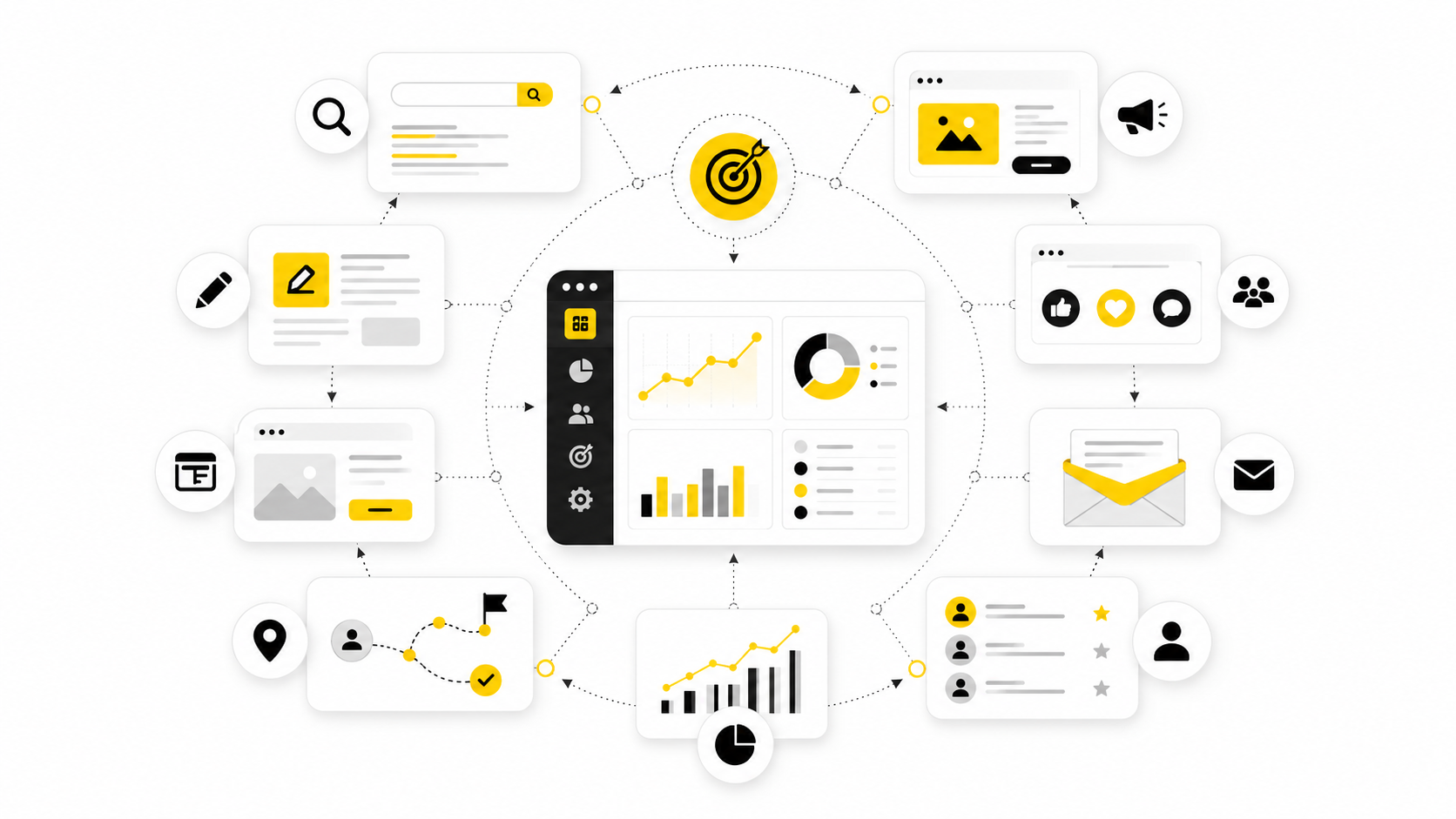
A 360 marketing agency helps a business stop treating marketing like a pile of disconnected tasks. Instead of running ads in one corner, content in another, email somewhere else, and reporting after the fact, a 360 approach connects strategy, creative, channels, automation, analytics, and customer experience into one operating system.
That matters because modern buyers do not move in a straight line. They discover a brand through search, social, referrals, ads, creators, review sites, emails, landing pages, sales calls, communities, and retargeting. If each touchpoint says something different, the customer feels it immediately.
The job of a 360 marketing agency is not to “do everything” for the sake of doing more. The job is to make every important marketing function work together, so the brand is easier to understand, easier to trust, and easier to buy from. In a market where U.S. digital advertising revenue reached nearly $300 billion in 2025, disconnected execution is not just messy. It is expensive.
Budgets are also under pressure. Gartner’s 2025 CMO Spend Survey found that marketing budgets stayed flat at 7.7% of company revenue, which means brands need more coordination, not more random activity. The winners are not always the teams with the biggest budget. They are often the teams with the cleanest strategy, strongest feedback loops, and best execution rhythm.
Why A 360 Marketing Agency Matters Now
Marketing used to be easier to separate into departments. The media team bought traffic, the creative team made assets, the content team wrote posts, the sales team handled leads, and leadership checked the numbers at the end of the month. That model breaks down when the customer journey becomes fragmented across platforms, devices, and decision stages.
A 360 marketing agency matters because it gives the brand one connected view of the market. Instead of optimizing one channel in isolation, it looks at how awareness, trust, conversion, retention, and referrals influence each other. That shift is important because Nielsen’s 2025 Annual Marketing Report highlights the need for more holistic measurement and data-driven marketing as marketers deal with changing technology, AI, and channel complexity.
The practical benefit is alignment. A strong 360 marketing agency makes sure the offer, audience, message, funnel, content, media plan, CRM, automation, and reporting all support the same growth objective. When that alignment is missing, businesses often spend more and learn less.
The 360 Marketing Framework
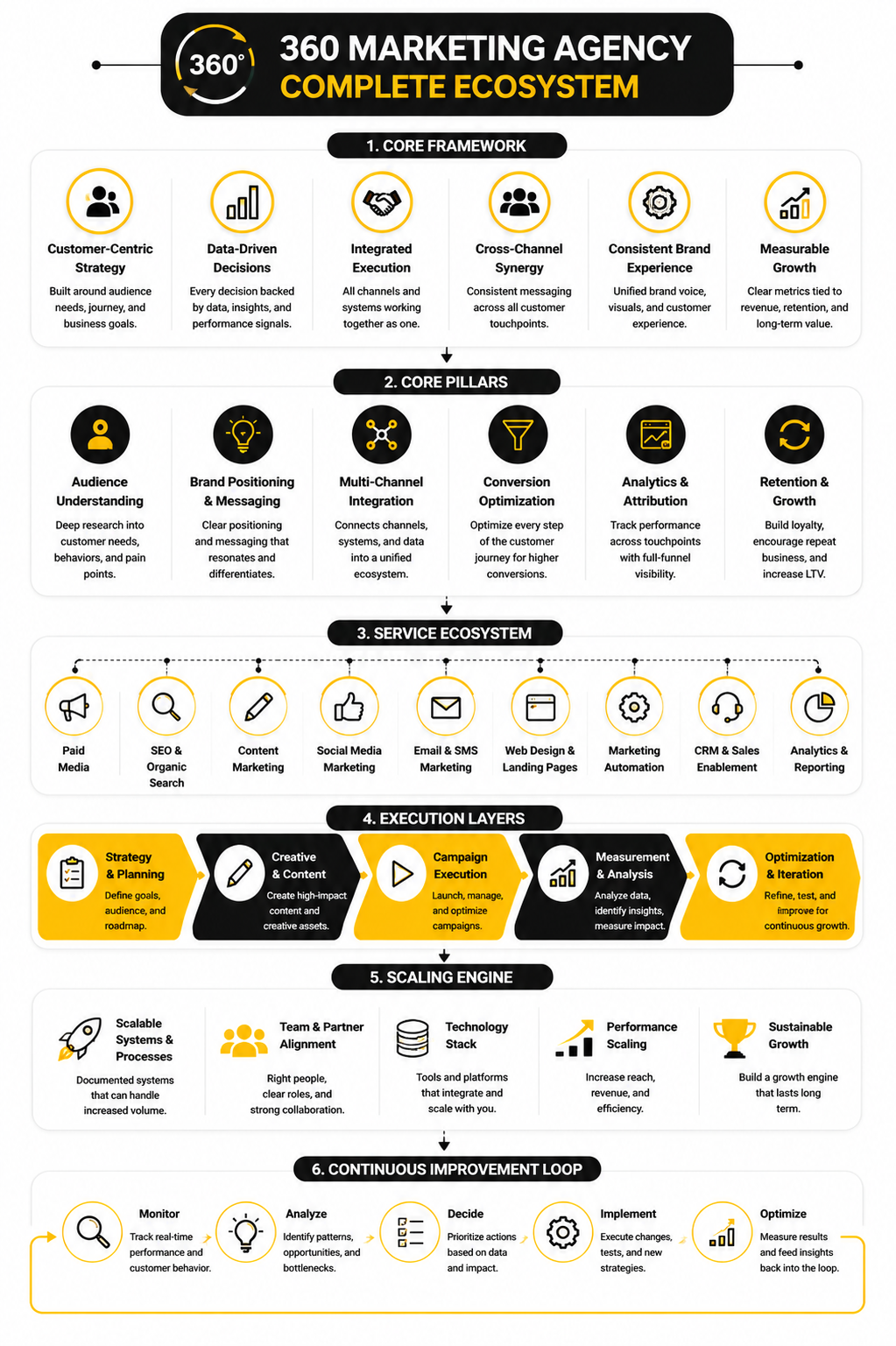
A 360 marketing framework starts with the customer, not the channel. The agency first clarifies who the brand is trying to reach, what those people need to believe, what blocks them from buying, and which touchpoints can move them forward. Only then does it decide which channels, campaigns, assets, and systems deserve attention.
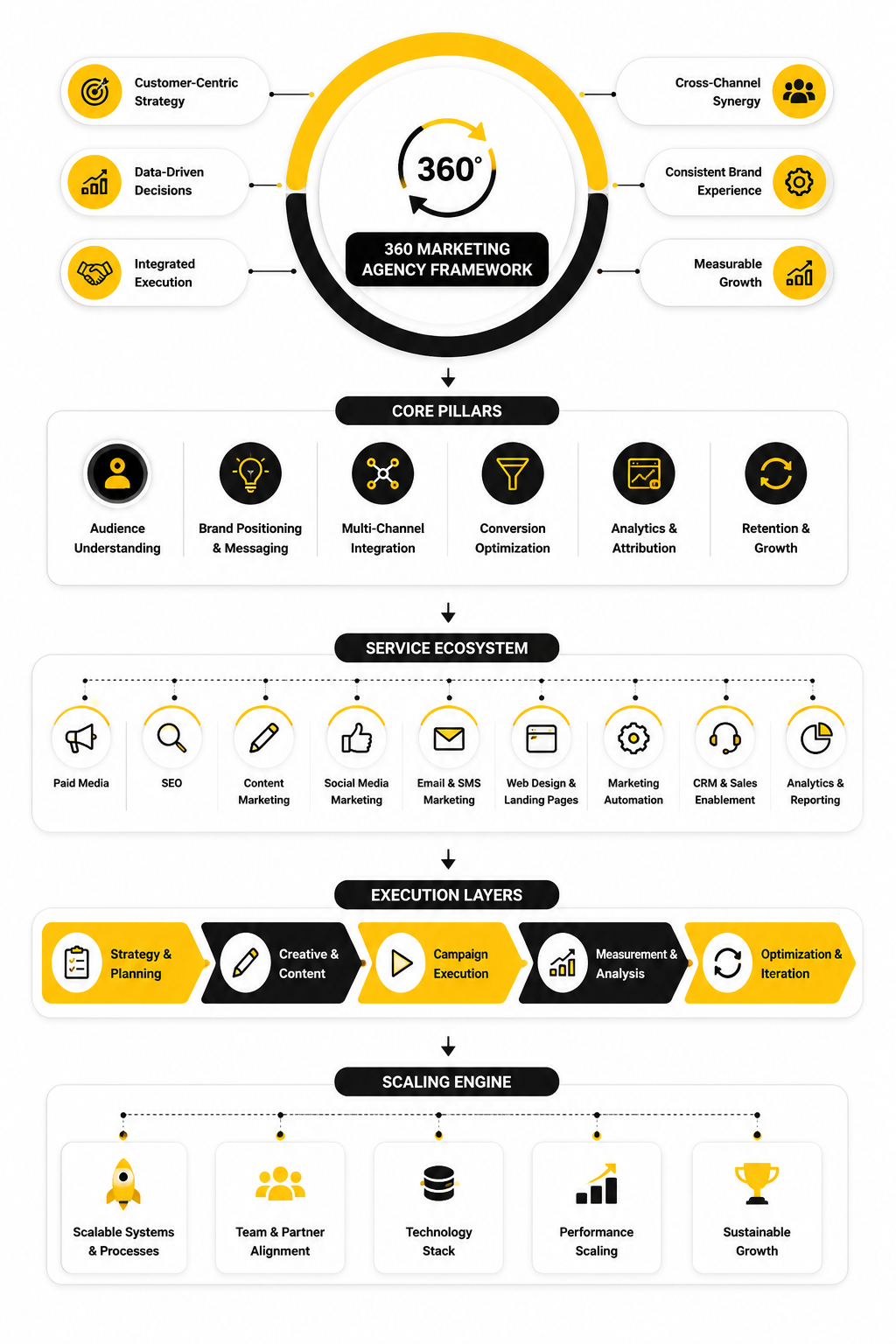
The framework is usually built around four connected layers: strategy, visibility, conversion, and retention. Strategy defines the market position and growth priorities. Visibility brings the brand into the right conversations through search, paid media, social, partnerships, content, and other discovery channels.
Conversion turns attention into measurable pipeline, revenue, or bookings. Retention keeps customers engaged after the first purchase, which is where email, SMS, customer education, loyalty, onboarding, community, and lifecycle marketing become critical. This is why a 360 marketing agency should not be judged only by how many services it lists on its website. It should be judged by how well those services work together.
Core Components Of A Connected Marketing System
A real 360 marketing system has several moving parts, but they should not feel chaotic. The core components usually include brand strategy, audience research, offer positioning, creative direction, content, paid acquisition, organic visibility, landing pages, sales enablement, CRM workflows, automation, analytics, and reporting. Each part has a specific role in moving the customer from first impression to long-term value.
The strongest agencies do not treat these components as separate deliverables. They connect them through shared messaging, shared data, and shared performance goals. For example, paid ads should inform landing page tests, landing page behavior should inform email follow-up, email engagement should inform sales conversations, and sales objections should inform new content.
This is where many brands feel the biggest difference between a specialist vendor and a 360 marketing agency. A specialist may improve one piece of the machine. A 360 agency is responsible for making the machine work as a system.
How Professional Implementation Works
Professional implementation is where a 360 marketing agency proves whether it is strategic or just busy. The difference is simple. A busy agency launches tasks, while a strategic agency builds a system that can learn, improve, and compound over time.
The first step is usually an audit. A good agency looks at the brand, offer, analytics, website, funnel, CRM, content, ads, email, social presence, sales process, and customer journey before making big recommendations. This prevents the classic mistake of adding more channels before fixing the gaps that already exist.
The second step is prioritization. Not every business needs every marketing service at the same time. A local service business may need stronger lead capture, follow-up automation, reviews, and conversion tracking before it needs a huge content operation. An ecommerce brand may need better landing pages, lifecycle email, paid creative testing, and retention flows before adding another social platform.
That is why implementation should feel sequenced, not random. The agency should define the growth bottleneck, fix the highest-leverage parts first, and then expand once the foundation is stable. This is especially important when marketing budgets are tight and leadership expects more output from the same resources, which is exactly the pressure reflected in Gartner’s finding that 2025 marketing budgets stayed flat at 7.7% of company revenue.
The Discovery Phase
Discovery is not a formality. It is where the agency decides whether the business has a traffic problem, a trust problem, an offer problem, a conversion problem, a retention problem, or a measurement problem. Those are very different problems, and treating them the same way wastes money fast.
A proper discovery phase should include customer research, competitor review, message analysis, funnel mapping, and performance baseline checks. The goal is to find the few inputs that will actually change results. More dashboards do not help if nobody knows what decision each metric is supposed to guide.
This is also where a 360 marketing agency should challenge weak assumptions. If the brand thinks it needs more leads, the agency may find that the real issue is slow speed-to-lead, poor follow-up, unclear pricing, low trust, or weak landing page relevance. That kind of diagnosis is uncomfortable, but it is useful.
The Strategy Phase
Strategy turns the audit into a focused plan. This is where the agency defines the audience segments, core message, channel priorities, funnel structure, content themes, offer angles, testing roadmap, and reporting rhythm. It should be specific enough that every team member knows what to build next.
A strong strategy also explains what the agency will not do yet. That matters because scattered marketing often comes from saying yes to every tactic. When every idea becomes urgent, nothing compounds.
The best 360 marketing agency strategy connects brand and performance instead of forcing them into separate boxes. Brand work builds memory, preference, and trust, while performance work captures demand and converts attention into measurable action. Nielsen’s 2025 marketing research emphasizes this need for holistic measurement and data-driven marketing, because modern marketing performance is rarely explained by one channel alone.
The Execution Phase
Execution is where the strategy becomes assets, campaigns, workflows, and measurable touchpoints. This can include ad creative, landing pages, search content, social content, email sequences, SMS flows, lead forms, booking pages, sales scripts, retargeting, CRM stages, and reporting dashboards. The exact mix depends on the business model.
For agencies managing lead generation, a platform like GoHighLevel can make sense because CRM, pipelines, automation, forms, calendars, messaging, and follow-up can live closer together. That does not magically create a strategy. It simply gives the agency a cleaner place to operate the system once the strategy is clear.
For brands focused on funnels and direct-response campaigns, tools like ClickFunnels or Systeme.io can support landing pages, sales pages, email, checkout flows, and simple campaign infrastructure. The important point is not which tool sounds popular. The important point is whether the tool supports the customer journey the agency is trying to build.
The Optimization Phase
Optimization is not just changing button colors or swapping headlines. Real optimization means studying what customers do, what they ignore, where they hesitate, and which messages move them closer to action. It is a disciplined feedback loop, not a guessing game.
A 360 marketing agency should review performance across the full path, not just the ad account. If ads generate clicks but landing pages fail, the issue may be message match. If landing pages convert but sales does not close, the issue may be lead quality, speed, positioning, or follow-up. If customers buy once but never return, the issue may be onboarding, retention, or post-purchase communication.
This is why the reporting rhythm matters so much. Weekly reviews should catch tactical problems. Monthly reviews should identify patterns. Quarterly reviews should decide whether the agency needs to shift budget, creative direction, audience focus, or channel mix.
How The Agency Connects Channels Without Creating Chaos
A 360 marketing agency should not flood a business with every channel at once. That is how teams get overwhelmed, campaigns lose focus, and reporting becomes impossible to interpret. The more carefully move is to build a connected channel system around the customer’s buying process.
The agency starts by identifying the channels that create awareness, the channels that build trust, and the channels that convert demand. Search may capture active intent. Paid social may create demand with strong creative. Email may nurture undecided buyers. Retargeting may bring people back after they compare options.
Once each channel has a clear job, the work becomes easier to manage. Content can answer the questions sales hears every day. Paid campaigns can test new angles quickly. Email can turn one-time attention into a relationship. Reporting can show how the whole system is moving, not just whether one platform had a good week.
Awareness Channels
Awareness channels introduce the brand to people who may not be ready to buy yet. This can include organic social, paid social, search content, YouTube, podcasts, partnerships, creator campaigns, public relations, and community activity. The goal is not instant conversion from every impression.
The job of awareness is to make the brand recognizable, relevant, and memorable. That matters because people often need multiple exposures before they trust a company enough to take the next step. A 360 marketing agency should use awareness channels to build demand, not just chase cheap reach.
The mistake is measuring every awareness effort like a direct-response campaign. Some channels influence future search, referrals, branded traffic, sales conversations, and retargeting performance. If the agency only values last-click attribution, it may cut the very activity that creates demand in the first place.
Trust-Building Channels
Trust-building channels help buyers feel confident enough to keep moving. These include case studies, reviews, comparison pages, webinars, educational content, newsletters, product demos, social proof, customer stories, and expert-led content. They are especially important when the offer is expensive, complex, or risky.
This layer is where many campaigns quietly fail. A business may get traffic, but buyers hesitate because they do not understand the value, do not believe the promise, or do not see enough proof. More traffic rarely fixes that.
A strong 360 marketing agency builds trust assets before scaling traffic too aggressively. It makes sure the brand can answer buyer objections in plain language. It also makes sure those answers appear in the right places, from landing pages and email sequences to sales enablement and retargeting creative.
Conversion Channels
Conversion channels turn interest into action. These can include landing pages, booking pages, lead forms, checkout flows, quote requests, product pages, sales calls, demos, and automated follow-up sequences. This is where clarity matters more than cleverness.
A conversion system should make the next step obvious. The offer should be clear, the page should match the promise that brought the visitor there, and the follow-up should happen quickly. If a prospect fills out a form and waits days for a response, the marketing system is leaking revenue.
This is where automation can create a real advantage. Tools like ManyChat, Brevo, and Moosend can support follow-up, segmentation, and customer communication when they are used with a clear plan. Automation should make the customer journey smoother, not noisier.
The Implementation Roadmap
Once the strategy, channels, and conversion paths are clear, the work needs to become operational. This is the part where a 360 marketing agency moves from recommendations into a repeatable process the business can actually run. Without that process, even a smart strategy turns into scattered execution.
The roadmap should be simple enough for the team to understand and detailed enough to prevent confusion. Everyone should know what is being built, why it matters, who owns it, how success will be measured, and when decisions will be reviewed. That level of clarity is what separates a real growth system from a pile of marketing activity.
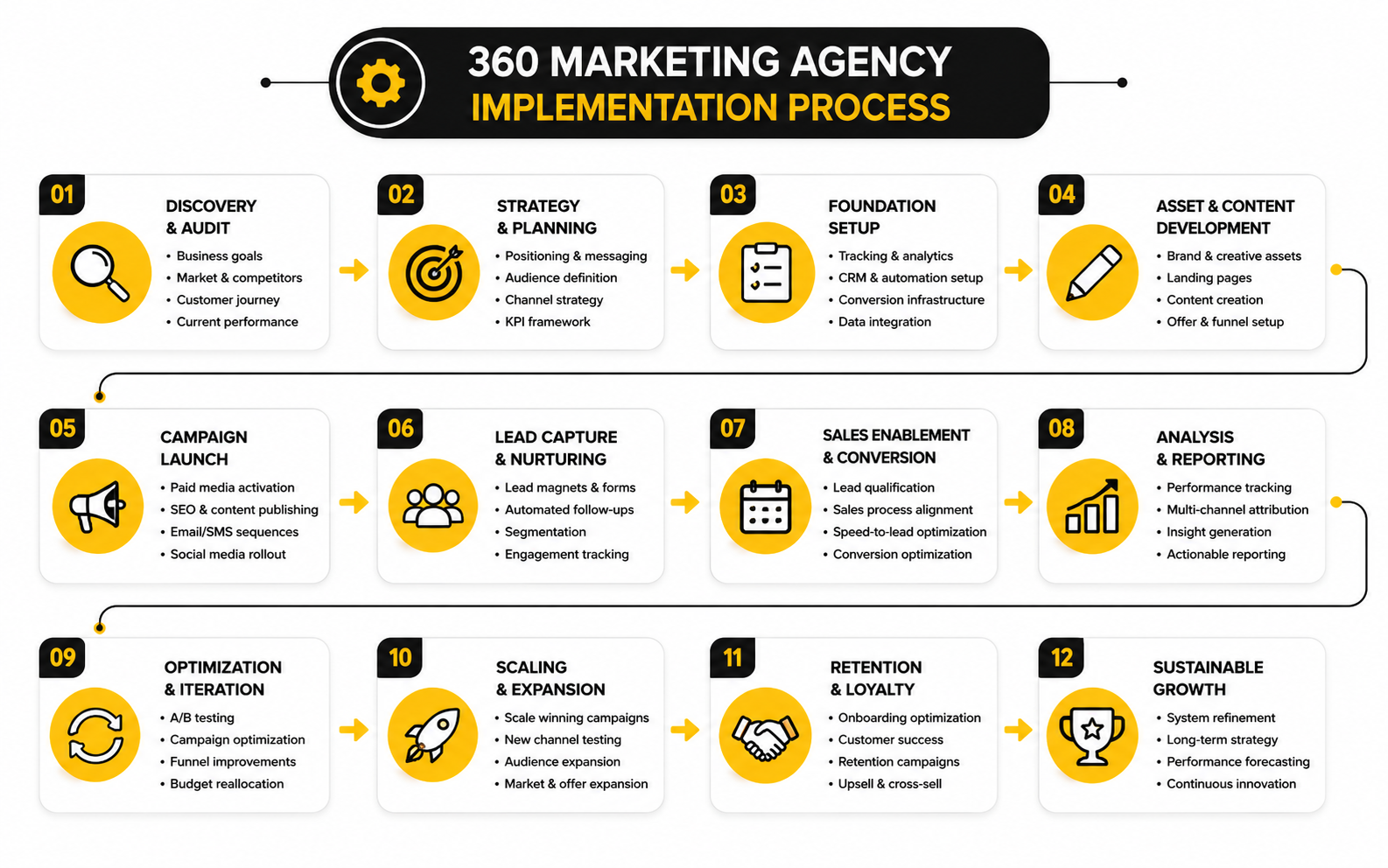
A practical implementation roadmap usually follows this sequence:
This order matters. A 360 marketing agency should not launch campaigns before the business can capture, nurture, and measure demand properly. If the foundation is weak, more traffic simply exposes the weakness faster.
Step 1: Define The Growth Goal
The first implementation step is deciding what growth actually means for the business right now. It might be more qualified leads, lower acquisition cost, higher average order value, more booked calls, stronger retention, better pipeline quality, or improved customer lifetime value. The answer changes the entire marketing plan.
A vague goal like “grow awareness” or “get more sales” is not enough. The agency needs a measurable target, a timeline, and a clear understanding of the business economics behind the target. This includes margins, close rates, sales cycle length, retention, fulfillment capacity, and the true value of a customer.
This is where many businesses skip too quickly into tactics. They want ads, content, funnels, or automation before they have defined the constraint. A strong 360 marketing agency slows this down, because the wrong goal creates the wrong campaign.
Step 2: Map The Customer Journey
Customer journey mapping turns abstract marketing into something visible. It shows where people first discover the brand, what they need to understand, where they compare options, what objections slow them down, and what happens after they convert. That map becomes the backbone of the entire system.
This matters because buyers rarely make decisions from one touchpoint. Salesforce’s State of Marketing research focuses heavily on unified data, personalization, loyalty, and account-based engagement, which reflects the reality that marketing teams need a connected view of customers across interactions, not isolated channel snapshots. The stronger the journey map, the easier it becomes to decide what content, automation, sales support, and reporting the business actually needs.
A useful journey map should include the emotional side of the decision too. What is the buyer worried about? What proof do they need? What would make the next step feel easy? The best implementation plans answer those questions before they spend aggressively.
Step 3: Build The Measurement Foundation
Measurement has to be built before serious scaling begins. If the agency cannot see what is happening, it cannot improve the system with confidence. That means tracking should cover traffic sources, landing page behavior, lead quality, pipeline movement, sales outcomes, customer retention, and revenue where possible.
The goal is not to create a dashboard with every metric in the world. The goal is to create a decision system. Each metric should help the agency decide whether to improve targeting, creative, messaging, landing pages, follow-up, sales process, offer structure, or retention.
This is especially important because platform-level reporting can be incomplete or misleading. A paid ad dashboard may show cheap leads, but the CRM may show poor close rates. A landing page may show a strong conversion rate, but sales may report that prospects are confused or not ready. A 360 marketing agency has to connect those dots.
Step 4: Create The Core Assets
Core assets are the pieces the marketing system depends on every day. These often include landing pages, lead magnets, email sequences, retargeting creative, sales enablement materials, product pages, comparison pages, case study pages, social proof, brand messaging guides, and content briefs. The exact list depends on the offer and buying journey.
For ecommerce brands, a tool like Replo can help teams build and test landing pages faster when the campaign strategy is already clear. For service businesses or agencies, GoHighLevel can support funnels, CRM stages, booking flows, and follow-up in one place. The tool is not the strategy, but the right tool can make implementation cleaner.
The key is to build assets that match the actual customer journey. A business does not need more PDFs, pages, or emails just to look active. It needs assets that reduce friction, answer objections, increase trust, and move buyers to the next step.
Step 5: Launch In Phases
A phased launch protects the business from unnecessary chaos. Instead of launching every campaign, workflow, and channel at once, the agency starts with the most important part of the system and verifies that it works. Then it expands from a stronger base.
For example, a lead generation business might launch one paid campaign, one landing page, one follow-up sequence, one sales handoff process, and one reporting dashboard first. Once the agency knows where prospects drop off, it can improve the system before adding more campaigns. This creates cleaner learning and faster problem-solving.
A phased approach also helps internal teams adapt. Sales needs to understand the lead source and follow-up expectations. Customer service may need to prepare for new questions. Leadership needs reporting that explains what is happening without drowning everyone in data.
Step 6: Improve The System Weekly
Weekly optimization is where small improvements start to compound. The agency should look at campaign performance, creative fatigue, lead quality, conversion rates, follow-up speed, sales notes, customer questions, and revenue movement. The goal is to identify what changed and what needs to happen next.
This rhythm should be practical, not theatrical. A useful weekly review asks direct questions. Are we reaching the right people? Are they responding to the message? Are they taking the next step? Are they becoming good customers?
The best 360 marketing agency teams do not hide behind vanity metrics. They use the data to make decisions. If something is not working, they diagnose it quickly and adjust the part of the system that is actually causing the issue.
Building The Operating Rhythm
Implementation does not end after launch. A 360 marketing system needs an operating rhythm, because markets change, customer behavior changes, competitors react, platforms shift, and creative performance declines over time. The agency’s process should make improvement normal.
The rhythm should include weekly tactical reviews, monthly performance analysis, and quarterly strategic resets. Weekly reviews keep execution tight. Monthly reviews show patterns. Quarterly reviews help the business decide whether to scale, reposition, change the offer, test new channels, or reallocate budget.
This rhythm also protects the relationship between the agency and the client. When communication is vague, trust drops quickly. When reporting is consistent and decisions are explained clearly, the client can see how the system is improving even before every metric is perfect.
Weekly Reviews
Weekly reviews should focus on immediate performance signals and execution blockers. This includes campaign delivery, lead volume, cost trends, conversion rates, creative tests, landing page behavior, email engagement, CRM movement, and sales feedback. The review should end with clear action items.
A good weekly review is not a long presentation. It is a decision meeting. The agency should explain what happened, what it means, and what will be changed next.
This is also where teams catch problems early. If a form breaks, a follow-up email fails, a campaign attracts the wrong audience, or sales does not contact leads quickly enough, waiting until the end of the month is too late. Weekly reviews keep the machine from drifting.
Monthly Analysis
Monthly analysis looks beyond daily noise. It compares trends across channels, audiences, offers, creative angles, funnel stages, and revenue outcomes. This is where the agency can tell whether the system is genuinely improving or just having a few good days.
A strong monthly review should connect marketing activity to business impact. It should show what drove qualified demand, what improved conversion, what created friction, and what should be prioritized next. It should also separate platform metrics from actual business results.
This is where CRM hygiene becomes critical. If lifecycle stages, source tracking, sales outcomes, and customer data are messy, monthly analysis becomes guesswork. A 360 marketing agency should care about the quality of the data, because better data creates better decisions.
Quarterly Strategic Resets
Quarterly resets are where the business zooms out. The agency and leadership should review positioning, offer performance, channel mix, customer quality, retention, budget allocation, and market changes. This is not about micromanaging every campaign. It is about deciding whether the strategy still fits the opportunity.
Deloitte’s 2025 marketing investment research highlights how CMOs are balancing investments across technology, talent, data, and growth priorities, which is exactly why quarterly resets matter. Marketing is not static. The system needs room to evolve as the business learns.
A quarterly reset can lead to bigger decisions. The agency may recommend entering a new channel, cutting a weak campaign, changing the offer, rebuilding a funnel, improving onboarding, or investing more in retention. The point is to make those decisions from evidence, not emotion.
Statistics And Data
A 360 marketing agency should use data to make better decisions, not to decorate reports. The point is not to dump every available number into a dashboard and hope the client feels impressed. The point is to understand what the numbers reveal about attention, trust, conversion, retention, and revenue.
This matters because marketing is becoming more expensive and more complex at the same time. U.S. digital advertising revenue reached nearly $300 billion in 2025, which means brands are competing in a crowded, highly measurable, and increasingly automated environment. More spend does not automatically create better growth, especially when the customer journey is split across search, paid social, organic content, email, referrals, landing pages, sales calls, and post-purchase experiences.
That is why analytics must connect the full system. A campaign can look strong inside one platform and still create weak business results. A channel can look expensive on a last-click report and still influence high-value buyers earlier in the journey. A 360 marketing agency has to interpret the data in context, because isolated numbers often tell the wrong story.
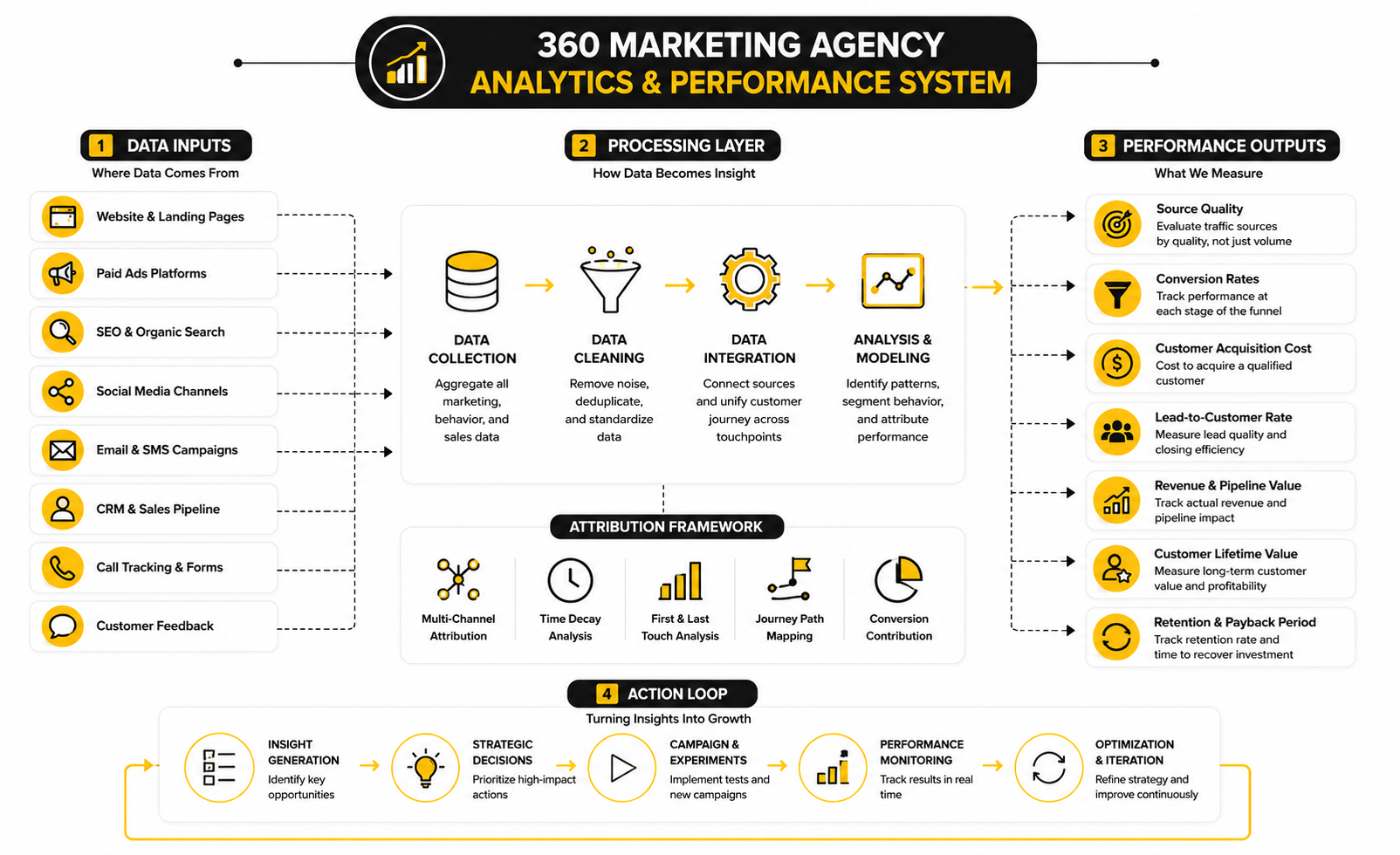
What The Data Should Actually Measure
The first measurement layer is visibility. This includes reach, impressions, branded search growth, organic discovery, referral traffic, social engagement quality, video completion, content rankings, and audience growth. These numbers show whether the brand is becoming easier to find and remember.
The second layer is intent. This includes clicks, landing page visits, product page views, form starts, pricing page activity, demo requests, quote requests, add-to-cart actions, and returning visitors. Intent metrics matter because they show whether awareness is turning into real interest.
The third layer is conversion. This includes leads, booked calls, purchases, trials, subscriptions, sales-qualified opportunities, close rates, cost per acquisition, revenue, and payback period. This is where the agency can see whether the marketing system is producing business outcomes, not just activity.
The fourth layer is retention. This includes repeat purchase rate, churn, customer lifetime value, renewal rate, referral activity, email engagement, onboarding completion, support friction, and customer satisfaction signals. Retention data is where many businesses find hidden growth, because improving customer value can make every acquisition channel more profitable.
Benchmarks Are Useful, But They Are Not The Strategy
Benchmarks can help a 360 marketing agency spot obvious problems. If landing page conversion is far below what similar campaigns usually produce, the page, offer, audience, or message match may need work. If email engagement drops quickly after signup, the nurture sequence may not be aligned with what the prospect expected.
But benchmarks become dangerous when teams treat them like universal truth. A high-ticket B2B service, a local home service company, a SaaS product, and an impulse-buy ecommerce brand should not be judged by the same conversion expectations. The sales cycle, price point, trust requirement, and buying committee all change what “good” performance looks like.
The better approach is to use external benchmarks as a starting point, then build internal benchmarks from the brand’s own data. Once a 360 marketing agency has enough reliable history, the most important question becomes simple. Are we improving against our own baseline in a way that creates profitable growth?
The Metrics That Matter Most
A good measurement system should separate surface metrics from decision metrics. Surface metrics can be useful, but they do not always tell the team what to do next. Decision metrics help the agency identify the constraint and take action.
The most useful metrics usually include:
These metrics work because they connect marketing activity to business reality. A low cost per lead is not impressive if the leads do not close. A strong click-through rate is not impressive if the landing page does not convert. A high conversion rate is not enough if customers churn quickly or never buy again.
How To Read Channel Performance Correctly
Channel performance should be judged by the role each channel plays in the journey. Search often captures existing demand, which makes it easier to measure close to conversion. Paid social may create demand earlier, which means its impact may show up later through branded search, retargeting, email signups, or assisted conversions.
Email and SMS often look small if the team only checks last-click revenue. In reality, they can improve conversion by keeping prospects warm, recovering abandoned interest, educating buyers, and increasing repeat purchases. Tools like Brevo and Moosend can support this layer when segmentation and follow-up logic are planned properly.
Social content can be even harder to measure cleanly. A post may not convert directly, but it can make the next ad feel familiar, make the sales call easier, or help a prospect trust the brand before they book. A 360 marketing agency should avoid judging every channel by the same attribution model, because different channels create value in different ways.
Why Attribution Needs Context
Attribution is useful, but it is not perfect. Last-click attribution gives all credit to the final touchpoint, which can undervalue the channels that created awareness and trust earlier. Platform attribution can overstate results because each platform wants to prove its own value.
This is why a 360 marketing agency should combine several views of performance. Platform data shows what happened inside each channel. Analytics data shows site and conversion behavior. CRM data shows lead quality and revenue outcomes. Customer conversations explain the friction that numbers cannot fully capture.
Nielsen’s 2025 marketing research emphasizes the need for holistic measurement because isolated reporting creates blind spots. That is the core idea here. The agency should not ask, “Which platform gets credit?” It should ask, “Which parts of the system are helping the buyer move forward, and which parts are slowing them down?”
The Analytics Stack
The analytics stack does not need to be complicated. It needs to be reliable. A practical stack usually includes website analytics, ad platform reporting, CRM tracking, call tracking when relevant, email performance, landing page data, sales pipeline reporting, and a simple executive dashboard.
For lead generation businesses, GoHighLevel can help connect forms, calls, calendars, pipelines, automations, and source tracking in one operating layer. For funnel-heavy businesses, ClickFunnels or Systeme.io can keep campaign pages, offers, and follow-up closer together. The right stack depends on the business model, but the goal is always the same: fewer blind spots and faster decisions.
The best stack is the one the team actually uses. Fancy reporting is pointless if the data is messy, the team does not trust it, or nobody knows what decision each metric supports. Clean tracking, clear naming conventions, and consistent review habits beat bloated dashboards every time.
How A 360 Marketing Agency Turns Data Into Action
Data only matters when it changes what the team does next. If the campaign attracts traffic but not leads, the agency should review audience fit, offer clarity, message match, page structure, and proof. If leads come in but sales does not close them, the agency should review lead quality, follow-up speed, sales scripts, objection handling, and qualification.
If customers buy once but do not return, the issue may be onboarding, product education, post-purchase communication, customer success, or retention offers. If content gets engagement but does not support revenue, the agency should map it to buyer questions and conversion paths. Every signal should point toward a specific decision.
This is the real value of measurement. A 360 marketing agency does not win by reporting more numbers. It wins by finding the bottleneck faster, fixing it with more confidence, and building a marketing system that gets more carefully over time.
Choosing The Right 360 Marketing Agency
Choosing a 360 marketing agency is not about finding the team with the longest service menu. Almost every agency can list strategy, ads, content, email, SEO, creative, automation, and analytics on a website. The real question is whether they can connect those functions into a system that improves the business.
A good agency should be able to explain how their work affects revenue, customer acquisition, retention, and operational efficiency. They should also be honest about what they are not going to prioritize immediately. That restraint matters, because the wrong agency will sell activity when the business actually needs focus.
The best fit usually depends on the company’s growth stage. A startup may need positioning, fast testing, landing pages, and founder-led content. A local service business may need reputation, lead capture, CRM workflows, and speed-to-lead. An ecommerce brand may need creative testing, landing page optimization, email flows, retention, and paid media discipline.
What A Strong Agency Should Ask You
The questions an agency asks are often more revealing than the pitch deck it presents. A serious 360 marketing agency will want to understand the business model before recommending channels. It will ask about margins, sales cycle length, average order value, close rates, retention, customer lifetime value, bottlenecks, team capacity, and past campaign performance.
That level of questioning is important because strategy depends on economics. A campaign that works for a high-margin service business may fail for a low-margin ecommerce product. A channel that looks expensive on the surface may be profitable if customer lifetime value is strong.
The agency should also ask about internal responsibilities. Marketing does not operate in a vacuum. If sales ignores leads, fulfillment disappoints customers, or leadership changes priorities every week, even a strong marketing plan will struggle.
Red Flags To Watch For
A weak agency usually rushes to tactics too quickly. It promises more leads, more followers, more traffic, or more impressions before understanding the customer journey. That is a problem because surface growth can hide deeper issues.
Be careful when an agency cannot explain how it measures quality. Low-cost leads are useless if they never become customers. High traffic is useless if the audience is wrong. Beautiful creative is useless if it does not support a clear buying path.
Another red flag is channel bias. Some agencies recommend the same channel to every client because that is what they know how to sell. A real 360 marketing agency should be channel-aware, not channel-obsessed. The business goal should decide the channel mix, not the agency’s comfort zone.
Questions To Ask Before Hiring
Before hiring a 360 marketing agency, the business should ask questions that expose the agency’s thinking. This keeps the conversation grounded and prevents the decision from being based only on personality, branding, or a polished proposal. The goal is to understand how the agency diagnoses problems, prioritizes work, and handles accountability.
Useful questions include:
These questions force the agency to explain the operating model, not just the deliverables. That is exactly what you want. A confident agency should be able to answer clearly without hiding behind jargon.
Strategic Tradeoffs That Matter
A 360 marketing agency has to make tradeoffs. Every business has limited budget, limited time, limited team capacity, and limited attention. Strategy is not just choosing what to do. It is choosing what not to do yet.
One of the biggest tradeoffs is speed versus depth. Fast campaigns can create quick learning, but deeper work on positioning, data, content, and retention can create stronger long-term performance. The right balance depends on how urgent the growth target is and how stable the current foundation looks.
Another tradeoff is acquisition versus retention. Many businesses keep pouring budget into new traffic while ignoring the customers they already earned. That is risky, especially when digital advertising keeps getting more competitive and IAB’s 2025 report shows U.S. digital ad revenue reaching a record $294.6 billion. When acquisition costs rise, retention becomes more than a nice bonus. It becomes a profit lever.
Brand Versus Performance
Brand and performance are often treated like rivals, but they should work together. Brand creates memory, preference, trust, and pricing power. Performance captures demand and turns interest into measurable action.
The mistake is overcorrecting in either direction. A company that only invests in brand may struggle to prove short-term impact. A company that only invests in performance may become dependent on constant spend, discounting, and direct-response hooks that wear out over time.
A strong 360 marketing agency builds both layers into the system. It makes the brand easier to remember while making the buying path easier to complete. That is the balance most businesses actually need.
Automation Versus Human Judgment
Automation can make a marketing system faster, cleaner, and more consistent. It can route leads, trigger follow-ups, segment contacts, recover abandoned interest, send reminders, and keep sales conversations from falling through the cracks. Used well, automation removes friction.
But automation also creates risk when it replaces judgment. A bad message sent automatically is still a bad message. A poorly timed sequence can make the brand feel careless. A messy CRM workflow can create confusion faster than a manual process ever could.
This is why tools should support the strategy, not define it. Platforms like GoHighLevel, ManyChat, and Brevo can help an agency execute faster, but the agency still needs to design the customer experience with care.
AI Versus Original Insight
AI is becoming part of modern marketing operations, but it does not remove the need for strategy. Salesforce’s marketing research notes that 83% of marketers recognize the shift toward personalized, two-way messaging, while only one in four are satisfied with how they use data to power those moments. That gap is the real opportunity.
AI can help with research, content drafts, segmentation, creative variants, customer support, and workflow speed. But it cannot automatically understand the brand’s market position, customer anxiety, sales friction, or offer economics. Those require human judgment.
A 360 marketing agency should use AI where it improves speed and quality, not where it creates generic output. The danger is not that AI exists. The danger is using it to produce more average work instead of sharper thinking.
Scaling Without Breaking The System
Scaling is not just increasing spend. Scaling means the system can handle more attention, more leads, more customers, and more complexity without falling apart. This is where many marketing programs run into trouble.
A campaign may work at a small budget because the agency is reaching the easiest audience first. As spend increases, the audience gets broader, creative fatigue appears, lead quality can change, and conversion rates may drop. That does not always mean the channel failed. It often means the system needs stronger segmentation, more creative depth, better nurture, and tighter sales feedback.
A 360 marketing agency should scale in layers. First, it proves the offer and conversion path. Then it expands creative testing. Then it improves follow-up and sales enablement. Then it adds new audiences, channels, or markets once the core economics make sense.
When To Add New Channels
New channels should be added when the current system has reached a logical ceiling or when the customer journey clearly needs another touchpoint. They should not be added because the team is bored or because a competitor appears active somewhere. More channels create more operational load.
Before adding a channel, the agency should ask whether the business has enough creative capacity, tracking clarity, offer alignment, and follow-up support. If those pieces are missing, a new channel can create confusion instead of growth. This is especially true for small teams trying to look bigger than they are.
The better move is to add channels with a clear job. One channel may create demand. Another may capture search intent. Another may nurture undecided buyers. Another may support retention. When every channel has a role, scaling becomes controlled instead of chaotic.
When To Rebuild The Funnel
Sometimes optimization is not enough. If the offer is unclear, the audience is wrong, the page does not match the campaign, or the follow-up sequence is disconnected, the funnel may need a rebuild. Small tweaks cannot fix a broken structure.
A rebuild is justified when the same bottleneck appears repeatedly across campaigns. If people click but do not understand the page, the issue is probably message clarity. If people submit forms but do not show up, the issue may be qualification or commitment. If people book calls but do not buy, the issue may be positioning, pricing, sales process, or proof.
This is where funnel tools can help, but only after the agency knows what it is rebuilding. ClickFunnels, Systeme.io, and Replo can support faster deployment, but the strategy still has to come first.
When To Bring More Work In-House
A business does not have to outsource everything forever. As the marketing system matures, some work may move in-house. This can make sense for brand voice, daily content, community management, customer education, or sales enablement.
The agency can still play a valuable role as strategist, specialist, analyst, or implementation partner. In some cases, the best 360 marketing agency relationship evolves from full execution into a hybrid model. The agency owns the system architecture and advanced work, while the internal team handles the pieces that require daily closeness to the customer.
The key is to avoid messy handoffs. If work moves in-house, the agency should document processes, naming conventions, reporting standards, campaign logic, and content guidelines. Otherwise, the business may gain control but lose consistency.
FAQs And Final Takeaways
A 360 marketing agency works best when the business treats marketing as one connected ecosystem. Strategy, creative, traffic, content, automation, analytics, sales, and retention all need to support the same customer journey. When those pieces stay disconnected, performance becomes harder to understand and harder to improve.
The final takeaway is simple. Do not hire a 360 marketing agency just because it promises every service. Hire one because it can diagnose the real constraint, build the right operating system, and keep improving the path from first touch to long-term customer value.
What Is A 360 Marketing Agency?
A 360 marketing agency is a marketing partner that connects multiple growth functions into one coordinated system. That can include strategy, branding, paid ads, SEO, content, social media, email, automation, landing pages, analytics, CRM, and retention. The goal is not to do every tactic at once, but to make the right tactics work together.
How Is A 360 Marketing Agency Different From A Traditional Agency?
A traditional agency may specialize in one channel, such as paid ads, SEO, social media, or creative production. A 360 marketing agency looks across the full customer journey and connects the work across channels, systems, and teams. That broader view helps the business avoid fixing one metric while ignoring the deeper bottleneck.
Who Should Hire A 360 Marketing Agency?
A business should consider a 360 marketing agency when its marketing feels fragmented, hard to measure, or difficult to scale. This is common when different vendors manage ads, content, email, web design, and CRM without one shared strategy. It can also help companies that have traffic but weak conversion, strong leads but poor follow-up, or good sales but low retention.
What Services Should A 360 Marketing Agency Provide?
The exact services depend on the business model, but the agency should usually cover strategy, audience research, positioning, campaign planning, channel execution, conversion optimization, automation, reporting, and performance analysis. For some brands, that may include search, paid media, landing pages, email, and CRM. For others, it may include content strategy, sales enablement, customer lifecycle marketing, and retention systems.
How Much Does A 360 Marketing Agency Cost?
Pricing depends on scope, market, team size, channels, creative volume, and whether the agency is handling strategy only or full execution. A small implementation package may cost far less than a full-service growth retainer with paid media, content, automation, analytics, and creative production. The better question is whether the agency can connect cost to business outcomes, because cheap marketing becomes expensive when it produces low-quality demand.
How Long Does It Take To See Results?
Some improvements can show up quickly, especially when the agency fixes obvious conversion leaks, broken tracking, poor follow-up, or weak landing pages. Bigger results usually take longer because the system needs clean data, creative testing, customer feedback, and enough campaign volume to reveal patterns. A serious 360 marketing agency should explain which results are expected early and which require a longer operating rhythm.
What Should A Business Prepare Before Hiring?
A business should prepare access to analytics, ad accounts, website data, CRM data, sales notes, customer feedback, past campaign reports, brand assets, and current marketing materials. It should also know its margins, average order value, close rate, sales cycle length, retention rate, and customer lifetime value where possible. The cleaner the starting information, the faster the agency can diagnose the real constraint.
Can A 360 Marketing Agency Replace An Internal Marketing Team?
Sometimes, but that is not always the best goal. A 360 marketing agency can handle strategy and execution for companies without internal marketing resources, but mature businesses often get better results from a hybrid model. The agency brings specialist skills and system-level direction, while the internal team brings customer closeness, product knowledge, and daily context.
What Tools Does A 360 Marketing Agency Need?
The tool stack depends on the growth system being built. Lead generation businesses may need CRM, pipeline tracking, booking, forms, automation, and call tracking, which is why platforms like GoHighLevel can be useful. Funnel-heavy businesses may use ClickFunnels, Systeme.io, or Replo, while lifecycle-heavy brands may rely on email, SMS, segmentation, and customer data tools.
What Metrics Should A 360 Marketing Agency Report?
The agency should report the metrics that explain business progress, not just platform activity. That usually includes source quality, conversion rates by stage, customer acquisition cost, lead-to-customer rate, revenue, pipeline value, customer lifetime value, retention, payback period, and sales feedback. Reports should make the next decision clearer, not bury the client in charts.
What Are The Biggest Risks Of Hiring The Wrong Agency?
The biggest risk is paying for activity that does not solve the real business problem. A weak agency may chase traffic while the offer is unclear, optimize ads while the sales process is broken, or produce content that never supports conversion. Another risk is poor measurement, because the business can end up spending more without knowing what is actually working.
How Do You Know If A 360 Marketing Agency Is Working?
The agency is working when the system becomes clearer, more measurable, and more profitable over time. You should see better diagnosis, cleaner execution, stronger customer journey alignment, faster learning, and more useful reporting. Even when a campaign underperforms, the agency should be able to explain why, what was learned, and what will change next.
Should A 360 Marketing Agency Focus More On Acquisition Or Retention?
It depends on the business economics. If the company has low awareness and a proven offer, acquisition may be the priority. If acquisition costs are rising or customers do not return, retention may create more profitable growth.
Is AI Important For A 360 Marketing Agency?
AI is useful when it improves research, creative testing, customer support, workflow speed, segmentation, and operational efficiency. It should not replace positioning, customer insight, strategic judgment, or brand taste. The strongest agencies will use AI to move faster while still protecting the quality of the thinking.
What Is The Best Way To Start With A 360 Marketing Agency?
The best starting point is a focused audit. The agency should review the customer journey, offer, messaging, channels, conversion paths, CRM, automation, sales handoff, and reporting before launching major campaigns. That gives the business a clear implementation plan instead of a random list of services.
Build a stronger local presence with BAAM AI
Turn your website, Google profile, social channels, and AI visibility into one growth engine
Most businesses do not need more random marketing activity. They need a consistent presence system that helps the right people find them, trust them, and take action. BAAM AI brings strategy, local SEO, website updates, Google Maps visibility, social content, AI-search readiness, media production, and reporting into one practical monthly engine.
If you want your marketing to keep working after the campaign ends, start with a free BAAM AI presence audit. See how your business shows up today and where the fastest visibility wins are at BAAM AI.