
BAAM AI Blog
22 Immutable Laws Of Marketing: A Practical Framework For Modern Brand Strategy
The 22 immutable laws of marketing are not really about tactics. They are about how markets remember, compare, simplify, and choose. That is why the ideas from Al Ries and Jack Trout still matter: they force you to...

The 22 immutable laws of marketing are not really about tactics. They are about how markets remember, compare, simplify, and choose. That is why the ideas from Al Ries and Jack Trout still matter: they force you to stop treating marketing like a pile of campaigns and start treating it like a battle for mental position.
Most brands do the opposite. They launch more offers, rewrite more slogans, copy more competitors, and assume that better features will eventually win. But customers rarely study a market that carefully. They remember categories, leaders, simple words, sharp contrasts, and repeated signals.
this guide breaks the 22 immutable laws of marketing into a practical working system. Not every law should be applied blindly, and some need modern interpretation. But the core lesson is still useful: marketing becomes much easier when your brand owns a clear place in the buyer’s mind.
Why The 22 Immutable Laws Of Marketing Still Matter
The reason the 22 immutable laws of marketing still get discussed is simple: most marketing problems are positioning problems in disguise. A company thinks it has a lead generation issue, a content issue, a funnel issue, or a pricing issue. But underneath that, the market often does not know what the company stands for, who it is for, or why it should be remembered instead of someone else.
That matters because attention is expensive and memory is limited. Buyers do not keep a detailed spreadsheet of every option in a category. They reduce complexity by remembering a few names, a few associations, and a few category cues that feel familiar when the buying moment arrives.
This is where the laws become useful. They push you to ask stronger questions before spending more money: Are we trying to be better when we should be trying to be first? Are we fighting in the wrong category? Are we adding complexity when we should be owning one idea?
The Strategic Framework Behind The Laws
The 22 immutable laws of marketing are often presented as a list, but they work better as a framework. The laws are not equal in weight, and they are not all used at the same stage of strategy. Some help you choose the category, some help you define the message, some protect focus, and some warn you against predictable growth mistakes.
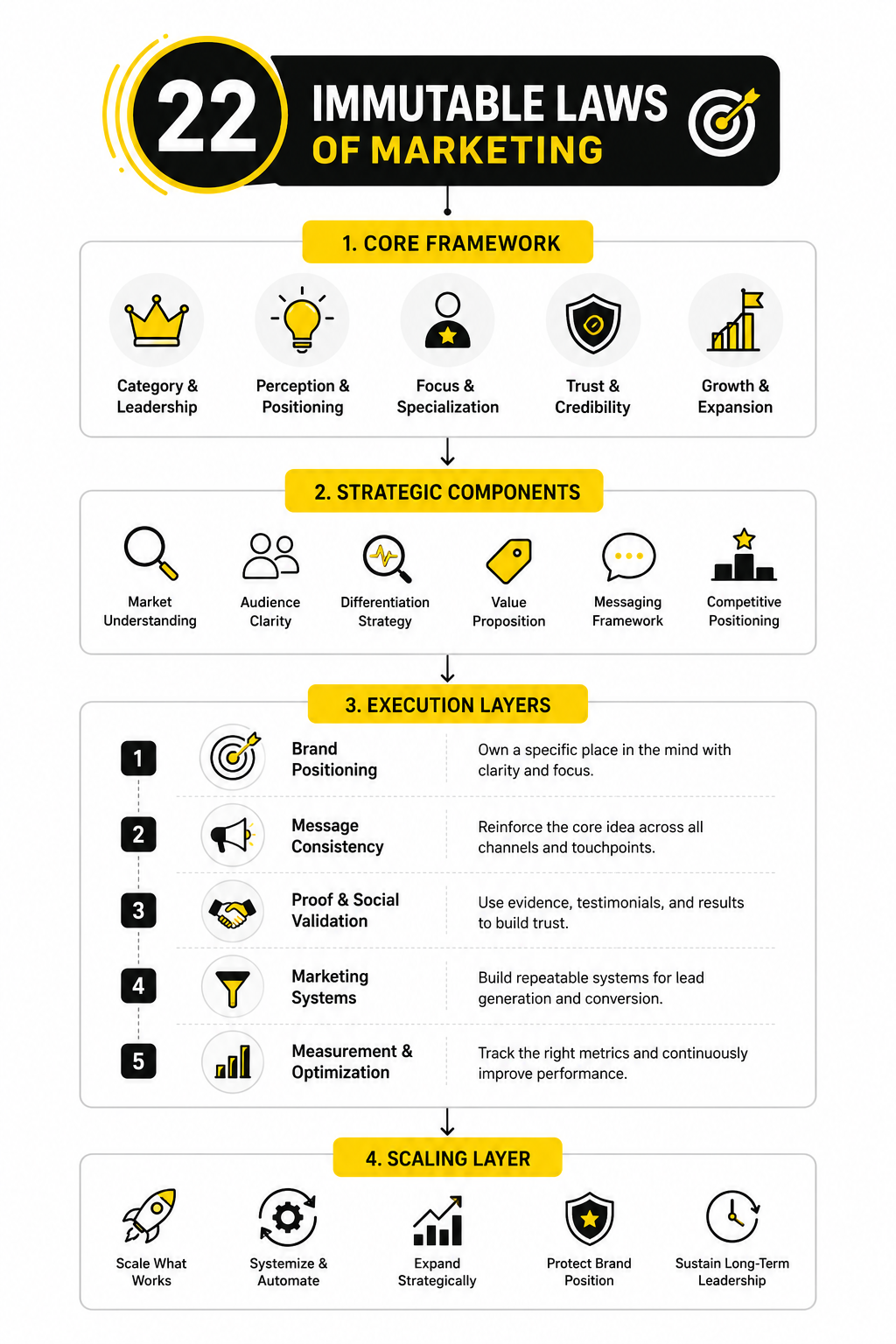
A practical way to use the framework is to group the laws into four layers: category, mind, perception, and execution. Category is about where you compete. Mind is about what buyers remember. Perception is about how buyers interpret your brand. Execution is about how consistently you protect the position over time.
This structure matters because it keeps the article from becoming a motivational list of marketing quotes. The goal is not to memorize all 22 laws. The goal is to understand how they work together so you can make better decisions about positioning, messaging, offers, channels, and growth.
How this guide Will Use The Laws
this guide will not treat the 22 immutable laws of marketing as sacred commandments. Markets have changed, channels have changed, and buyers now move through more fragmented journeys than they did when the book was first published. Still, the mental mechanics behind many of the laws remain extremely relevant.
The strongest parts of the framework are the ideas around leadership, category creation, focus, perception, and consistency. These are still central to brand building, especially in crowded markets where every competitor claims to be faster, more carefully, easier, or more affordable. The weaker parts are the ones that can sound too absolute without context, especially when modern companies can test, segment, and distribute offers in ways older brands could not.
So the approach here is practical. We will keep what is useful, challenge what needs nuance, and translate the laws into decisions a founder, marketer, consultant, agency owner, or growth team can actually use.
The Strategic Framework Behind The Laws
The 22 immutable laws of marketing make more sense when you stop reading them as isolated rules and start seeing them as a sequence. The first decision is not what to say in an ad, what funnel to build, or what content calendar to publish. The first decision is where you want the brand to live in the market’s mind.
That is the practical value of the framework. It helps you separate positioning decisions from execution decisions. A weak position will not become strong just because you add more emails, more ads, more landing pages, or more automation.
This is where many marketers get stuck. They try to solve a strategic problem with tactical volume. But if the category is unclear, the promise is generic, or the brand has no memorable contrast, more activity usually creates more noise.
Category Comes Before Competition
The first layer of the 22 immutable laws of marketing is category choice. A brand has a much better chance when it can be first in a meaningful category instead of being another option in a crowded one. That does not always mean inventing something completely new; it often means defining the category in a sharper, more specific way.
This is why “better” is usually weaker than “different.” Better forces the buyer to compare you against the current leader on the leader’s terms. Different gives the buyer a new mental shelf to put you on.
For a small company, this is not theory. It is survival. Competing directly with a bigger brand usually means the larger brand has more awareness, more trust, more distribution, more reviews, and more budget. A sharper category gives you room to become the obvious choice for a narrower buyer, use case, problem, or moment.
The Mind Is The Real Marketplace
The second layer is mental position. The market is not just a place where products compete. It is a place where memories compete.
That is why the 22 immutable laws of marketing keep returning to perception. Buyers do not respond only to objective product quality. They respond to what they already believe, what they recognize quickly, and what feels safe enough to choose.
This can be uncomfortable for product-focused founders. You may have a stronger feature set, a better service model, or a more flexible offer, but the buyer still may not care. If the market does not understand your position in a few seconds, your real advantage is hidden.
Perception Beats Product Claims
The third layer is perception. Marketing does not happen in a clean, neutral environment where every claim gets equal attention. It happens inside a buyer’s existing assumptions.
That means the same message can feel powerful or pointless depending on the position behind it. If a known expert says “simple automation for local agencies,” the market may understand the promise instantly. If an unknown brand says “the most advanced all-in-one business growth ecosystem,” the market may ignore it because the claim feels too broad to believe.
This is why clarity matters more than cleverness. A clear position makes the buyer’s job easier. A clever but vague message makes the buyer work, and most buyers will not do that work for you.
Focus Protects The Position
The fourth layer is focus. Once a brand starts gaining traction, the temptation is to expand the offer, broaden the audience, and chase every possible revenue stream. That is exactly where many positioning advantages get diluted.
The 22 immutable laws of marketing are strict about this because focus is what makes a position stick. A brand becomes easier to remember when it repeats the same core idea in different ways over time. It becomes harder to remember when every campaign introduces a new angle, a new promise, and a new identity.
This does not mean a company can never expand. It means expansion should not destroy the word, category, or association the brand worked hard to own. Growth is useful only if the market can still explain what you are.
The Core Laws That Shape Market Position
The next group of laws is where the framework becomes more concrete. These laws are about leadership, categories, memory, and the danger of trying to win by imitation. They are especially useful for founders, consultants, creators, and agencies because they expose a painful truth: most brands do not lose because they are bad, they lose because they are hard to place.
If someone cannot quickly describe your category, your audience, and your reason to exist, your marketing has to work too hard. Every ad must educate from scratch. Every sales call must rebuild context. Every campaign starts from zero instead of compounding.
The better move is to build a position that makes each new activity easier. Your content becomes clearer. Your offers become sharper. Your landing pages become more direct. Your sales process becomes less defensive because the buyer already understands why you belong in the conversation.
The Law Of Leadership
The Law of Leadership says it is better to be first than it is to be better. That sounds extreme until you look at how people actually remember markets. The first brand to define a category often becomes the reference point everyone else gets compared against.
This does not mean the first company always wins forever. Bad execution, weak distribution, poor timing, or a better-defined competitor can still change the game. But being first in the mind gives a brand a powerful advantage because it becomes the default example.
For practical marketing, the lesson is clear. Do not build your whole strategy around being a slightly better version of the category leader. Build around a position where you can become the first name the right buyer thinks of.
The Law Of The Category
The Law of the Category is the escape hatch for everyone who is not first. If you cannot be first in an existing category, create or define a new category where you can be first. This is one of the most useful ideas in the entire book.
The key is that the category still has to matter to the buyer. You cannot invent a fake category that only sounds good in a pitch deck. The category must help the buyer understand a real problem, a real use case, or a real buying situation more clearly than before.
This is especially powerful in service businesses and software markets. A general agency is easy to ignore. A retention agency for subscription brands is easier to remember. A business automation platform is broad. A client acquisition and follow-up system for local service providers is sharper.
The Law Of The Mind
The Law of the Mind says it is better to be first in the mind than first in the marketplace. This is the nuance that makes the leadership idea more practical. A company can launch first and still fail to become the brand people remember.
The market does not reward historical accuracy. It rewards mental availability. The brand that becomes easiest to recall in a buying situation often feels like the leader, even if another company technically arrived earlier.
This is why messaging consistency matters so much. You are not just explaining your offer once. You are building a memory structure that helps people retrieve your brand later, when the need becomes active.
The Law Of Perception
The Law of Perception says marketing is not a battle of products, but a battle of perceptions. That does not mean product quality is irrelevant. It means quality only helps when the market can perceive, understand, and trust it.
A strong product with weak perception has a visibility problem. A clear brand with a decent product can often grow faster because buyers know what to do with it. That may sound unfair, but it is how crowded markets work.
The practical takeaway is not to manipulate people. The takeaway is to make your value easier to perceive. Use sharper language, clearer positioning, stronger proof, and fewer claims that require the buyer to decode your entire business.
The Perception Laws That Shape Buyer Choice
Once the brand has a category and a position, the next challenge is buyer interpretation. This is where the 22 immutable laws of marketing become especially useful because they force you to respect how people actually make choices. Buyers do not process your offer in isolation; they compare it against memories, assumptions, competitors, and simple mental shortcuts.
This is why perception is not a soft topic. It affects whether people trust your promise, understand your offer, remember your brand, and feel confident enough to move forward. If your marketing creates the wrong perception, the buyer may reject the offer before they even understand the details.
The practical goal is to make your brand easier to notice, easier to explain, and easier to choose. That requires more than catchy copy. It requires a clear process for turning positioning into repeated market signals.
The Law Of Focus
The Law of Focus says the most powerful concept in marketing is owning a word in the prospect’s mind. This is not about picking a random keyword and repeating it everywhere. It is about becoming associated with one clear idea that buyers can remember without effort.
That idea should be simple, but not shallow. “Speed,” “safety,” “automation,” “simplicity,” “premium,” “local,” “private,” and “done-for-you” can all become powerful positions when they connect to a real buying need. The mistake is trying to own five ideas at once because the team is afraid of leaving value on the table.
A focused word gives your strategy discipline. It helps you decide what to say, what to ignore, what to build, and what not to chase. Without that discipline, marketing becomes a rotating list of claims that may sound good internally but never compound externally.
The Law Of Exclusivity
The Law of Exclusivity says two companies cannot own the same word in the prospect’s mind. This is uncomfortable because many brands want to borrow the language of the leader. They see a competitor winning with a clear idea, so they try to attach themselves to the same idea with slightly different wording.
That usually creates a weaker version of the same position. If the market already links a competitor with “low cost,” “enterprise,” “luxury,” or “fast delivery,” copying that association rarely makes you memorable. It mostly reminds the buyer who already owns the idea.
A better move is to find the open angle. If the competitor owns complexity and enterprise depth, you may own simplicity and speed. If they own premium service, you may own transparency. If they own all-in-one, you may own specialist expertise.
The Law Of The Ladder
The Law of the Ladder says every category has a hierarchy in the buyer’s mind. Some brands sit near the top, some sit in the middle, and many are not on the ladder at all. Your strategy should reflect your actual rung instead of pretending the market already sees you as the leader.
This matters because a challenger brand needs a different message than a category leader. Leaders can reinforce the category and protect familiarity. Challengers usually need contrast, specialization, or a reason why the buyer should reconsider the default choice.
If you are not first, do not act like you are. That does not mean playing small. It means using your position honestly and intelligently so your marketing creates a reason to switch, not just another reason to ignore you.
The Law Of Duality
The Law of Duality says that over time, many markets become a two-brand race. That pattern is not universal, especially in fragmented digital markets, but the strategic lesson still holds. Buyers often simplify crowded categories into a few familiar choices.
For smaller brands, this is both a warning and an opportunity. The warning is that broad markets are hard to enter once the top players are established. The opportunity is that you can define a narrower market where the ladder is not already locked.
That is why niche positioning can be so powerful. You may not become the second name in the entire CRM category, funnel category, or email marketing category. But you can become the obvious choice for a specific audience, workflow, price point, business model, or use case.
How To Apply The Laws In Modern Marketing
This is where the 22 immutable laws of marketing need to become operational. A positioning idea is not useful if it stays in a strategy document. It has to show up in the offer, landing page, sales process, content, email follow-up, onboarding, and product experience.
Modern marketing gives you more channels than ever, but that also makes consistency harder. A brand can say one thing on its homepage, another in ads, another in email, another on social, and another during sales calls. The buyer feels that inconsistency even if they cannot name it.
The solution is to turn the laws into a repeatable process. You do not need a complicated brand theory exercise. You need a practical sequence that moves from category choice to message discipline to execution.
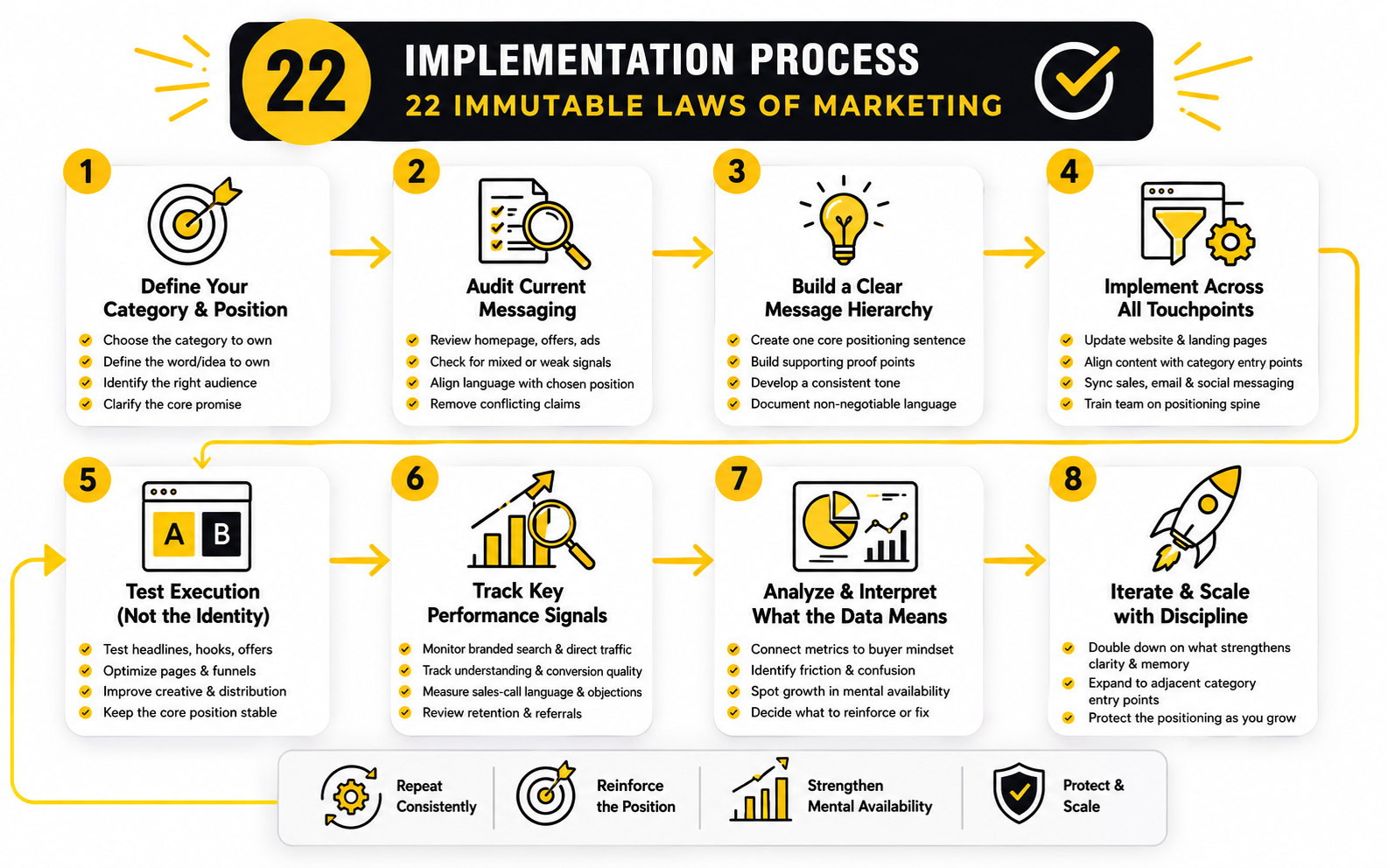
Step 1: Define The Category You Want To Win
Start by naming the category where you want to become the obvious choice. Be specific enough that a real buyer would understand it, but not so narrow that the market disappears. A category like “marketing automation” is broad; “automated follow-up for local service businesses” is easier to grasp and easier to position.
The category should connect to a buying moment. Ask what problem the buyer is trying to solve when they start searching, asking for recommendations, or comparing options. That moment is often more useful than your internal product description.
This is also where you decide whether you are entering an existing category or creating a sharper subcategory. If the existing category is dominated by stronger brands, a subcategory may give you a cleaner path. The goal is not to sound unique for the sake of it; the goal is to make the buyer understand where you belong.
Step 2: Choose The Word Or Idea You Want To Own
After the category is clear, choose the core association you want to build. This should be the simplest useful idea that captures why the buyer should remember you. It should also be believable based on your product, service, proof, and customer experience.
Do not choose a word just because it sounds attractive. Choose a word you can defend. If you want to own “fast,” your onboarding, delivery, support, and proof should all reinforce speed. If you want to own “simple,” the product experience and sales process cannot feel complicated.
This is where many brands expose the gap between positioning and reality. They claim one thing, but the experience says another. The market always believes the experience eventually.
Step 3: Build The Proof Around The Position
A position becomes stronger when the proof supports it from multiple angles. Proof can include customer outcomes, product demonstrations, comparisons, guarantees, founder expertise, third-party validation, or a clear explanation of the mechanism behind the result. The point is to make the promise feel grounded.
This does not mean stuffing the page with random testimonials and badges. Proof should support the specific idea you want to own. If the position is speed, show time saved. If the position is simplicity, show fewer steps. If the position is reliability, show consistency, process, and risk reduction.
For funnel-heavy businesses, this is where tools can help turn strategy into execution. A builder like ClickFunnels can be useful when the positioning is already clear and the team needs a direct path from message to offer to conversion. The tool will not fix weak positioning, but it can help a focused message move faster.
Step 4: Align Every Touchpoint
Once the category, core idea, and proof are defined, every touchpoint should reinforce the same position. Your homepage should not feel like a different company from your ads. Your email sequence should not introduce a new promise every three messages. Your sales calls should not depend on a completely different explanation than the one used in your content.
This is where operational discipline matters. A simple positioning document can guide headlines, offer names, content themes, comparison pages, onboarding scripts, and follow-up campaigns. Without that shared reference point, every channel starts improvising.
For service businesses, agencies, and local-market operators, an all-in-one platform like GoHighLevel can support this alignment because CRM, funnels, email, SMS, and pipeline activity can live closer together. The strategic point is not the software itself. The point is that your system should make it easier to repeat the same market position, not harder.
Step 5: Protect The Position Over Time
The final step is protecting the position once it starts working. This is harder than it sounds because early traction creates temptation. You will see new audiences, new offers, new features, new channels, and new competitors worth chasing.
Some expansion is healthy. But if every opportunity pulls the brand away from the idea that made it memorable, growth becomes dilution. That is why the Law of Focus is not just a messaging law; it is a management law.
Protecting the position means saying no more often than feels comfortable. It means keeping the strongest idea visible even when campaigns change. It means giving the market enough repetition to actually remember you.
Statistics And Data That Actually Matter
Measurement is where the 22 immutable laws of marketing either become useful or turn into vague brand theory. You cannot manage positioning only by gut feeling. But you also cannot judge positioning only by last-click conversions, because last-click data usually shows what captured demand, not what created demand.
That distinction matters. If your brand is becoming easier to remember, the effect may show up first in search volume, direct traffic, branded clicks, sales-call language, referral quality, lower resistance in the pipeline, and stronger response to the same offer. If you only watch immediate conversion rates, you may miss the deeper signal.
Good measurement should answer one practical question: is the market becoming more likely to think of us, understand us, trust us, and choose us? That is the real scoreboard. Everything else is just a supporting metric.
Awareness Is Not The Same As Mental Availability
A brand can have awareness and still not be chosen. Someone may have heard your name before, but that does not mean they think of you when a buying situation appears. The stronger question is whether your brand comes to mind in the right context.
That is why mental availability is a better lens than simple awareness. The Ehrenberg-Bass Institute describes mental availability as the probability that a buyer will notice, recognize, or think of a brand in buying situations, which depends on the quantity and quality of memory structures connected to the brand. In plain English: the brand has to be easy to retrieve when the buyer needs a solution.
This connects directly to the 22 immutable laws of marketing because so many of the laws are about owning a position in the mind. If your measurement only asks “Do people know us?” it is too shallow. You also need to ask “What do people know us for?” and “When do they think of us?”
The Metrics Should Match The Position
The wrong metric can make a good strategy look weak. A focused brand may be doing the right thing by narrowing its message, but if the team judges success only by total impressions, it may panic too early. A sharper position often reduces irrelevant attention before it increases high-quality demand.
That is not a problem. That is the point. If your positioning is built around a specific audience, use case, or category entry point, you should measure whether that specific audience is responding more clearly.
For example, a company positioning around simplicity should track whether people understand the offer faster, complete onboarding with less friction, and ask fewer confused sales questions. A company positioning around speed should track time-to-value, response time, delivery time, and whether buyers mention speed as a reason they chose the brand. A company positioning around trust should track proof engagement, referral quality, sales-cycle confidence, and objections around risk.
Useful Benchmarks Need Context
Benchmarks can help, but they are dangerous when used lazily. An average email open rate, click rate, landing page conversion rate, or ad click-through rate can tell you whether something is obviously broken. It cannot tell you whether your positioning is strong.
Email is a good example. The DMA Email Benchmarking Report 2025 reported that unique click rates reached 2.3%, which is useful as a directional reference. But a high click rate on the wrong message does not prove you own a strong position, and a lower click rate from a colder audience does not automatically mean the strategy is wrong.
The same applies to open rates. Some 2025 email benchmark datasets show average open rates above 40%, but open rates are affected by industry, list quality, subject line style, privacy changes, audience warmth, and sending behavior. The action is not to chase the benchmark blindly; the action is to compare your own segments over time and ask whether clearer positioning improves the quality of response.
Build A Positioning Analytics System
A useful analytics system should connect brand memory, market response, and commercial results. You do not need a massive enterprise dashboard. You need a clean view of whether your position is becoming more recognizable and whether that recognition is turning into better demand.
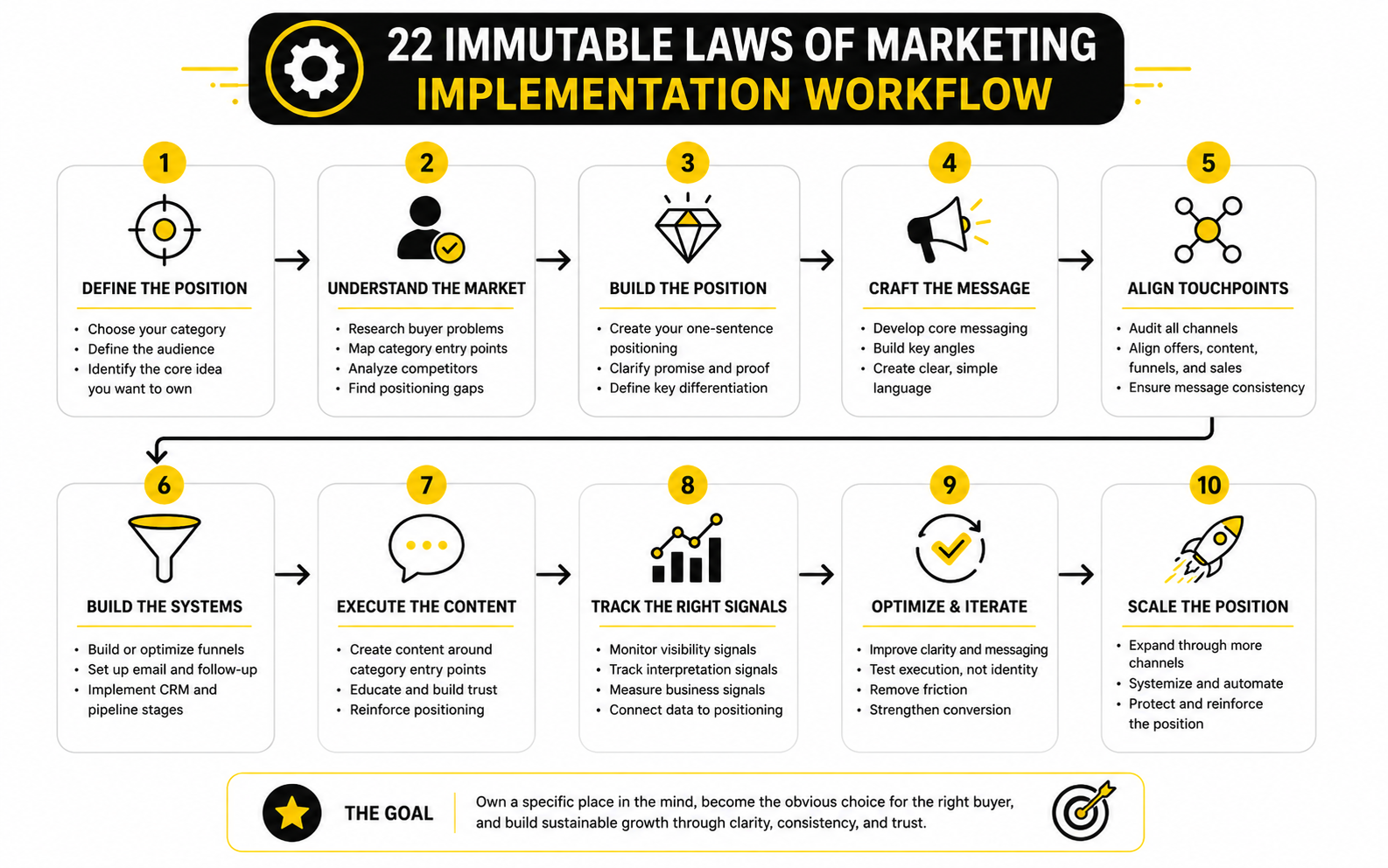
The simplest system has three layers. First, track visibility signals like impressions, reach, branded search, direct traffic, and repeat visitors. Second, track interpretation signals like message recall, survey responses, sales-call language, content engagement, and which comparison pages people visit. Third, track business signals like lead quality, conversion rate, sales cycle length, retention, referrals, and revenue by segment.
This matters because positioning works through accumulation. One campaign rarely proves the whole strategy. But if the same position is repeated across content, funnels, email, sales, and product experience, the data should begin to show that the right people understand the brand faster and move with less resistance.
Track Category Entry Points
Category entry points are the situations, problems, moments, and triggers that make someone think about a category. They are important because people do not usually wake up thinking about brands. They think about jobs to be done, deadlines, frustrations, risks, goals, and changes in their business.
A brand becomes more mentally available when it is connected to more relevant category entry points. For example, a marketing automation platform might want to be remembered when a business misses leads, forgets follow-ups, needs appointment reminders, wants better pipeline visibility, or tries to reactivate old contacts. Those are practical buying moments.
This gives you a better way to measure content and campaign performance. Instead of asking only which post got the most traffic, ask which buying moment it strengthened. If the same entry points keep driving qualified searches, replies, demos, or sales conversations, your position is getting more useful.
Read Search Data As A Market Signal
Search data is not perfect, but it is one of the clearest ways to see how people frame their problems. If more people search your brand name, compare you to competitors, or combine your brand with the category you want to own, that can signal growing mental availability. If people only find you through generic queries, your brand may still be weak even if traffic looks fine.
This is where the Law of Focus becomes measurable. If you want to own a specific idea, watch whether that idea starts appearing in branded searches, reviews, sales calls, social comments, and customer language. The market will often tell you whether your positioning is landing.
Do not overreact to short-term movement. Search demand can shift because of seasonality, campaigns, PR, algorithm changes, or competitor activity. Look for patterns over a longer window and connect search behavior to pipeline quality before making strategic changes.
Measure Message Clarity Before Scaling Spend
Scaling paid traffic before message clarity is expensive. If the buyer does not understand the category, the offer, or the reason to choose you, a bigger budget mainly buys more confusion. This is why the 22 immutable laws of marketing should influence measurement before media spend increases.
Before scaling, check the basics. Can people explain what you do after seeing the page for a few seconds? Do leads repeat your intended positioning language back to you? Are the same objections appearing because the message is unclear? Are people clicking but not converting because the promise is too broad?
For businesses running funnels, a platform like ClickFunnels can help test offers and pages quickly, but the test is only valuable if the message is disciplined. For teams managing follow-up, pipeline stages, and multi-channel conversations, GoHighLevel can make it easier to see where prospects stall. In both cases, the tool should support the positioning system, not replace it.
The Best Data Leads To A Decision
Data should not sit in a dashboard like decoration. It should tell you what to do next. If branded search is rising but conversion is flat, the market may be noticing you before the offer is strong enough. If conversion is good but qualified traffic is weak, the message may work only after someone is already educated. If leads are increasing but sales quality is dropping, the position may be attracting the wrong audience.
This is where marketers need to be honest. Not every bad number means the strategy is wrong, and not every good number means the brand is strong. A viral post can create attention without position. A high-converting page can capture demand without building memory.
The right question is always the same: what does this number reveal about the buyer’s mind? If the data shows that buyers understand you faster, remember you in the right moments, and choose you with less friction, the position is getting stronger. If not, the next move is not more noise. It is sharper strategy.
Advanced Strategy: When The Laws Start To Conflict
The 22 immutable laws of marketing are useful, but they are not a checklist you apply mechanically. In real markets, the laws can create tension. A brand may want focus, but it also needs growth. It may want to create a new category, but buyers may still search inside an old one. It may want to be different, but it cannot be so different that the market does not understand it.
That is where strategy begins. Beginners look for a rule that gives them permission. Professionals look at the tradeoff, choose deliberately, and accept the cost of that choice.
The biggest mistake is pretending there is no tradeoff. Every strong position excludes something. Every category choice narrows something. Every clear message leaves out details that someone inside the company believes are important.
Focus Versus Expansion
Focus is one of the strongest ideas in the 22 immutable laws of marketing, but focus gets harder as a company grows. Early on, focus feels like discipline. Later, it can feel like limitation because the business sees more revenue opportunities around the edges.
That is where many brands weaken themselves. They add more audiences, more features, more claims, more content pillars, and more offers until the original position gets buried. The company may be bigger, but the brand becomes blurrier.
The more carefully move is staged expansion. Keep the core position stable while expanding around adjacent problems the buyer already associates with you. Do not stretch the brand into a new promise unless the market can understand the connection quickly.
Category Creation Versus Existing Demand
Creating a category can be powerful, but it is also expensive. If the market does not already have language for the problem, you must educate before you can sell. That can work beautifully for companies with patience, funding, distribution, or a strong content engine, but it can crush teams that need fast revenue.
Entering an existing category is easier for demand capture because buyers already know what to search for and compare. The downside is that you inherit the existing ladder, which usually means stronger competitors already own the obvious positions. You may get traffic faster, but you also fight harder for attention and trust.
The practical answer is often a hybrid. Use existing category language so buyers can find you, then introduce a sharper subcategory so they can remember you. That gives you both search relevance and strategic differentiation.
Differentiation Versus Clarity
Differentiation is not the same as being unusual. A brand can be weird, clever, or highly original and still fail because buyers do not understand why it matters. The market does not reward difference by itself; it rewards difference that makes choice easier.
This is an important distinction. If your positioning needs a long explanation before it makes sense, it may be too abstract. If buyers understand the words but cannot see why they should care, it may be too cosmetic.
Strong differentiation usually has a practical edge. It helps buyers choose faster, avoid a risk, get a better outcome, save time, reduce complexity, or feel more confident. That is the difference between a real position and a branding exercise.
Brand Building Versus Direct Response
Modern marketers often argue as if brand building and direct response are enemies. They are not. They just operate on different time horizons.
Direct response captures demand that is active now. Brand building increases the chance that future buyers remember, trust, and prefer you before they click, search, compare, or book a call. If you only do direct response, you may become dependent on expensive short-term capture. If you only do brand building, you may create attention without enough commercial momentum.
The best operators connect both. They use positioning to make the brand memorable, then use funnels, offers, email, retargeting, and sales systems to turn that memory into action. The point is not to choose between brand and performance. The point is to make performance marketing easier because the brand already means something.
Short-Term Testing Versus Long-Term Memory
Testing is useful, but it can quietly destroy positioning if you test the wrong things too aggressively. A headline test may improve conversion today while pulling the message away from the idea you need the market to remember. A campaign may generate cheaper leads while attracting people who do not fit the position.
This is why you need two levels of testing. Test execution fast, but protect strategy slowly. Offers, hooks, page layouts, subject lines, and calls to action can change more often. The core category, promise, and mental association should change only when the evidence is strong enough.
A good rule is simple: optimize the expression, not the identity. You can test different ways to communicate the position without reinventing the position every week. That is how you get learning without creating brand confusion.
Product Reality Versus Marketing Promise
The Law of Perception can be misunderstood. It does not mean you can market your way around a weak product forever. Perception may win the first click, but experience shapes the second purchase, the referral, the review, and the long-term reputation.
This is where positioning has to be honest. If you claim simplicity, the product must feel simple. If you claim premium support, the support must be excellent. If you claim automation, the customer should not feel buried in manual work.
A strong position creates expectations. That is powerful, but it is also dangerous. The clearer the promise, the more obvious it becomes when the experience fails to match it.
Scaling Without Diluting The Brand
Scaling is not just doing more. It is repeating the right things through more channels, more people, more systems, and more customer interactions. That is much harder than it sounds.
As teams grow, every department starts adding its own interpretation of the brand. Sales adjusts the pitch to close deals. Content chases trends. Product adds features. Partnerships create new angles. Customer success explains the value in its own language.
None of this is automatically bad, but it needs a shared center. The brand should have a clear positioning spine: category, audience, enemy, promise, proof, tone, and non-negotiable language. Without that spine, scale turns into drift.
When To Reposition
Repositioning should not be treated as a cosmetic refresh. It is a strategic move that changes how the market should understand you. That means it carries risk.
A reposition may be necessary when the current category is shrinking, the brand is trapped under a stronger competitor, the buyer has changed, the product has evolved beyond the old promise, or the market consistently misunderstands the offer. In those cases, staying consistent can become a liability. Consistency only helps when the position is worth reinforcing.
But do not reposition just because the team is bored. Internal boredom usually arrives long before external memory. The market often needs far more repetition than the company wants to give it.
How To Handle Competitive Pressure
Competitors will copy features, offers, ads, landing pages, and sometimes even language. That is annoying, but it is also normal. The more visible your position becomes, the more likely others will try to borrow parts of it.
The answer is not constant reaction. If you react to every competitor, you let them control your strategy. You end up chasing their moves instead of strengthening your own place in the market.
Respond only when the pressure threatens your position. If a competitor copies a feature, strengthen the broader promise. If they copy your language, deepen the proof. If they undercut price, clarify the value of the outcome. Your goal is not to win every comparison; it is to remain the most obvious choice for the buyer you are built to serve.
The Role Of Tools In Advanced Execution
Tools matter, but they should not lead the strategy. A funnel builder, CRM, email platform, chatbot, scheduling tool, or analytics system can support positioning only after the position is clear. Otherwise, the business just automates confusion.
For example, ManyChat can support a clear conversational marketing strategy when the brand already knows the audience, trigger, and next action. Brevo or Moosend can support email execution when the message hierarchy is already disciplined. Buffer can help maintain content consistency when the brand knows what it wants to repeat.
The mistake is using tools to create the strategy for you. Tools distribute, automate, measure, and organize. They do not decide what you should stand for.
The Expert-Level Filter
The best way to use the 22 immutable laws of marketing is to turn them into a filter for decisions. Before launching a campaign, adding an offer, entering a channel, or rewriting a homepage, ask whether the move strengthens the position or weakens it. That one question prevents a lot of expensive noise.
A strong filter sounds like this:
If the answer is weak, the tactic probably needs work. Not because tactics are unimportant, but because tactics only compound when they point in the same strategic direction. That is the real lesson behind the laws: marketing gets powerful when the market hears one clear idea, from many places, over a long enough period to believe it.
Common Mistakes, Practical Examples, And FAQ
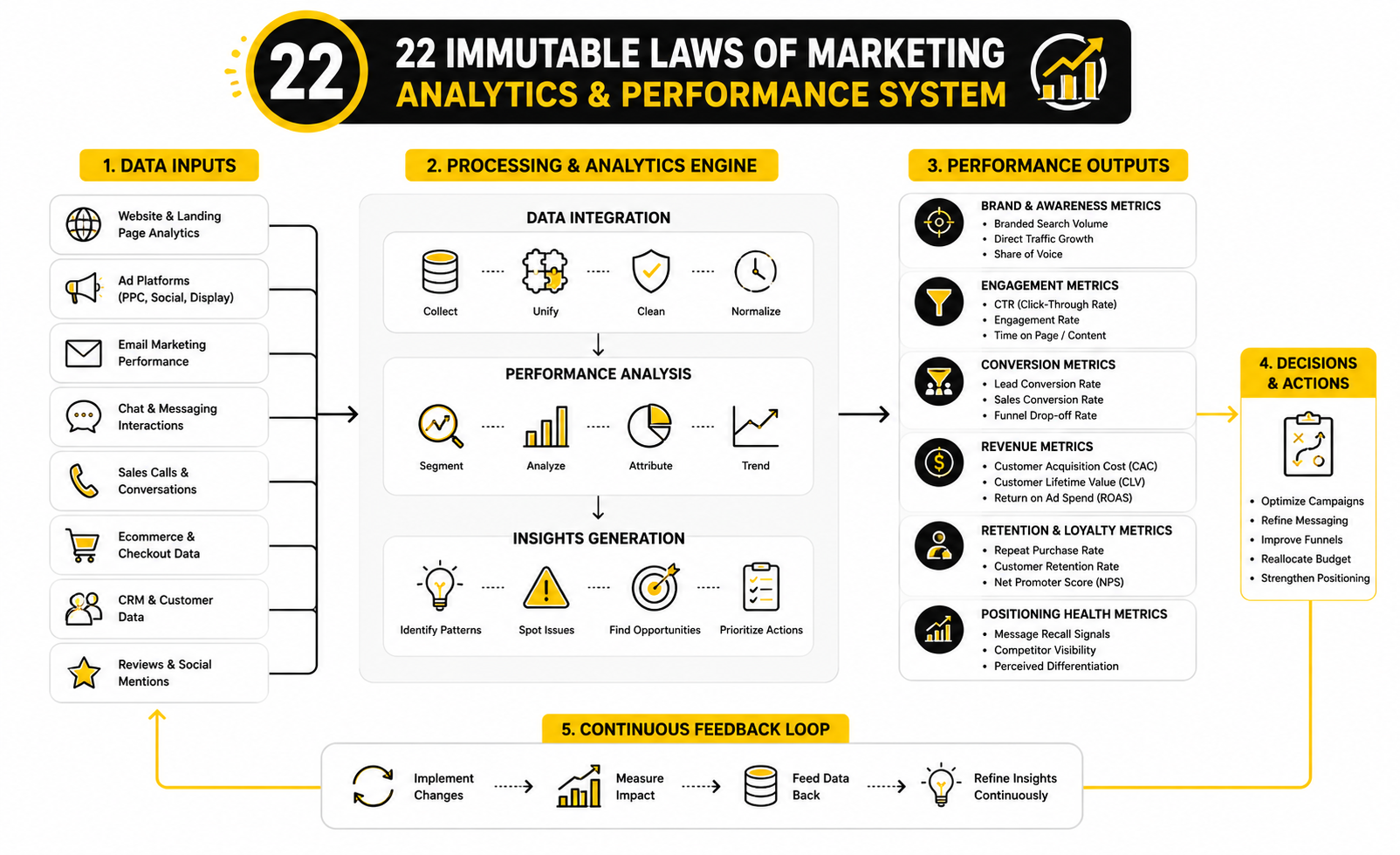
The final layer of the 22 immutable laws of marketing is not about memorizing the laws. It is about building a system that keeps your brand clear when the market gets noisy, competitors get aggressive, and internal pressure pushes the business in too many directions. That system should help you choose a category, own a useful idea, prove the promise, measure the right signals, and protect the position as the company grows.
This matters because most marketing breakdowns do not happen all at once. They happen slowly. A new campaign adds a slightly different promise, a new offer attracts a slightly different buyer, a new channel rewards a slightly different message, and after enough small compromises, the market no longer knows what the brand stands for.
The fix is not to make marketing rigid. The fix is to create a clear operating system. Strategy should be stable enough to compound, while execution stays flexible enough to test, improve, and adapt.
Mistake 1: Trying To Own Too Many Ideas
The most common mistake is trying to make the brand stand for everything good at once. The company wants to be fast, affordable, premium, simple, advanced, personal, scalable, flexible, and innovative. Internally, that feels like a complete value proposition. Externally, it feels like noise.
The 22 immutable laws of marketing push against this because memory needs simplicity. Buyers are more likely to remember one sharp association than ten average ones. A brand can still have many benefits, but the market-facing position needs a clear center.
The practical move is to choose the idea that creates the most buying clarity. What do you want the right customer to remember when they are finally ready to compare options? That answer should guide the homepage, funnel, sales pitch, email sequence, content themes, and proof.
Mistake 2: Confusing Differentiation With Random Creativity
Another mistake is assuming that being different automatically makes a brand stronger. Strange language, unusual visuals, edgy ads, or contrarian messaging can create attention, but attention without understanding does not build a useful position. If the buyer notices you but cannot explain why you matter, the positioning has failed.
Strong differentiation should make the buyer’s decision easier. It should clarify who the brand is for, what problem it solves, and why the promise is meaningfully different from the default options. That is much harder than simply being louder or more creative.
This is why the best marketing often feels obvious after it works. It creates a clean contrast that the market can repeat. The buyer should not need a brand strategist to decode what you mean.
Mistake 3: Changing Strategy Too Quickly
Teams often underestimate how long it takes for a market to remember something. Internally, the message feels old after a few weeks because the team sees it every day. Externally, many buyers may have barely noticed it once.
This creates a dangerous pattern. The company changes the position before the market has had enough repetition to associate the brand with the idea. Then it does the same thing again next quarter, creating constant motion without memory.
Do not confuse internal boredom with market saturation. If the position is strategically sound, keep the core stable and improve the execution around it. Change the hook, page structure, offer framing, proof, or creative angle before you throw away the actual position.
Mistake 4: Measuring The Wrong Win
A campaign can produce clicks and still weaken the brand. A post can go viral and still attract the wrong audience. A page can convert cold traffic and still teach the market a promise you cannot defend.
That is why measurement needs interpretation. The number matters only when you know what question it answers. More leads are not automatically better if they create lower sales quality, weaker retention, or more confused prospects.
The best operators look for alignment between attention, understanding, trust, and commercial value. If a metric improves while the brand becomes harder to explain, that is not a clean win. It is a warning.
Mistake 5: Letting Tools Lead The Strategy
Tools are useful, but they are not strategy. A funnel platform can publish pages, an email platform can send campaigns, a CRM can organize follow-up, and a chatbot can automate conversations. None of them can decide what the market should remember about you.
This matters because technology can make bad positioning move faster. If the message is unclear, automation spreads confusion at scale. If the offer is misaligned, better tracking only helps you watch the wrong people move through the wrong system.
Use tools after the strategic foundation is clear. Platforms like GoHighLevel, ClickFunnels, ManyChat, and Buffer can support strong execution, but they should serve the position, not replace it.
What Are The 22 Immutable Laws Of Marketing?
The 22 immutable laws of marketing are a set of positioning and brand strategy principles created by Al Ries and Jack Trout. The laws explain how brands compete for space in the buyer’s mind, not just in the marketplace. They cover ideas like leadership, category creation, focus, perception, exclusivity, and the risks of line extension.
Are The 22 Immutable Laws Of Marketing Still Relevant?
Yes, but they need modern interpretation. The core ideas around category, memory, perception, and focus are still highly useful because buyers still simplify choices through mental shortcuts. Some parts should be applied with nuance because digital channels, testing systems, and buyer journeys are more fragmented today.
What Is The Most Important Law In The Book?
The Law of Focus is one of the most useful because it forces a brand to decide what idea it wants to own. Without focus, marketing becomes a pile of claims that do not compound. A clear word or association makes the brand easier to remember, easier to explain, and easier to choose.
What Is The Difference Between The Law Of Leadership And The Law Of The Category?
The Law of Leadership says it is better to be first than better. The Law of the Category says that if you cannot be first in an existing category, you should create or define a new category where you can be first. Together, they show why positioning is often more powerful than direct comparison.
Does Being First Always Guarantee Market Leadership?
No. Being first helps only if the brand becomes first in the buyer’s mind and continues to execute well. A company can launch early and still lose if another brand creates stronger memory, clearer positioning, better distribution, or a more trusted experience.
How Can A Small Business Use The 22 Immutable Laws Of Marketing?
A small business should use the laws to narrow its market, sharpen its message, and avoid competing directly against larger brands on their terms. Instead of claiming to be better for everyone, the business should become the obvious choice for a specific audience, problem, location, workflow, or buying moment. That makes the marketing easier to understand and easier to remember.
What Does It Mean To Own A Word In The Prospect’s Mind?
Owning a word means the market associates your brand with one clear idea. That idea could be speed, safety, simplicity, premium quality, automation, convenience, or another meaningful benefit. The word only works when the product, proof, customer experience, and repeated messaging all support it.
Why Is Perception So Important In Marketing?
Perception matters because buyers do not evaluate every product objectively from scratch. They rely on what they already believe, recognize, trust, and remember. A better product can still lose if the market does not understand why it is better or does not associate the brand with a clear reason to choose it.
How Do I Know If My Positioning Is Working?
Your positioning is working when the right buyers understand your value faster, repeat your language back to you, compare you less randomly, and move through the buying process with less confusion. You can also watch signals like branded search, direct traffic, referral quality, sales-call language, qualified conversion rates, and customer reasons for choosing you. The strongest signal is not just more attention; it is clearer demand from the right people.
Should I Use All 22 Laws At The Same Time?
No. The laws are better used as a strategic filter than a rigid checklist. Some laws help with category choice, some help with messaging, some help with competitive strategy, and some help with scaling discipline. Use the law that matches the decision you are making.
Can A Brand Change Its Position Later?
Yes, but repositioning should be done carefully. A brand should consider repositioning when the market has changed, the old category is limiting growth, buyers misunderstand the offer, or a stronger competitor owns the current space. It should not reposition just because the team is tired of repeating the same message.
What Is The Biggest Risk When Applying The Laws?
The biggest risk is applying the laws too literally without understanding the market context. For example, creating a new category can be powerful, but it also requires education. Focus is powerful, but it must still connect to a real buyer need. The point is not to worship the laws; the point is to use them to make sharper strategic decisions.
How Do The 22 Immutable Laws Of Marketing Apply To Digital Funnels?
Digital funnels work better when the positioning is already clear. A funnel should not introduce a vague offer and hope the page design fixes it. The category, promise, proof, and call to action should all reinforce the same idea so the buyer understands why the offer matters before they are asked to act.
How Do These Laws Apply To Content Marketing?
Content marketing should strengthen the category entry points you want to own. Instead of publishing random topics, create content around the problems, moments, comparisons, objections, and goals that make people enter your category. Over time, that helps the market connect your brand to the situations where your solution is relevant.
What Should I Do First After Reading This Guide?
Start by writing one sentence that defines your category, your buyer, and the idea you want to own. Then audit your homepage, offer, ads, content, email follow-up, and sales language against that sentence. If the touchpoints do not reinforce the same position, fix the message before you scale more traffic.
Build a stronger local presence with BAAM AI
Turn your website, Google profile, social channels, and AI visibility into one growth engine
Most businesses do not need more random marketing activity. They need a consistent presence system that helps the right people find them, trust them, and take action. BAAM AI brings strategy, local SEO, website updates, Google Maps visibility, social content, AI-search readiness, media production, and reporting into one practical monthly engine.
If you want your marketing to keep working after the campaign ends, start with a free BAAM AI presence audit. See how your business shows up today and where the fastest visibility wins are at BAAM AI.